Address
Work Hours
Monday to Friday: 7AM - 7PM
Weekend: 10AM - 5PM

Address
Work Hours
Monday to Friday: 7AM - 7PM
Weekend: 10AM - 5PM


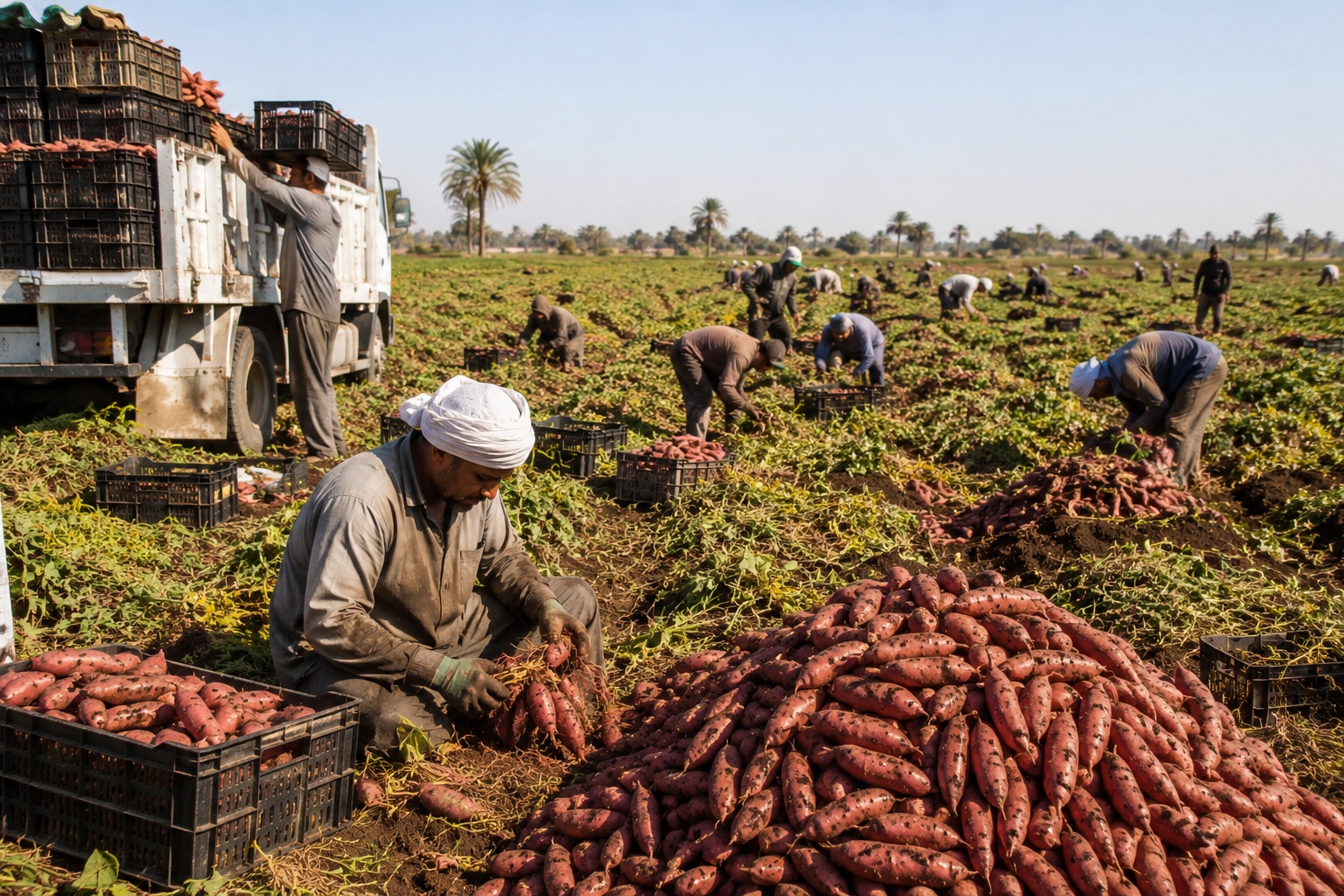
Variety, size grade, curing schedule, carton and pallet configuration, set points and the October to March shipping window for Egyptian sweet potato, written for importers and wholesale buyers.
Sweet potato is one of the few Egyptian crops that arrives at destination in better condition than it left, provided the curing is done properly and the container is not run too cold. Buyers who specify it as though it were a normal root vegetable tend to receive loads with soft ends, black spotting and a shorter shelf life than the season should give them. The specification below is what our export desk works to for the 2026/2027 campaign.
Beauregard is the dominant orange-flesh variety in Egyptian export volume, grown mainly in Beheira, Menoufia and Nubaria. It gives a copper to rose skin, deep orange flesh and a regular tapered shape that grades well. Covington appears in smaller volumes and holds its shape slightly better on long transits. For buyers serving Middle Eastern and North African markets, white and cream-flesh selections are available but the volume is limited and needs to be contracted before harvest.
Skin colour is worth writing into the contract. Orange-flesh varieties supplied against a specification that only says “sweet potato” have arrived on the wrong side of a retail buyer’s expectation more than once.
Egyptian export grading follows piece weight rather than diameter. The standard bands are 100 to 200 g, 200 to 400 g, 400 to 600 g and above 600 g. Most EU and UK retail programmes take 200 to 400 g. Gulf wholesale takes a broader 150 to 500 g. Anything above 600 g moves into processing or foodservice channels and should be priced separately rather than mixed into a retail grade.
Shape tolerance matters as much as weight. Class I (a grade tier from the applicable marketing standard, not a marketing term — see our Extra, Class I and Class II tolerances reference) allows slight irregularity but not the forked or constricted roots that come from heavy soil. Ask for a shape tolerance figure in the specification and it will be graded to it.
Sweet potato must be cured. Freshly lifted roots are wounded at harvest and the skin has not set. Curing at 29 to 32 C and 85 to 90 percent relative humidity for five to seven days closes those wounds, sets the periderm and converts some starch to sugar. A load that skipped curing will show decay, weight loss and skin scuffing on arrival regardless of how well the reefer was run. Our approach to this is the same across the storage crops, and the reasoning is set out in the note on curing onions, garlic and root crops.
After curing, roots move to holding at 13 to 15 C. They are never dropped below 12 C. Sweet potato is chilling sensitive, and the damage from a cold store or a reefer set at 8 C shows up as internal browning and hard core after cooking, which the buyer discovers only at the end of the chain.
The common export packs are 5 kg and 6 kg cartons for retail programmes, 10 kg cartons for wholesale, and 15 kg cartons or mesh bags for processing volume. Cartons are single-layer or double-layer depending on grade, with a vent area on the long sides. On a 1000 x 1200 mm pallet a 10 kg carton typically builds 100 cartons in ten layers to a height of about 2.05 m, giving one tonne per pallet. Twenty pallets fit a 40 ft high cube reefer.
Set point is 13 to 14 C with fresh air exchange at 15 to 25 cubic metres per hour and relative humidity at 85 to 90 percent. Transit from Alexandria or Damietta to North European ports runs 10 to 14 days, to Jeddah and Jebel Ali 7 to 12 days. Under a correct set point the crop carries six to eight weeks of shelf life beyond arrival, which is what makes it a workable programme item rather than a spot purchase.
Harvest opens in late September and runs to March, with the largest and most uniform sizes coming from October to January. Volume in February and March comes out of storage and grades slightly smaller. Buyers running weekly programmes should be contracting September and October volume now. Availability by month for this and the other crops is listed in the Egyptian produce export calendar 2026/2027.
Sweet potato ships under HS 0714.20. Consignments carry a phytosanitary certificate issued by the Central Administration of Plant Quarantine, a certificate of origin, and where the destination requires it, a residue analysis from an accredited laboratory. SGS or Intertek inspection at loading is arranged on request and is billed at cost.
Tell us the destination port, the grade band, the carton format and the weeks you need covered, and we will come back with a specification sheet and an FOB or CFR price under Incoterms 2020. WhatsApp +20 10 9911 1918 or use the quote form on the site.
