Address
Work Hours
Monday to Friday: 7AM - 7PM
Weekend: 10AM - 5PM

Address
Work Hours
Monday to Friday: 7AM - 7PM
Weekend: 10AM - 5PM


A working specification for Egyptian ware potatoes in 2026/2027: Spunta, Cara, Diamant and Lady Rosetta, size grades in millimetres, 25 kg mesh and carton formats, storage temperature, brown-rot pest-free-area rules for the EU, and the two harvest windows.
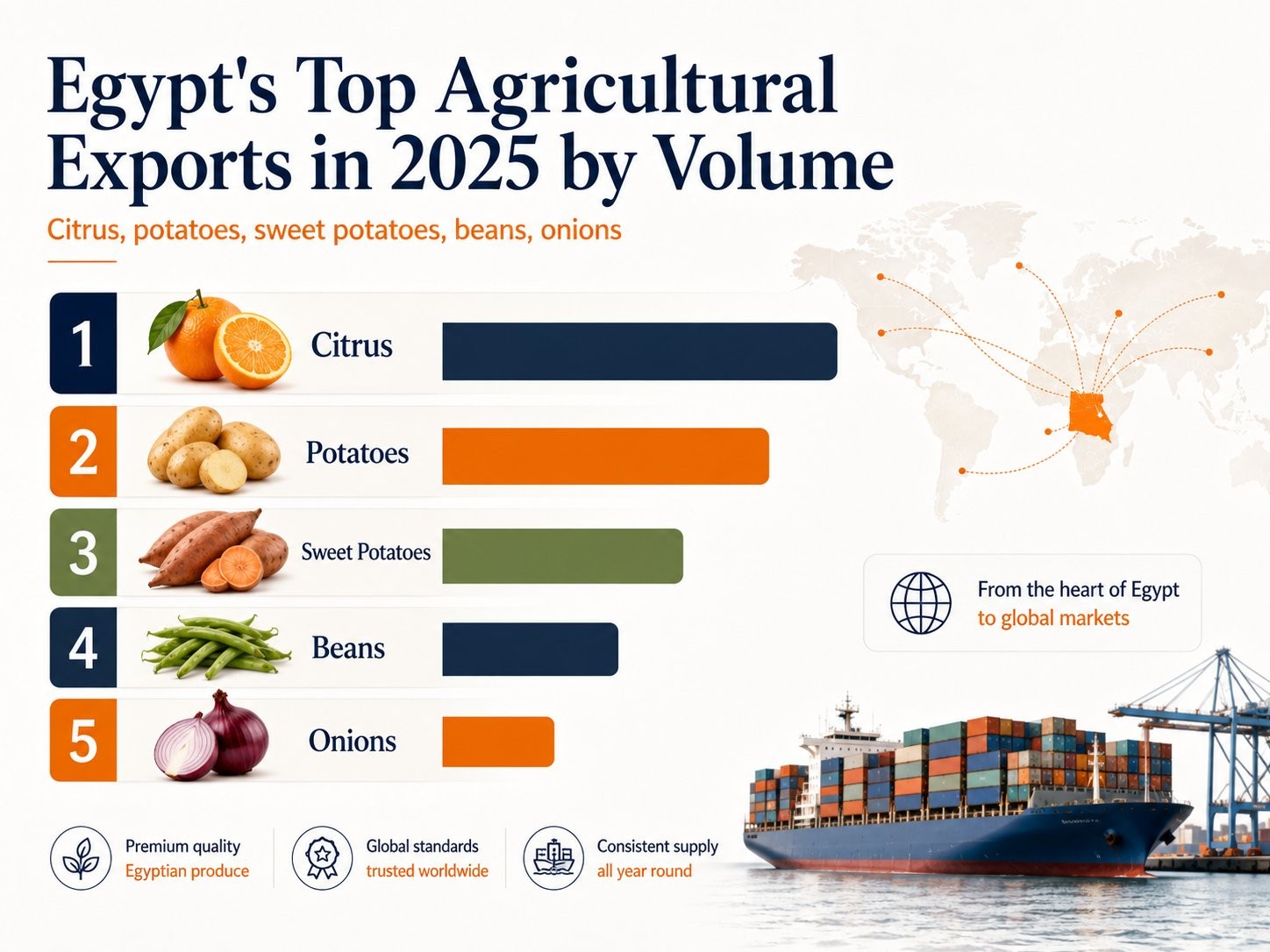
Potato is one of the largest vegetable lines Egypt ships, and it is also the one most often bought on a vague specification. A buyer who writes down variety, size grade, bag format and storage temperature before the offer is priced gets a very different arrival from a buyer who orders “Egyptian potatoes, 25 kg”. What follows is the specification our commercial team works from for the 2026/2027 season.
Egypt runs two commercially relevant potato crops. The winter, or main, crop is planted from October and harvested from January through May. This is the export crop for the European Union, the United Kingdom and Russia, and it carries the volume. The summer and autumn crop is planted around February to March and again in July to August, harvested from late August into November. Autumn-crop volume moves mainly into Gulf, Levant and East African markets, with limited European interest because it competes with local Northern Hemisphere supply.
Right now, in the middle of September, autumn-crop lifting is under way and winter-crop planting is being set. Buyers contracting for the January to May window should be talking to packers now rather than in December.
Spunta. Long oval, yellow flesh, the traditional Egyptian export variety and still the volume item for Mediterranean, Gulf and Russian buyers. Good size, reliable yield, moderate storage life.
Cara. Round to oval, white skin with pink eyes, popular in the United Kingdom and Ireland. Holds shape well in cooking.
Diamant and Mondial. Oval, light yellow flesh, uniform shape, favoured where a clean-skinned table potato is required for retail packing.
Lady Rosetta and Hermes. Processing varieties with higher dry matter and low reducing sugars, contracted for crisping rather than the table trade. These are bought on dry matter and fry colour, not on appearance, and should never be substituted into a table order.
Substitution between varieties is the single most common source of dispute on Egyptian potato contracts. If a programme is specified as Spunta, it should say that a substitution requires written agreement.
Egyptian ware potato is graded on the longest transverse diameter. The common bands are 35 to 55 mm, 40 to 70 mm, 45 to 75 mm, 50 to 70 mm and 60 mm and up. Retail programmes usually take 40 to 70 mm or 45 to 75 mm. Catering and wholesale take the larger bands.
Specify, alongside the size band, the tolerance for greening, mechanical damage, common scab, hollow heart and soil adhering. Class I tolerances under the general marketing standard allow a small percentage of produce outside the class, and that percentage is worth writing into the contract rather than assuming. Our note on quality classes and tolerances sets out how Extra, Class I and Class II differ in practice.
The standard export format is a 25 kg woven polypropylene or jute mesh bag, palletised and strapped. Retail programmes take 1 kg, 1.5 kg, 2 kg or 2.5 kg printed nets, packed 10 to 15 kg to an outer. Big bags of 1000 to 1250 kg move to processors. Cartons of 10 or 15 kg are used where a cleaner presentation is needed.
On a 1000 x 1200 mm pallet, 25 kg bags typically stack 40 to 48 bags for 1000 to 1200 kg per pallet. A 40 ft ventilated container normally carries 24 to 26 tonnes of bagged potato depending on payload limits at the port of loading.
Table potato travels at 7 to 10 degrees Celsius with active ventilation. Do not set a potato container below about 5 degrees. Low temperature converts starch to reducing sugars, which sweetens the potato and darkens it on frying, and the damage is not reversible in transit. Potatoes also need curing and drying before bagging, which is where most shelf life is won or lost. We cover that in our note on curing onions, garlic and root crops.
Egyptian ware potato entering the European Union must come from designated production areas subject to brown rot surveillance, with field inspection and consignment sampling, and the consignment must be accompanied by the correct phytosanitary documentation naming that area. This is not a formality that can be sorted out after loading. Confirm at the time of booking that the lot originates in an approved area and that the paperwork will state it.
PEI Trade supplies Egyptian ware and processing potato from graded packhouse lots, shipping through Alexandria, Damietta and Port Said, with third-party inspection available on request. To price a potato programme for the 2026/2027 season, message our export desk on WhatsApp at +20 10 9911 1918 with destination, variety, size band, bag format and monthly volume, and we will come back with an offer against a named vessel window.
