Address
Work Hours
Monday to Friday: 7AM - 7PM
Weekend: 10AM - 5PM

Address
Work Hours
Monday to Friday: 7AM - 7PM
Weekend: 10AM - 5PM


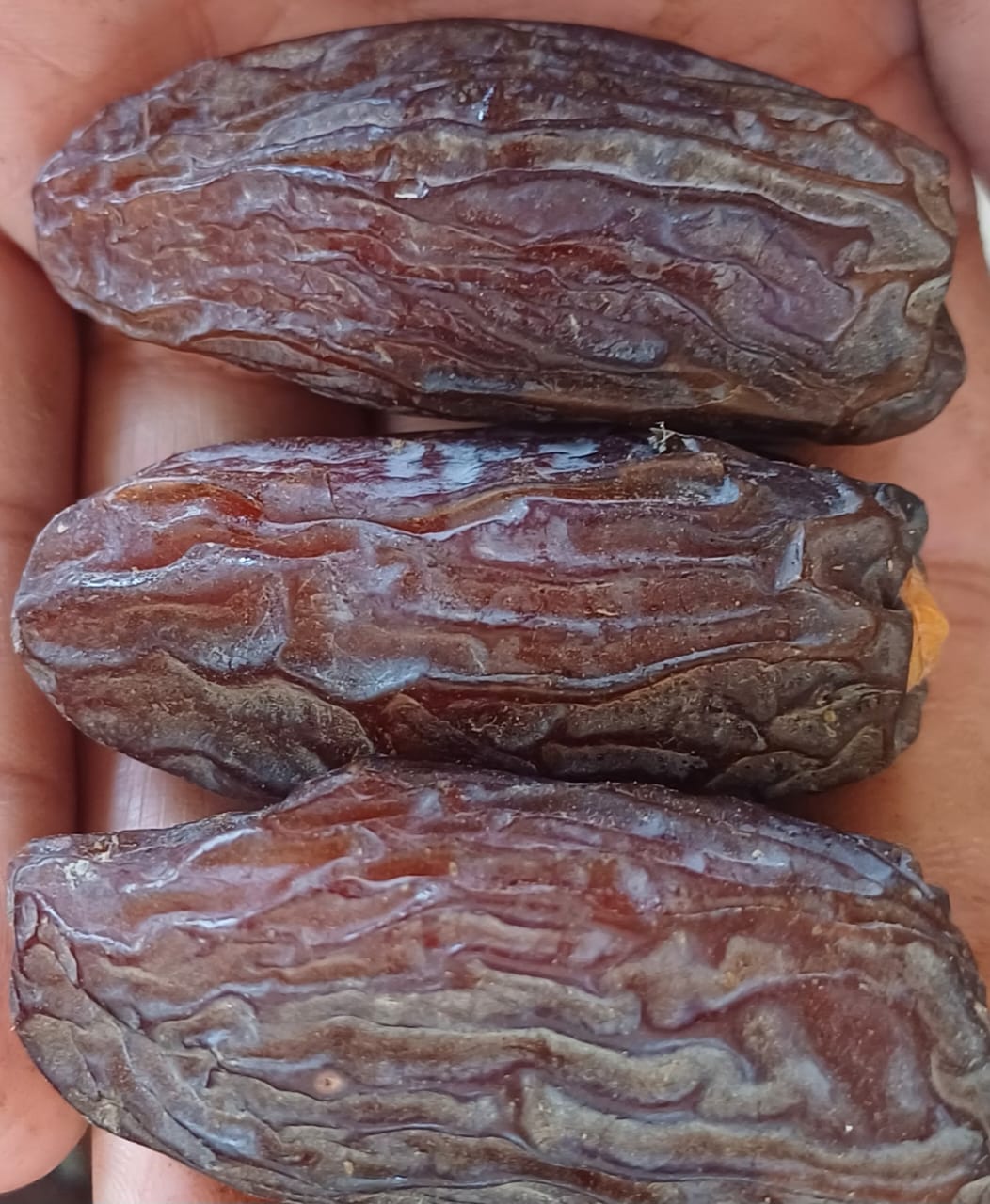
How Egyptian, Jordanian and Palestinian Medjool dates compare: volumes, harvest timing, size bands, grade names and packs, with sources.
Last updated: 2 November 2026
Egyptian, Jordanian and Palestinian Medjool are the same date variety. What differs between the three origins is the volume each produces, when the harvest starts, and how each packer names its sizes and grades. The safest way to compare offers is by grams per fruit, skin separation and moisture, not by the size name on the carton.
This page sets the three origins side by side. Every figure about Jordan and Palestine comes from a published source, linked next to it and listed at the end. Figures about Egyptian Medjool from PEI Trade are our own.
On this page
Medjool (also written Mejhoul or Majhoul) is a single date cultivar whose origin is the Tafilalet area of Morocco, according to a peer-reviewed paper in Acta Horticulturae (ISHS). It was introduced to California in 1927, and from there it spread to new growing regions (UC ANR). The same source warns that not every palm sold as Medjool is true to type, which is one more reason to judge fruit on its measured specification.
The main growing areas reported for the two neighbouring origins are:
No single official dataset compares the three origins. The figures below come from trade press quoting date boards, associations or individual companies, for different seasons, so read them as orders of magnitude rather than a ranking.
| Origin | Reported volume | Season | Source |
|---|---|---|---|
| Egypt | Medjool harvest projected at 60,000 tonnes or more | 2026 | FreshPlaza, 13 Jul 2026, quoting an Egyptian Medjool grower |
| Jordan | Over 37,000 tonnes of dates; Medjool is over 85% of about one million palms | 2026 | FreshPlaza, 5 Oct 2026, citing the Jordan Dates Association |
| Palestine (West Bank) | Medjool production estimated at 35,000 tonnes | 2026/27 | FreshPlaza, 22 Oct 2026, quoting a Jericho-based producer |
The Jordanian figure covers all dates, of which Medjool is the large majority. Jordan exports around 65% of its date crop (FreshPlaza, Oct 2026), and Palestinian producers name Turkey and the European Union as their main markets (FreshPlaza, Oct 2026).
All three origins harvest Medjool in late summer and early autumn, and all three supply stored fruit after the harvest, so availability depends less on the calendar than on how much stored fruit remains.
| Origin | Harvest | After the harvest | Source |
|---|---|---|---|
| Egypt (PEI Trade) | New crop available from 1 August 2026 | Supply from cold storage all year | PEI Trade |
| Jordan | The new season starts in September | Some producers hold 10–15% of the crop until after Ramadan | FreshPlaza, 2023, quoting the Jordan Dates Association |
| Palestine (West Bank) | The 2026 harvest began on 25 September | Shipments run until July or August | FreshPlaza, 22 Oct 2026 |
We found no published national size standard for Medjool from the date boards of these origins. Size bands are set by each exporter, and the same name can cover different weights, as the published bands below show.
| Origin and exporter | Published size bands (grams per fruit) | Source |
|---|---|---|
| Jordan: Petra Global Trade | Small up to 14 g; Medium 15–17 g; Large 18–21 g; Jumbo 22–25 g; Super Jumbo over 25 g | Exporter’s catalogue, 2024 |
| Palestine: ExportCircle | 15–27 g from small to super jumbo, without a band per size | Exporter’s website |
| Egypt: Palm Hills Dates | Common sizes 14–23 g per fruit | FreshPlaza, Aug 2025 |
| Egypt: PEI Trade | Babysmall 8–13 g; Small 14–16 g; Medium 17–18 g; Large 19–21 g; Jumbo 22–23 g; SuperJumbo 24–27 g; and a Mix of Small to SuperJumbo | PEI Trade |
On these published bands, a Jumbo from the Jordanian exporter weighs 22–25 g, while the Palestinian exporter gives a single range of 15–27 g from small to super jumbo, so the same size name can mean different weights. Ask every supplier for the weight per fruit in grams, or the count of fruits per kilogram, and check it on arrival by weighing 100 fruits from several cartons.
Medjool grades are usually defined by skin separation, the degree to which the skin has lifted away from the flesh. Grade names and their limits differ between packers. Our own grades are:
Two packers can both sell “Premium” with different limits. Ask for the skin-separation percentage behind each grade name, and whether it is measured on the fruit or as a tolerance across the lot.
Whatever the origin, ask how many cartons and tonnes of the pack you want fit into a 40 ft reefer, because that sets the real cost per kilogram landed.
Import and labelling rules differ by market, so confirm your own requirements with your customs broker before you order from any origin.
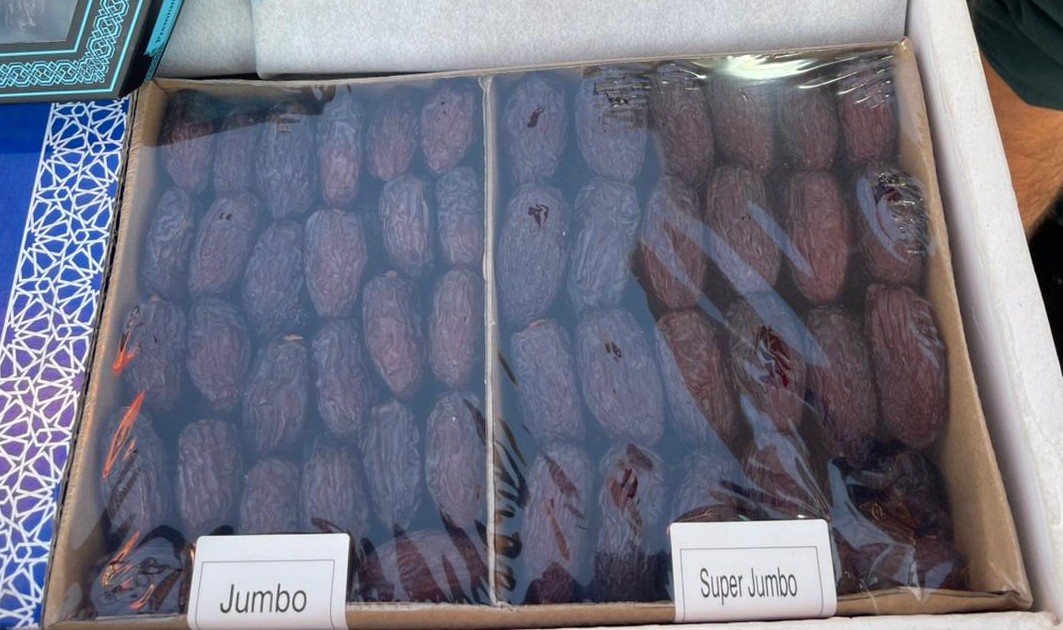
PEI Trade exports Egyptian Medjool by the container to registered importers: three grades defined by skin separation (Premium, Delight and Classic), six sizes from Babysmall to SuperJumbo plus a Mix of sizes, and 5 kg cartons or 8 kg cartons of 250 g, 500 g or 1 kg packs. A 40 ft high-cube reefer holds about 20 to 20.5 tonnes in 5 kg cartons. New-crop fruit is available from 1 August and stored fruit ships all year. We don’t publish a price list; every price is quoted per order.
Fruit weights by size, grade definitions, container loads and documents are set out in our Egyptian Medjool grades, sizes and packing guide.
Yes, it is the same Medjool variety, which originated in the Tafilalet area of Morocco. What differs between origins is the grower, the grading and the harvest timing, so compare offers by grams per fruit, skin separation and moisture.
Published figures come from different sources and seasons, so they are not a ranking. An Egyptian grower projected Egypt’s 2026 Medjool harvest at 60,000 tonnes or more; Jordan reported over 37,000 tonnes of dates; and a Palestinian producer estimated 35,000 tonnes of Medjool for 2026/27.
The Jordanian season starts in September, and the 2026 Palestinian harvest began on 25 September. Egyptian new-crop Medjool from PEI Trade is available from 1 August, with supply from cold storage all year.
No. There is no common standard: one Jordanian exporter publishes Jumbo as 22 to 25 g, while one Palestinian exporter gives a single range of 15 to 27 g from small to super jumbo. Always ask for grams per fruit.
A phytosanitary certificate, a fumigation certificate issued to the rules of the destination country, and a certificate of origin, with the bill of lading, commercial invoice and packing list.
Tell us the grade, size, packing and destination port, with your delivery term (EXW, FOB, CFR or CIF by sea, or CIP by air), and we reply with a price for your exact specification.
