Address
Work Hours
Monday to Friday: 7AM - 7PM
Weekend: 10AM - 5PM

Address
Work Hours
Monday to Friday: 7AM - 7PM
Weekend: 10AM - 5PM


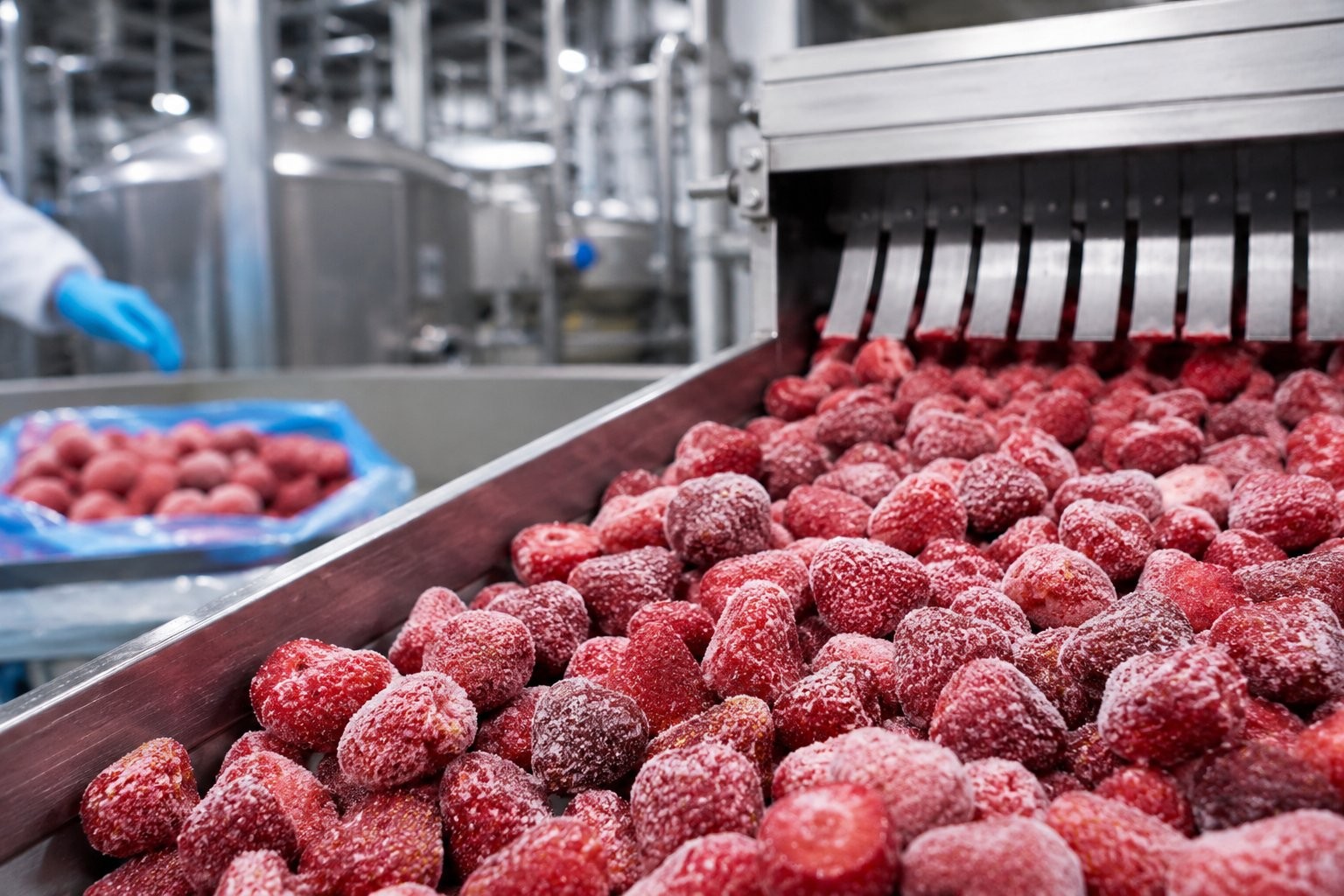
Brazil is one of Egypt’s fastest-growing — and most dominated — frozen-strawberry markets. Egyptian IQF (individually quick frozen) strawberry shipments to Brazil grew roughly thirtyfold over five years, exceeding 30,000 tonnes in 2024, and Egypt now supplies close to 90% of Brazil’s frozen-strawberry imports. This is the frozen / IQF trade under HS 0811.10, distinct from fresh strawberry: Nile Delta winter fruit is quick-frozen at −18 °C and shipped in reefer containers into Brazil’s dairy, ice-cream, juice and bakery industries. This guide covers grades, logistics, market requirements, seasonal availability and how to open a supply program.
Brazil has a large and growing appetite for frozen strawberry across ice cream, dairy and yogurt, juices and açaí blends, and bakery — and domestic supply doesn’t come close to covering it. Egypt filled that gap decisively: shipments grew roughly thirtyfold in five years to exceed 30,000 tonnes in 2024, and Egypt now accounts for close to 90% of Brazil’s frozen-strawberry imports. That near-monopoly reflects Egypt’s scale as the world’s leading origin (about 27% of global trade in 2024), consistent IQF quality, and pricing that Brazilian processors can build around.
For Brazilian buyers, an Egyptian program means a proven, high-volume supply line — counter-seasonal to the Southern Hemisphere — that can be drawn down year-round from cold storage.
| Grade / format | Profile | Typical Brazilian use |
|---|---|---|
| Grade A — IQF whole | Calibrated whole berries, bright red, free-flowing | Retail repack, premium desserts |
| Grade B — IQF whole/mixed | Wider calibre tolerance, minor colour variation | Ice cream, dairy, industrial mixes |
| Sliced / diced | Uniform IQF cut pieces | Fillings, bakery, food manufacturing |
| Crumble / broken | Pieces and fragments | Juice, pulp, purée, beverage bases |
Specifications are agreed per buyer: Brix, calibre, defect and foreign-material tolerances, microbiology and residue compliance. See the Egyptian strawberry export guide and the Egyptian Frozen & IQF Export Report.
| Period | Activity | Brazil notes |
|---|---|---|
| Dec–Feb | Delta harvest begins; IQF processing ramps | New-crop freezing; contract for the season |
| Mar–Apr | Peak harvest & freezing | Best new-crop availability |
| May–Nov | Shipping from cold storage | Year-round drawdown, counter-seasonal to local supply |
This page covers IQF (individually quick frozen) strawberry under HS 0811.10, frozen at −18 °C for food manufacturing — not fresh fruit.
Egypt supplies close to 90% of Brazil’s frozen-strawberry imports. Shipments grew roughly thirtyfold in five years, exceeding 30,000 tonnes in 2024.
By reefer sea freight from Alexandria, Damietta or Port Said to Santos (and Navegantes/Itajaí for the south), held at −18 °C throughout.
ANVISA and MAPA import compliance, a health/phytosanitary certificate, certificate of origin, Portuguese-language labeling, cold-chain logs, and farm/processing food-safety certification.
Building a Brazil frozen-strawberry program? PEI Trade supplies IQF whole, sliced, diced and crumble grades to your Brix and calibre spec, with ANVISA/MAPA-aligned documentation, −18 °C cold-chain management and reefer delivery to Santos and southern Brazilian ports. Send your target volumes, grade, packing and delivery window for a compliant offer.
PEI Trade. “Egyptian Frozen Strawberry Exports to Brazil: IQF Market Guide.” peitrade.com, 2026, https://peitrade.com/egyptian-frozen-strawberry-exports-to-brazil/
Sources: International Trade Council / FreshPlaza reporting on Egypt–Brazil frozen-strawberry trade (thirtyfold growth, >30,000 t 2024, ~90% import share); Amwal Al Ghad 2024 export overview (HS 0811.10). HS code 0811.10.
PEI Trade · New Cairo, Egypt · [email protected] · WhatsApp +20 109 911 1918 · www.peitrade.com · Brand: nile-prime.com · Ports: Alexandria, Damietta, Sokhna, Port Said (Incoterms 2020)