Address
Work Hours
Monday to Friday: 7AM - 7PM
Weekend: 10AM - 5PM

Address
Work Hours
Monday to Friday: 7AM - 7PM
Weekend: 10AM - 5PM


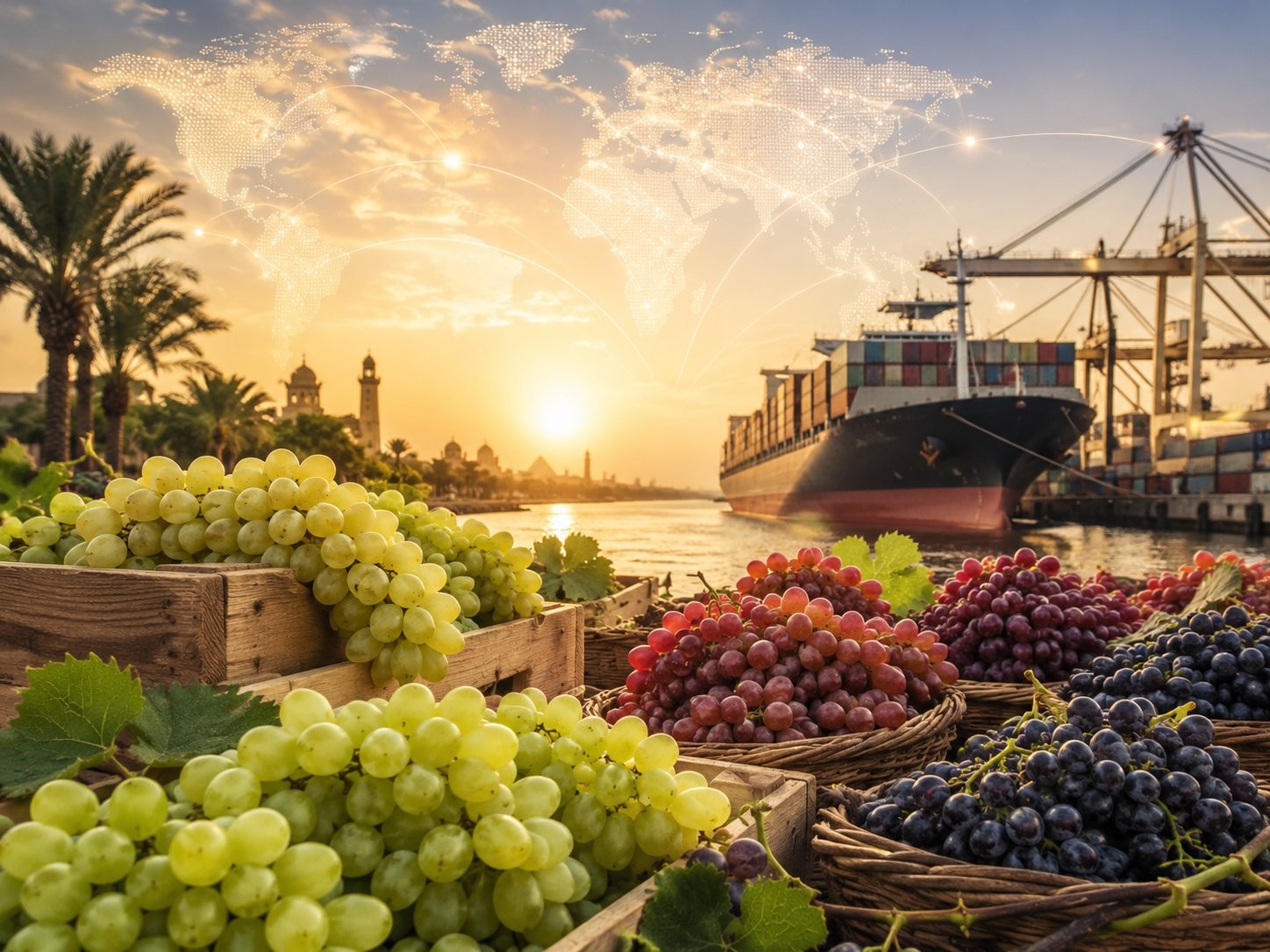
Egypt exports ~220,000 t of table grapes — the near-sole EU supplier in June-July. Top markets (Netherlands, Germany), varieties, season and the 2026 outlook.
Egyptian table grapes are the country’s second-biggest fruit crop after citrus, with exports of around 220,000 tonnes forecast for the 2025/26 marketing year off a crop of roughly 1.67 million tonnes. Egypt’s real edge is timing: it is almost the sole exporter of fresh grapes to the EU in June and July, the gap before the European and Northern-Hemisphere harvests. This report compiles the volumes, destinations, varieties and season into one citable reference, updated annually. For the wider picture see the produce export statistics hub and the State of Egyptian Agri-Export 2026. Sourcing now? See our ranking of the best Egyptian grape exporters.
Two markets — the Netherlands and Germany — take the bulk of Egypt’s grape exports, and Egypt has climbed into the top five suppliers to the EU on the strength of its early window, new varieties and improving logistics. The figures below set out where Egypt’s grapes go, when, and where the trade is heading.
2026 edition · Last Updated: June 2026. Figures use official Egyptian data and USDA marketing-year data cross-checked with EastFruit and ITC Trademap; see Sources & Methodology.
The headline numbers, ready to quote:
Egypt has become one of the world’s largest table-grape producers and a top-five supplier to the EU, competing on an early-season window that few origins can match.
| Producer | Table-grape production (2025/26, approx.) |
|---|---|
| China | ~15.0 million t |
| India | ~3.15 million t |
| Brazil | ~1.76 million t |
| Uzbekistan | ~1.73 million t |
| Egypt | ~1.67 million t |
| European Union | ~1.52 million t |
Source: USDA Fresh Deciduous Fruit (2025/26). Egypt ranks among the top five table-grape producers worldwide.
Production and exports have climbed steadily on the back of new plantings, varietal diversification and better logistics and phytosanitary compliance.
| Metric | Value | Basis / source |
|---|---|---|
| Table-grape production | ~1.67 million t | 2025/26 · USDA |
| Table-grape exports (forecast) | ~220,000 t | 2025/26 · USDA |
| Table-grape exports (official) | ~191,000 t | 2025 · CAPQ |
| Rank among Egyptian fruit crops | #2 (after citrus) | USDA |
USDA marketing-year (Oct–Sep) export forecast (~220,000 t) is higher than the CAPQ calendar-year figure (~191,000 t); see Sources & Methodology for the basis difference.
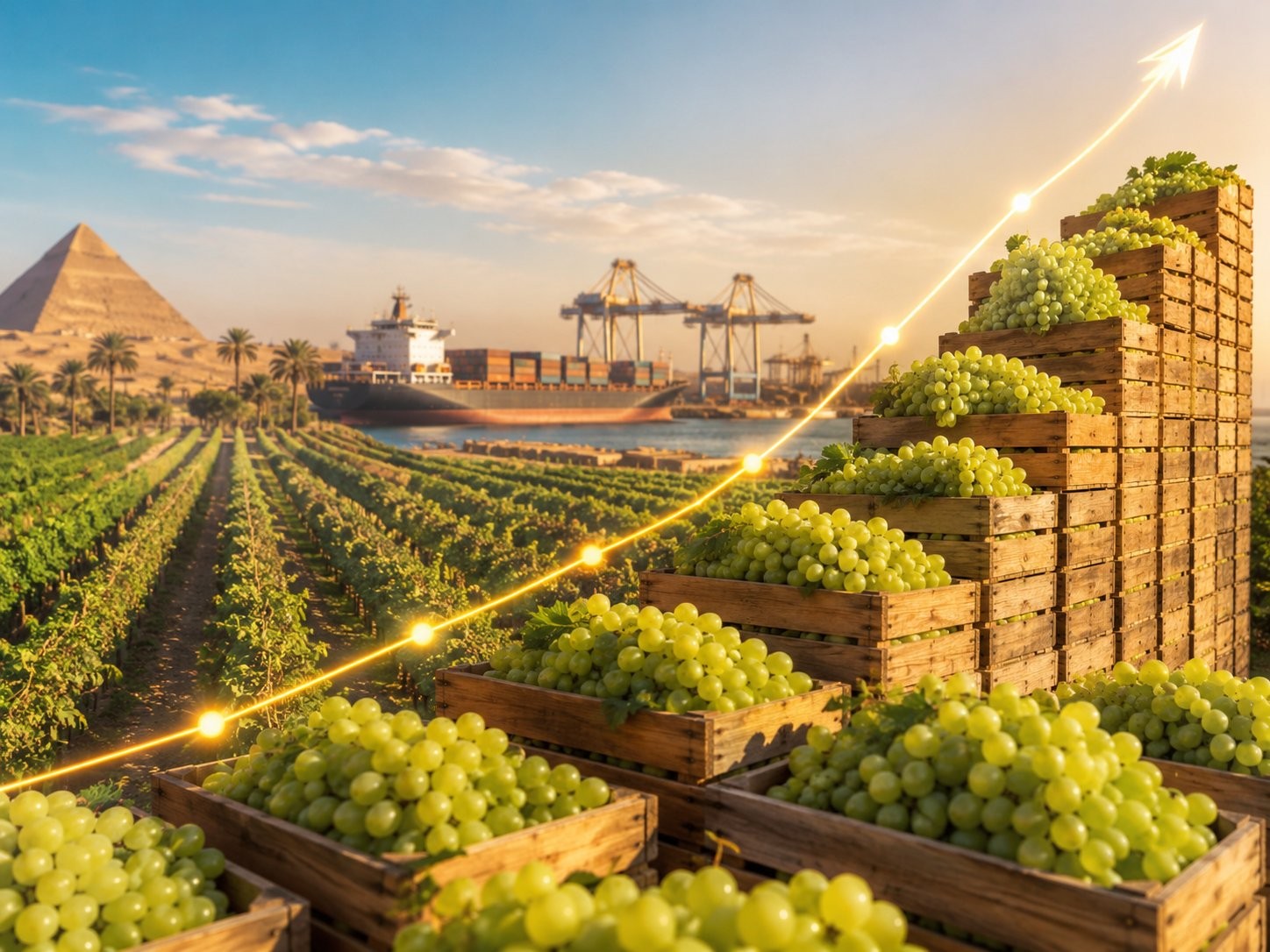
Egypt’s structural advantage is timing. Its grapes hit Europe in late spring and early summer — ahead of Italian, Spanish and other Northern-Hemisphere supply — so that in June and July Egypt is almost the only origin shipping fresh grapes into the EU. That window commands attention from retailers filling the gap between Southern-Hemisphere imports and the European harvest, and it is why two EU markets dominate Egypt’s export map.
The Netherlands (a major EU re-export hub) and Germany together absorb most of Egypt’s grapes, with Ireland, the UK and others growing.
| Market | 2024 volume / trend | Note |
|---|---|---|
| Netherlands | ~34,000 t (Jan–Jul, +14%) | #1; EU re-export hub |
| Germany | ~26,500 t record (+~30%) | Top-five supplier status |
| Ireland | ~2,400 t (more than doubled) | 3rd-largest in 2024 |
| Italy | ~2,300 t | |
| UK, Gulf, Russia, others | growing | diversification |
Source: EastFruit; FreshPlaza (2024). The Netherlands and Germany together take 70–75% of Egyptian grape exports.

Egypt ships a full seedless range across the window, from early whites to late reds. Crimson holds the leading position; licensed “club” varieties are a growing premium segment, and varietal licensing compliance is now a focus for EU-bound fruit.
| Variety | Type | Window |
|---|---|---|
| Early Sweet / Prime | Early white seedless | May–June |
| Flame Seedless | Red seedless | June |
| Superior (Sugraone) | White seedless | June–July |
| Crimson | Late red seedless (leading) | July–August |
| Club / licensed varieties | Premium seedless | across window |
Prices in the 2024/25 season were broadly stable, with the early June–July window and premium seedless varieties commanding the strongest returns. Live FOB depends on variety, calibre, brix and timing within the window.
| Indicator | Value | Basis |
|---|---|---|
| Season price environment 2024/25 | Broadly stable | trade press |
| Premium driver | June–July window + seedless varieties | trade |
PEI Trade does not publish a price list. Grape FOB moves week to week with variety, grade, calibre, brix, available volume and vessel space, and a figure fixed at publication misleads more than it helps. For a current number against your spec and destination port, ask the export desk.
Table grapes are grown mainly in the reclaimed desert lands west of the Nile Delta and along the Cairo–Alexandria and Cairo–Ismailia corridors, where modern trellising, drip irrigation and protected cultivation support early ripening and export-grade quality. Production is around 1.67 million tonnes and rising as new plantings mature and growers add seedless and club varieties.
| Item | Detail |
|---|---|
| Export season | May–August; July peak; near-sole EU supplier in June–July |
| Container | 40ft reefer, ~0°C, controlled atmosphere for long hauls |
| Packing | Punnets / clamshells and 4.5–5 kg cartons by market |
| Lead ports | Alexandria, Damietta; airfreight for premium early fruit |
| Transit to Rotterdam | ~7–9 days |
The outlook is for continued growth. Area expansion and new varieties lift production toward 1.67 million tonnes and exports toward 220,000 tonnes, the June–July EU window remains a structural advantage, and improving logistics and phytosanitary compliance open more retail programmes. The swing factors are weather at flowering, varietal-licensing compliance for club grapes, and freight. Exporters with the right early-window varieties and clean licensing are best placed.
Egypt is the origin to cover the June–July gap with seedless grapes ahead of European supply. The practical levers for 2026: book early-window programmes (Prime, Flame, Superior) and late Crimson early, specify brix and calibre, confirm variety licensing for club grapes, and choose punnet or carton formats by retailer. PEI Trade ships across the variety range and can advise on programme timing, packing, ports and Incoterms — see our ranking of the best Egyptian grape exporters for how to qualify any supplier.
Method. This report compiles USDA marketing-year data and official Egyptian (CAPQ) figures, cross-checked with EastFruit and ITC Trademap. The USDA 2025/26 export forecast (~220,000 t, Oct–Sep) is higher than the CAPQ calendar-year figure (~191,000 t) because of differing periods and scope; we label figures with their basis.
Edition: 2026 · Compiled: June 2026 · Update cadence: annually at season open.
Reusing a figure? Please cite it and link to this page as the source.
PEI Trade (2026). Egyptian Grape Export Report 2026. PEI Trade. https://peitrade.com/egyptian-grape-export-report-2026/
Egypt’s table-grape exports are forecast at about 220,000 tonnes for the 2025/26 marketing year (USDA), off a crop of roughly 1.67 million tonnes. Official CAPQ figures put 2025 exports near 191,000 tonnes; the difference reflects period and scope.
The export season runs roughly May to August, peaking in July. Egypt’s key advantage is that it is almost the only origin shipping fresh grapes to the EU in June and July, ahead of European and Northern-Hemisphere supply.
The Netherlands and Germany together take 70–75% of Egyptian grape exports. Ireland, Italy, the UK, the Gulf and Russia are also growing markets. Egypt is now a top-five grape supplier to the EU.
Egypt ships a full seedless range — early whites such as Prime and Early Sweet, Flame and Superior in mid-season, and Crimson as the leading late red — plus a growing segment of licensed club varieties.
Yes. With production around 1.67 million tonnes, Egypt is among the world’s top five table-grape producers and table grapes are its second-biggest fruit crop after citrus.
Looking for a grape partner who can fill the June–July window with the right seedless varieties, manage licensing, packing, cold chain and documentation into the EU and beyond? Let’s build your 2026 grape programme.
Browse our grapes product page, see our ranking of the best Egyptian grape exporters, or read the full produce export statistics, the potato report and the State of Egyptian Agri-Export 2026.
