Address
Work Hours
Monday to Friday: 7AM - 7PM
Weekend: 10AM - 5PM
Address
Work Hours
Monday to Friday: 7AM - 7PM
Weekend: 10AM - 5PM


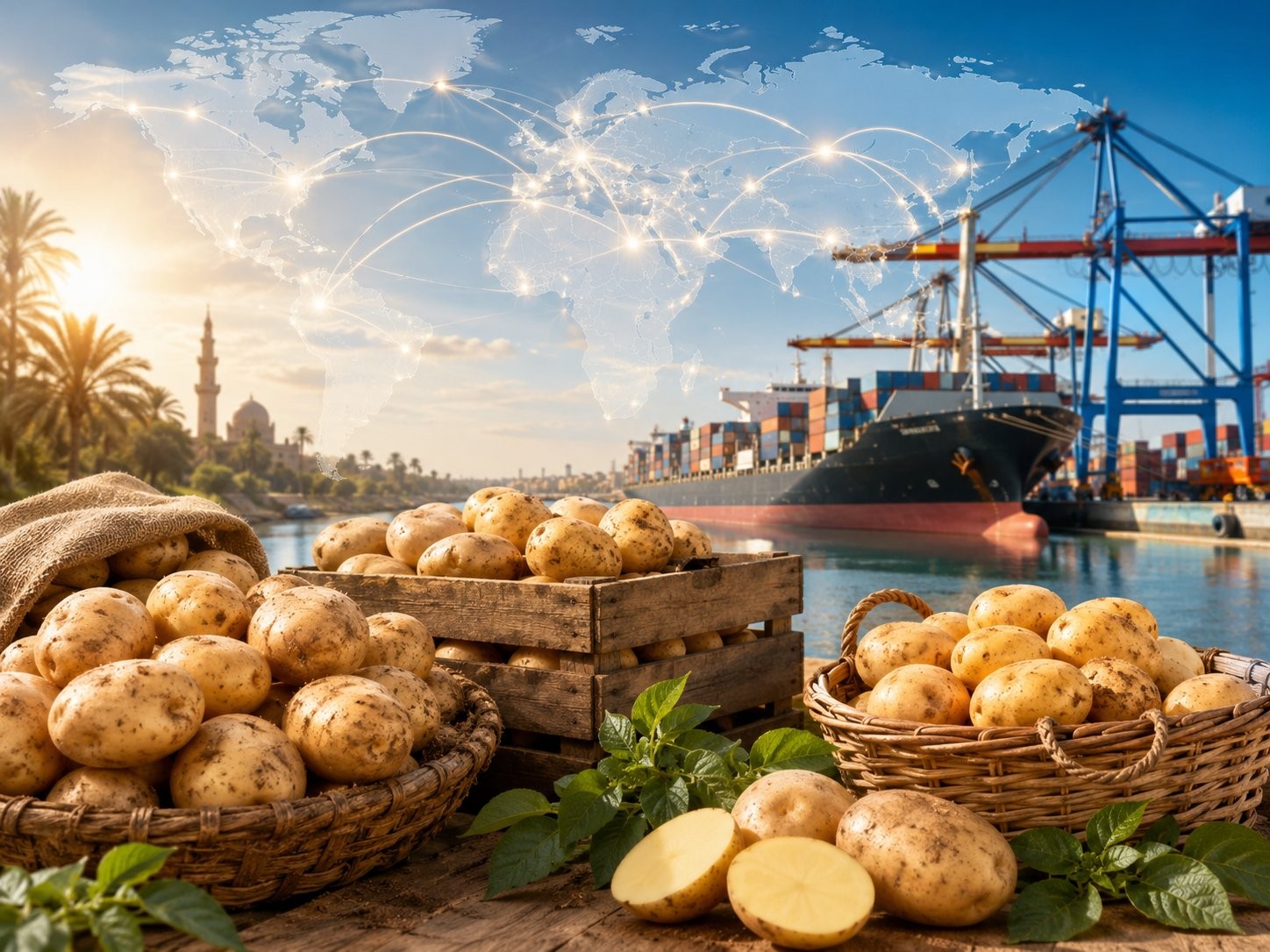
Egypt's potato exports topped 1M tonnes in 2025 — the #1 supplier to Russia (67%). Destinations, EU access, processing and the 2026 outlook.
Egyptian potato exports topped one million tonnes in 2025, keeping fresh potatoes Egypt’s largest fresh-vegetable export by volume and its second-largest agricultural export overall. Egypt is now the number-one supplier of potatoes to Russia — about 67% of Russia’s potato imports by value — and the European Union has just eased its import rules for Egyptian potatoes. This report compiles the volumes, destinations, market access and processing into one citable reference, updated annually. For the wider picture see the produce export statistics hub and the State of Egyptian Agri-Export 2026.
Behind the headline is a fast-shifting export map: a surge in Russian demand after a weak 2024 harvest there, record volumes to the UK, growth across Asia, and an EU regulatory opening — all met by consistent Egyptian supply and cold storage that now stretches shipments to year-end. The figures below set out where Egypt’s potatoes go, what they earn, and where the trade is heading.
2026 edition · Last Updated: June 2026. Figures use trade-press and official Egyptian data cross-checked with EastFruit, IndexBox, Rosselkhoznadzor and USDA; see Sources & Methodology.
The headline numbers, ready to quote:
The fresh-potato export trade is led by the big European origins, but Egypt is the dominant counter-seasonal supplier to Russia, the Middle East and parts of Asia, and one of the largest exporters outside Europe.
| Exporter | Export volume (approx.) | 2024 export value |
|---|---|---|
| France | ~3.3 million t | USD 1.21 billion |
| Netherlands | ~2.8 million t | USD 632 million |
| Germany | ~2.7 million t | USD 724 million |
| Belgium | ~1.01 million t | — |
| Egypt | ~0.9–1.0 million t | — |
Source: FAO-based trade rankings (2024). Egypt’s own marketing figures put 2025 fresh-potato exports above 1 million tonnes; see Sources & Methodology for the basis difference.
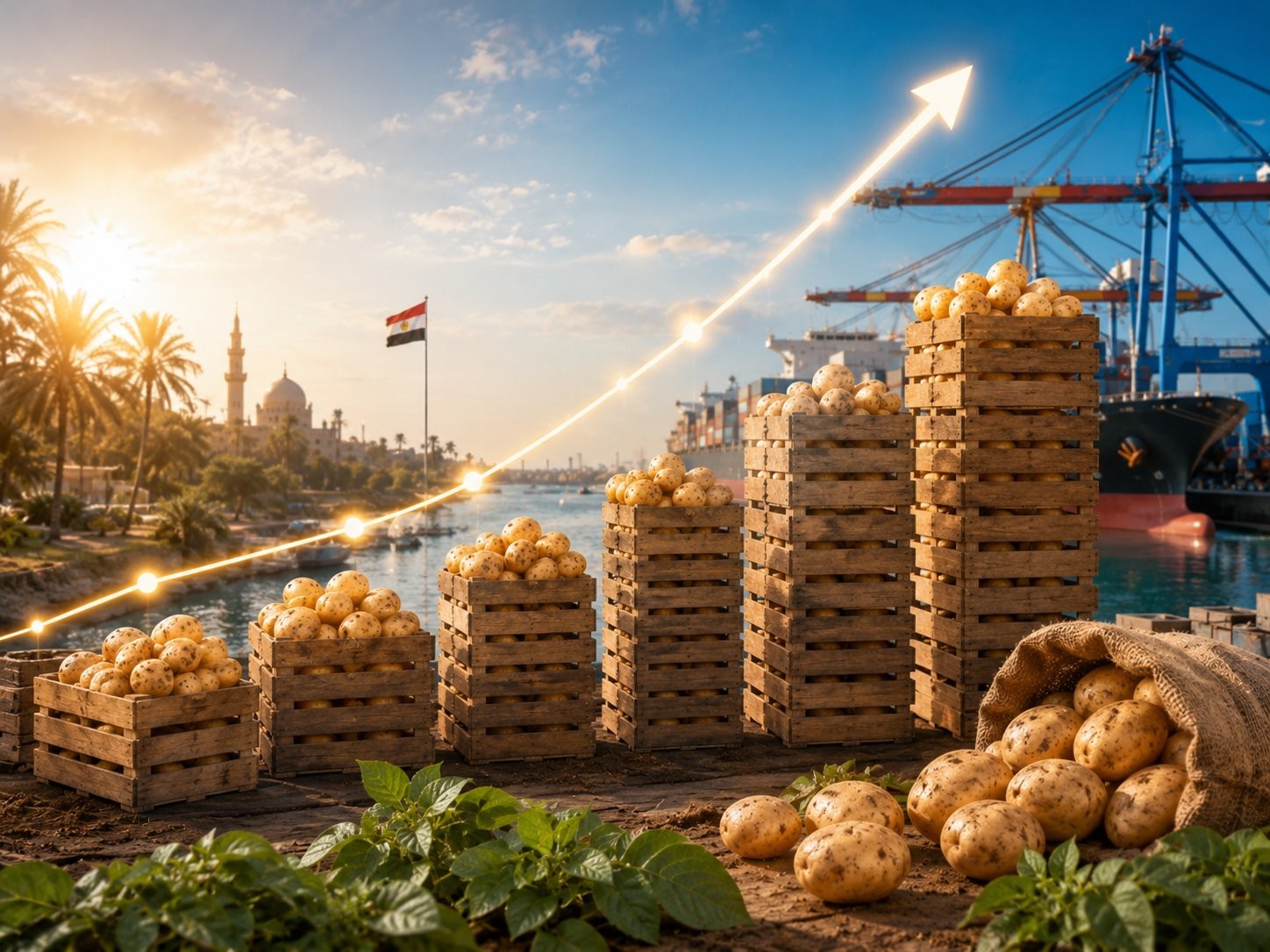
Egypt set an export record in 2023 and kept building from there. Volumes rose again in 2024 and pushed past one million tonnes in 2025, with cold storage sustaining shipments late into the year.
| Year | Fresh potato exports | Note |
|---|---|---|
| 2023 | record volume | previous high |
| 2024 | ~1.0 million t | crop ~7 million t |
| 2025 | >1.0 million t | CAPQ reports ~1.3 million t |
Source: trade press (potatoes.news, EastFruit) and CAPQ / Ministry. Fresh-potato export volume is reported differently across sources (trade ~1.0M t, FAO ~0.9M t, CAPQ ~1.3M t) — see methodology.
The surge was opportunity-driven. A weak 2024 harvest in Russia — production down about 14% on adverse weather and seed shortages — reopened that market in a big way. The EU relaxed import requirements. Several traditional origins faced shortfalls while Egyptian production stayed ample and consistent, and Egypt’s location, ports on two seas, and post-harvest cold storage let exporters serve Russia, the UK, the Gulf and Asia from one base.
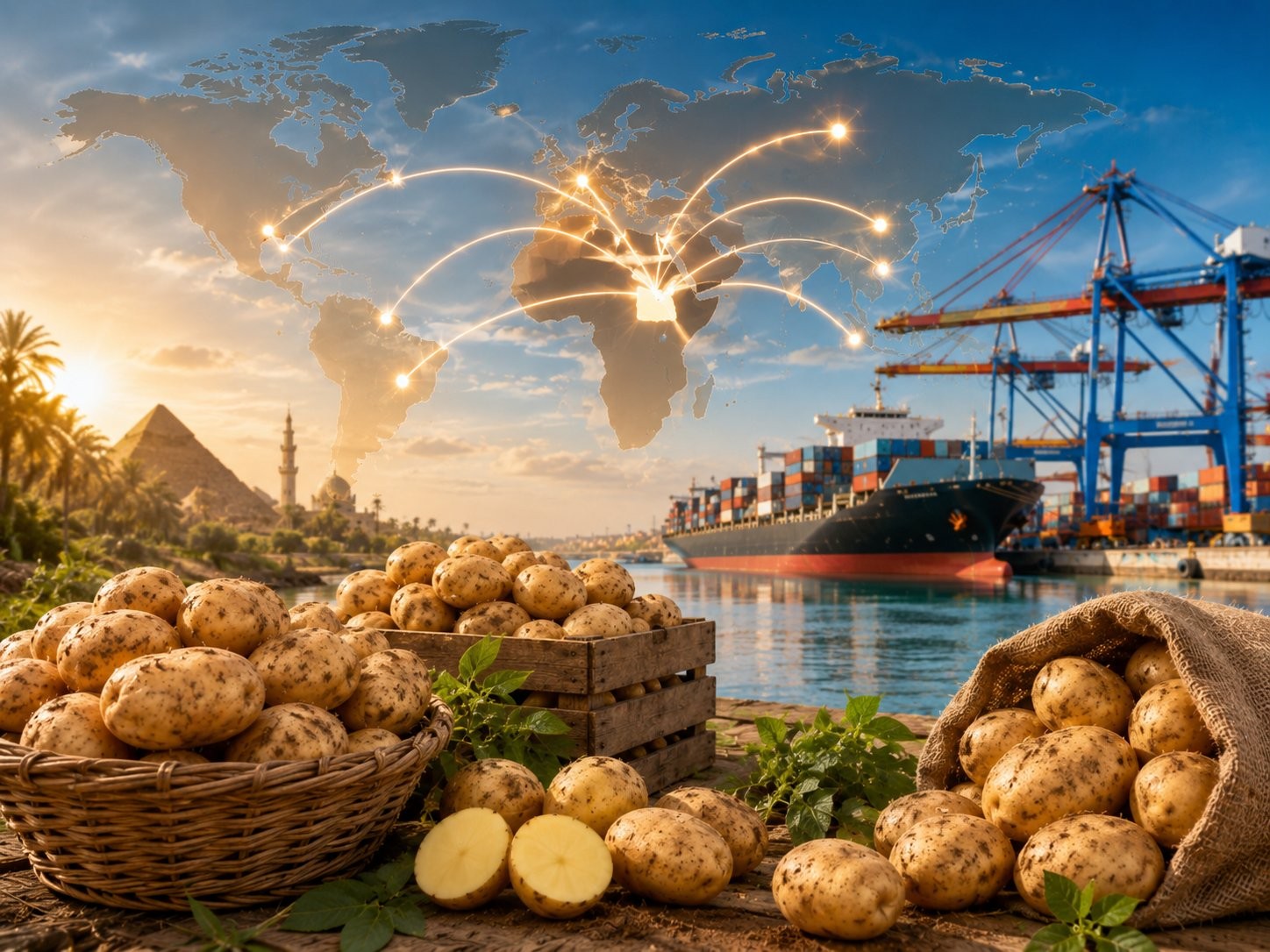
Egypt ships potatoes to more than 30 countries across Europe, the Middle East, Africa and Asia. The 2024/25 map tilted sharply toward Russia and the UK.
| Market | Trend | Note |
|---|---|---|
| Russia | ~3.5× (to May 2025) | #1 supplier, ~67% of imports by value |
| United Kingdom | ~2.7× (2024) | Record volumes |
| EU (Netherlands, others) | Rising | Import rules eased in 2025 |
| Malaysia / SE Asia | +146% (Jan–Jul 2025) | Record 2,500 t; diversification |
| Gulf (Saudi, UAE) | Steady | Core regional demand |
| Africa | Emerging | Regional supply |
Source: EastFruit; FreshPlaza; Rosselkhoznadzor (Russia 2025). Trends are directional where absolute volumes by market are not cleanly reported.
Russia is the clearest growth story. After a weak domestic harvest, Russia turned to imports, and Egypt captured the bulk of it.
| Metric (Russia) | Value |
|---|---|
| Potato imports to May 2025 | 432,200 t |
| Same period 2024 | 124,800 t |
| Growth | ~3.5× |
| Egypt share of Russia imports (value, 2024) | ~67% |
| Duty-free quota | 150,000 t (proposed doubling to 300,000 t) |
Source: Rosselkhoznadzor / Argus-Fito (2025); IndexBox (2024 value share).
A structural change for 2025/26: the European Union eased its import rules for Egyptian potatoes under Regulation (EU) 1289/2025, raising shipment limits and reducing inspection requirements. For a market historically governed by tight brown-rot phytosanitary controls, this lowers friction and cost and supports higher EU volumes going forward.
Beyond fresh ware potatoes, Egypt is scaling processed potato exports — French fries, chips and dehydrated flakes — with French-fry export capacity reported up about 50% in 2024 versus 2023. Processing adds margin and smooths demand for fresh supply across the season.
2025 was a soft-price year globally. Rising output from Europe, Asia, Egypt, Türkiye and newer exporters created a “potato flood” — oversupply that pressured prices even as Egyptian volumes rose. Egyptian FOB levels stayed competitive, which is part of why Egypt won share in price-sensitive markets like Russia.
| Indicator | Value | Basis / source |
|---|---|---|
| Global price environment 2025 | Soft (oversupply) | 2025 · trade press |
| Russia potato price move | +1.5× since Jan 2025 (domestic) | Rosstat |
PEI Trade does not publish a price list. Potato FOB moves week to week with grade, calibre, available volume, packing and vessel space, and a figure fixed at publication misleads more than it helps. For a current number against your spec and destination port, ask the export desk.
Egypt produces around 7 million tonnes of potatoes a year across old lands in the Nile Delta and Valley and new reclaimed desert lands under modern irrigation. Three crop cycles — winter (the main export crop), summer and an autumn (“nili”) crop — combine with cold storage to give roughly six months of production and near year-round export availability.
| Item | Detail |
|---|---|
| Main export crop | Winter crop, shipping from ~January; storage extends to year-end |
| Crop cycles | Winter (main), summer, nili (autumn) |
| Container | 40ft reefer; ventilated for ware potato |
| Lead ports | Alexandria, Damietta (Mediterranean); Red Sea access for Asia |
| Packing | 25 kg / 10 kg bags, big bags, cartons by market |
The outlook is constructive on demand and access. Russian and Asian demand should stay strong, the EU easing is a tailwind, and Egypt’s consistent volume and quality keep winning share. The main swing factors are global oversupply weighing on prices, Red Sea freight on Asia lanes, and weather. Exporters that combine competitive FOB with reliable calibre and documentation are best placed.
Egypt offers large, consistent volume, a long storage-backed shipping window, competitive FOB, and access to both Mediterranean and Red Sea ports. The practical levers for 2026: contract winter-crop and storage programmes early, specify calibre and grade clearly, confirm phytosanitary and EU documentation, and choose the port that fits the destination. PEI Trade ships ware potatoes across these markets and can advise on calibre, packing, ports and Incoterms.
Method. This report compiles trade-press and official Egyptian figures, cross-checked with EastFruit, IndexBox, Rosselkhoznadzor (Russia) and USDA. Fresh-potato export volume is reported differently by source — trade press ~1.0 million tonnes, FAO-based rankings ~0.9 million tonnes, and CAPQ ~1.3 million tonnes for 2025 — because of differing scopes (calendar vs marketing year, fresh-only vs including processed and seed). We label figures with their basis.
Edition: 2026 · Compiled: June 2026 · Update cadence: annually.
Reusing a figure? Please cite it and link to this page as the source.
PEI Trade (2026). Egyptian Potato Export Report 2026. PEI Trade. https://peitrade.com/egyptian-potato-export-report-2026/
Egypt exported over 1 million tonnes of fresh potatoes in 2025 (about 1 million tonnes in 2024) from a crop of roughly 7 million tonnes. CAPQ reports around 1.3 million tonnes for 2025; figures vary by source and scope.
Yes. Egypt is Russia’s number-one potato supplier, accounting for about 67% of Russia’s potato imports by value in 2024. Russian imports rose about 3.5-fold to 432,200 tonnes by May 2025 after a weak domestic harvest.
Egypt ships potatoes to more than 30 countries. The largest 2024/25 markets were Russia and the UK, alongside the EU, the Gulf, Africa and growing Asian markets such as Malaysia.
Yes. Under Regulation (EU) 1289/2025 the European Union eased import rules for Egyptian potatoes, raising shipment limits and reducing inspections, which lowers cost and supports higher EU volumes.
Egypt grows winter (the main export crop), summer and autumn (nili) crops, giving about six months of production. Cold storage extends shipping toward year-end, so Egyptian potatoes are available for export across much of the year.
Looking for a potato partner who manages grade and calibre selection, storage programmes, packing, ports and documentation across Russia, the EU, the Gulf, Africa and Asia? Let’s build your 2026 potato programme.
Browse our potatoes and sweet potatoes product pages, or see the full produce export statistics, the frozen & IQF report and the State of Egyptian Agri-Export 2026.
