Address
Work Hours
Monday to Friday: 7AM - 7PM
Weekend: 10AM - 5PM
Address
Work Hours
Monday to Friday: 7AM - 7PM
Weekend: 10AM - 5PM


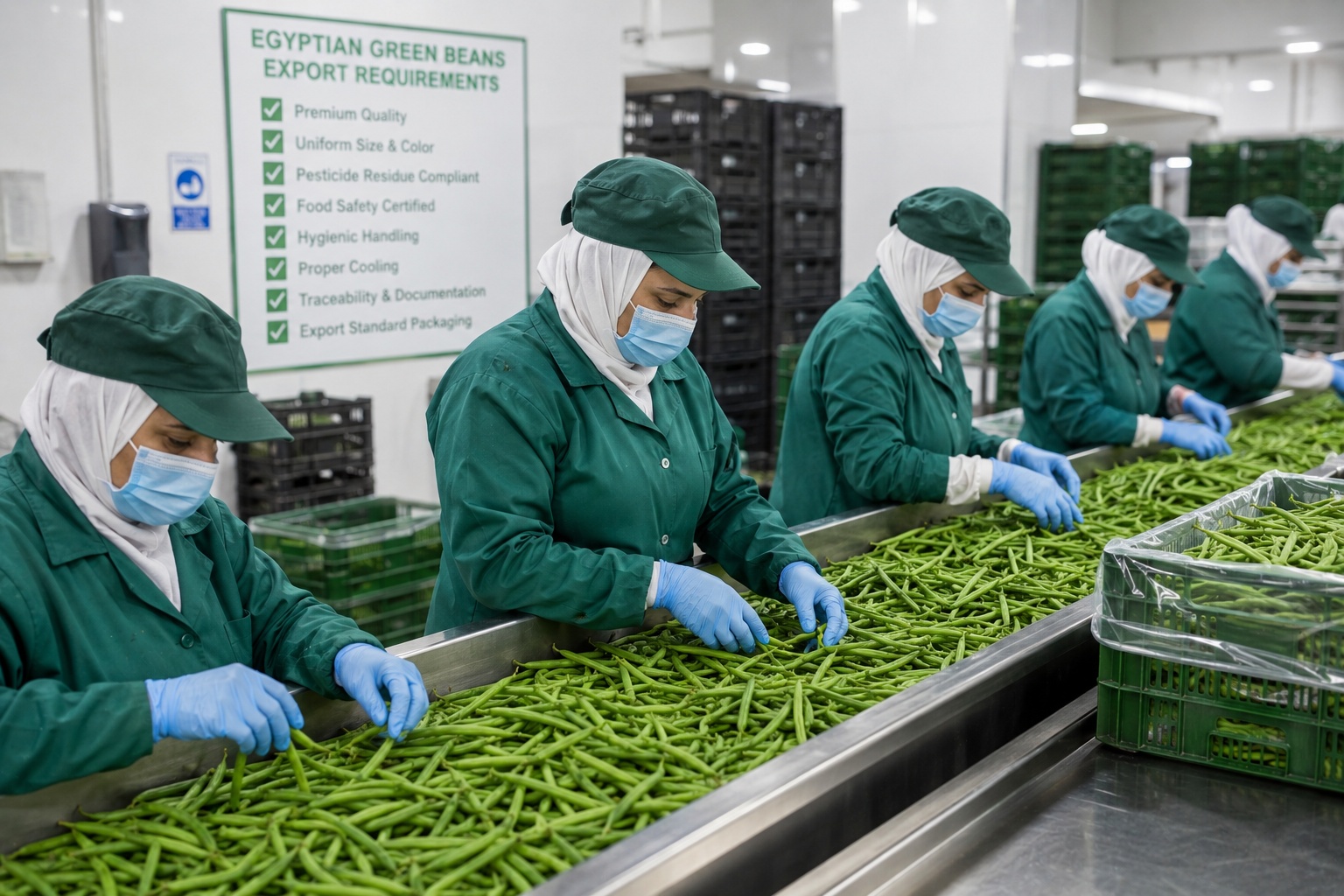
Green beans are one of the more closely-scrutinised fresh exports: a regulated insect pest governs market access, and pesticide residues are watched especially carefully — Egyptian beans have at times faced extra EU border checks. When sold frozen, a food-safety layer is added on top. This guide sets out what an importer and exporter need in place to move Egyptian green beans (fresh and frozen) cleanly.
Quick answer: Fresh Egyptian green beans need a phytosanitary certificate (key pest: false codling moth, Thaumatotibia leucotreta), strict compliance with MRLs (EU: Regulation (EC) No 396/2005 — beans are residue-monitored and Egyptian beans have at times been subject to increased official controls for pesticide residues, historically around 10–20% border sampling under Regulation (EU) 2019/1793; verify the current annex), and GLOBALG.A.P. with ISPM 15 packaging and traceability. Frozen beans additionally need HACCP with BRCGS / IFS / ISO 22000 and microbiological control. Fresh beans trade under HS 0708.20, frozen under HS 0710.22.
Every fresh consignment travels with an official phytosanitary certificate from Egypt’s plant-quarantine authority (CAPQ), confirming inspection and freedom from quarantine pests. For green beans the headline concern is false codling moth (Thaumatotibia leucotreta), a regulated EU pest, so monitored field programs and pre-export inspection are essential. Under EU plant-health law (Regulation (EU) 2019/2072), host consignments must meet defined special requirements for false codling moth — typically pest-free-area origin or an approved systems approach with inspection; confirm the conditions in force for the season.
Residues are where green beans face the most scrutiny. Egyptian beans must meet EU MRLs under Regulation (EC) No 396/2005, and because beans have historically shown residue exceedances, Egyptian green beans have at times been placed under increased official controls (a higher rate of border sampling). That makes disciplined use of approved products, strict pre-harvest intervals, and residue testing before shipment non-negotiable. This control rate has historically sat in the region of 10–20% and is set in the annexes of Regulation (EU) 2019/1793, revised roughly twice a year — so confirm the current rate and Egypt’s listing before shipping.
For EU and UK retail, GLOBALG.A.P. (often with the GRASP add-on) is the baseline, alongside packhouse food-safety management (HACCP) and clear lot-coded traceability from field to pack. Wood pallets and dunnage must be ISPM 15 compliant.
Frozen / IQF green beans are a processed food, so they require full food-safety management: HACCP with a GFSI-recognised scheme (BRCGS, IFS or ISO 22000 / FSSC 22000), strict hygiene, microbiological control, and an unbroken −18°C cold chain.
| Document | Purpose |
|---|---|
| Phytosanitary certificate | Confirms inspection & freedom from FCM (fresh) |
| Residue test report | MRL compliance — critical for beans |
| Certificate of Origin | Proves Egyptian origin |
| EUR.1 movement certificate | Preferential tariff treatment where applicable |
| GLOBALG.A.P. certificate | Good agricultural practice assurance |
| Food-safety cert (frozen: BRCGS/IFS/ISO 22000) | Required for frozen beans |
| Invoice, packing list, B/L | Customs & transport |
| ISPM 15 marked pallets | Compliant wood packaging |
False codling moth (Thaumatotibia leucotreta), a regulated EU pest; control and inspection are required.
Beans have historically shown residue exceedances, so Egyptian green beans have at times faced increased EU border checks (historically around 10-20% sampling) – making approved products, pre-harvest intervals and residue testing essential.
A phytosanitary certificate, residue test report, certificate of origin, EUR.1 (where applicable), GLOBALG.A.P. certificate, ISPM 15 pallets and commercial documents – plus food-safety certification for frozen beans.
HACCP with BRCGS/IFS/ISO 22000, microbiological control and an unbroken minus 18 degrees C cold chain.
Fresh green beans are HS 0708.20; frozen are HS 0710.22.
How to cite this page
PEI Trade. “Egyptian Green Beans Export Requirements.” peitrade.com, 2026. https://peitrade.com/egyptian-green-beans-export-requirements/
This page is part of our Egyptian Green Bean Export Guide hub.
Export Egyptian green beans the compliant way with PEI Trade. Phytosanitary documentation and pest control, disciplined residue management with pre-shipment testing, GLOBALG.A.P. handling, and food-safety certification for frozen — with EU/UK-ready paperwork. Contact: [email protected] · WhatsApp +20 109 911 1918 · www.peitrade.com