Address
Work Hours
Monday to Friday: 7AM - 7PM
Weekend: 10AM - 5PM
Address
Work Hours
Monday to Friday: 7AM - 7PM
Weekend: 10AM - 5PM


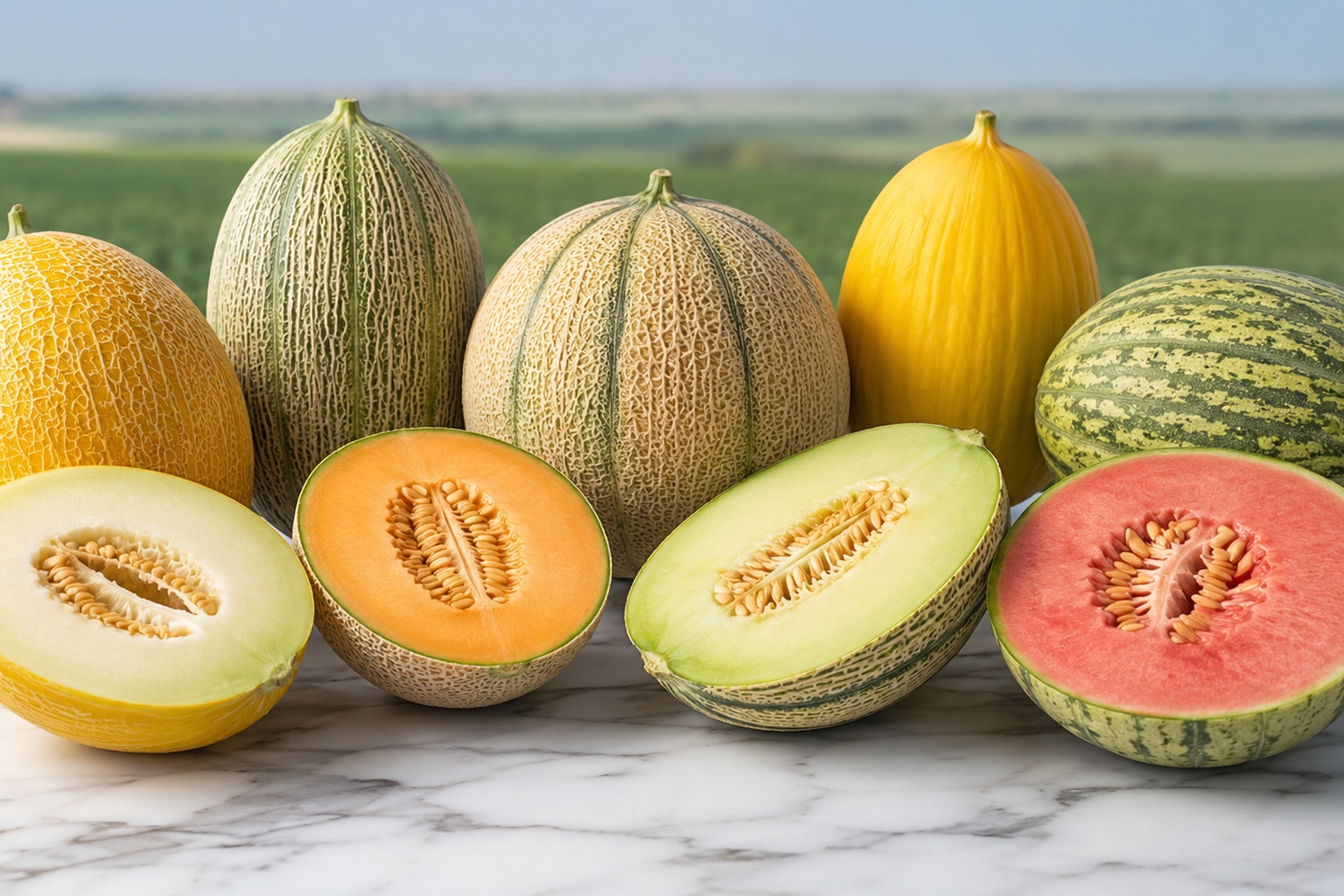
Melon buyers choose by type: aromatic netted cantaloupe, fragrant Galia, premium smooth-skinned Charentais, or sweet pale honeydew. Each has its own skin, flesh colour, aroma and market. Egypt grows all four, with cantaloupe and Galia leading exports. This guide breaks down the main Egyptian melon types and how to match them to your buyers.
Quick answer: Egypt’s main melon types are cantaloupe (netted skin, orange aromatic flesh), Galia (netted skin, green-to-amber fragrant flesh), Charentais (smooth grey-green skin, deep orange flesh, premium) and honeydew (smooth skin, pale sweet flesh). The key quality measures are sweetness (Brix), aroma and finish. Melons trade under HS code 0807.19.
| Type | Skin / flesh | Best for |
|---|---|---|
| Cantaloupe | Netted skin / orange, aromatic | EU, Gulf & regional retail |
| Galia | Netted skin / green-to-amber, fragrant | EU retail |
| Charentais | Smooth grey-green / deep orange | EU premium & specialty |
| Honeydew (Amarillo) | Smooth yellow / pale, very sweet | Gulf & EU |
Cantaloupe (muskmelon) is the backbone of Egyptian melon exports: netted skin, sweet aromatic orange flesh, and broad appeal across EU, Gulf and regional markets. It is graded by size and Brix and harvested at the right ripeness (“slip”) stage for shipping. Aroma and sweetness are its selling points.
Galia melons have netted skin with fragrant green-to-amber flesh and are popular in EU retail. Charentais — smooth grey-green skin with deep orange, intensely flavoured flesh — is the French-style premium melon for specialty European programs. Both reward careful ripeness management.
Honeydew (yellow / Amarillo) melons have smooth skin and pale, very sweet flesh, with strong demand in the Gulf and a place in EU ranges. They tend to store and travel a little better than the aromatic netted types and are warmer-stored.
For mainstream EU and Gulf retail, specify cantaloupe; for EU retail variety, Galia; for premium/specialty, Charentais; for the Gulf and sweet pale flesh, honeydew. Then agree size grade and Brix minimum. A good supplier will match type and ripeness to your destination’s standard.
Cantaloupe (muskmelon), with Galia also important for EU retail.
A smooth grey-green-skinned, deep-orange-fleshed French-style premium melon for specialty markets.
It has smooth skin and pale, very sweet flesh, is popular in the Gulf, and stores a little better and warmer than netted melons.
Sweetness (Brix), along with aroma and skin finish.
Melons other than watermelon fall under HS code 0807.19.
How to cite this page
PEI Trade. “Egyptian Melon Varieties: Cantaloupe, Galia & More.” peitrade.com, 2026. https://peitrade.com/egyptian-melon-varieties/
This page is part of our Egyptian Melon Export Guide hub.
Source the right Egyptian melon with PEI Trade. Cantaloupe, Galia, Charentais and honeydew, graded to your size and Brix, with GLOBALG.A.P. handling and careful ripeness management. Contact: [email protected] · WhatsApp +20 109 911 1918 · www.peitrade.com