Address
Work Hours
Monday to Friday: 7AM - 7PM
Weekend: 10AM - 5PM

Address
Work Hours
Monday to Friday: 7AM - 7PM
Weekend: 10AM - 5PM


Saudi Arabia is a leading Gulf market for Egyptian fresh okra (HS 0709.99). Okra — bamia — is a staple of Saudi and wider Gulf cooking, and Egypt is a primary supplier of tender, small-calibre fresh okra. With short Red Sea transit and both air and fast reefer options, Egyptian okra reaches the Kingdom in prime condition. This guide covers grades, cold-chain logistics, SFDA requirements, seasonality and pricing for Saudi importers.
Saudi Arabia is a top Gulf market for Egyptian fresh okra (bamia, HS 0709.99). Gulf buyers prize baby/fine okra (very small, tender). Grades by calibre: baby, fine, medium. Ships by air (1–2 days) or fast reefer sea (3–5 days) at 7–10°C. Imports need an SFDA health certificate, phytosanitary certificate, GSO MRL compliance and Halal handling.
Okra is a core Gulf vegetable, cooked in stews and with meat, and Saudi domestic production cannot meet year-round demand for small, tender pods. Egypt is a primary origin: it grows the fine and baby calibres Gulf consumers prefer, and its short Red Sea/air links preserve the freshness okra demands. Competitive pricing and reliable volumes make Egypt the default fresh-okra supplier for Saudi wholesalers and retail.
| Market snapshot | Detail |
|---|---|
| Market profile | Top Gulf fresh-okra market |
| HS code | 0709.99 (other fresh vegetables — okra) |
| Preferred grade | Baby / fine (small, tender) |
| Routes | Air (1–2 days); fast reefer sea (3–5 days) |
| Cold chain | 7–10°C, 90–95% RH |
| Peak window | Broad supply; summer main crop |
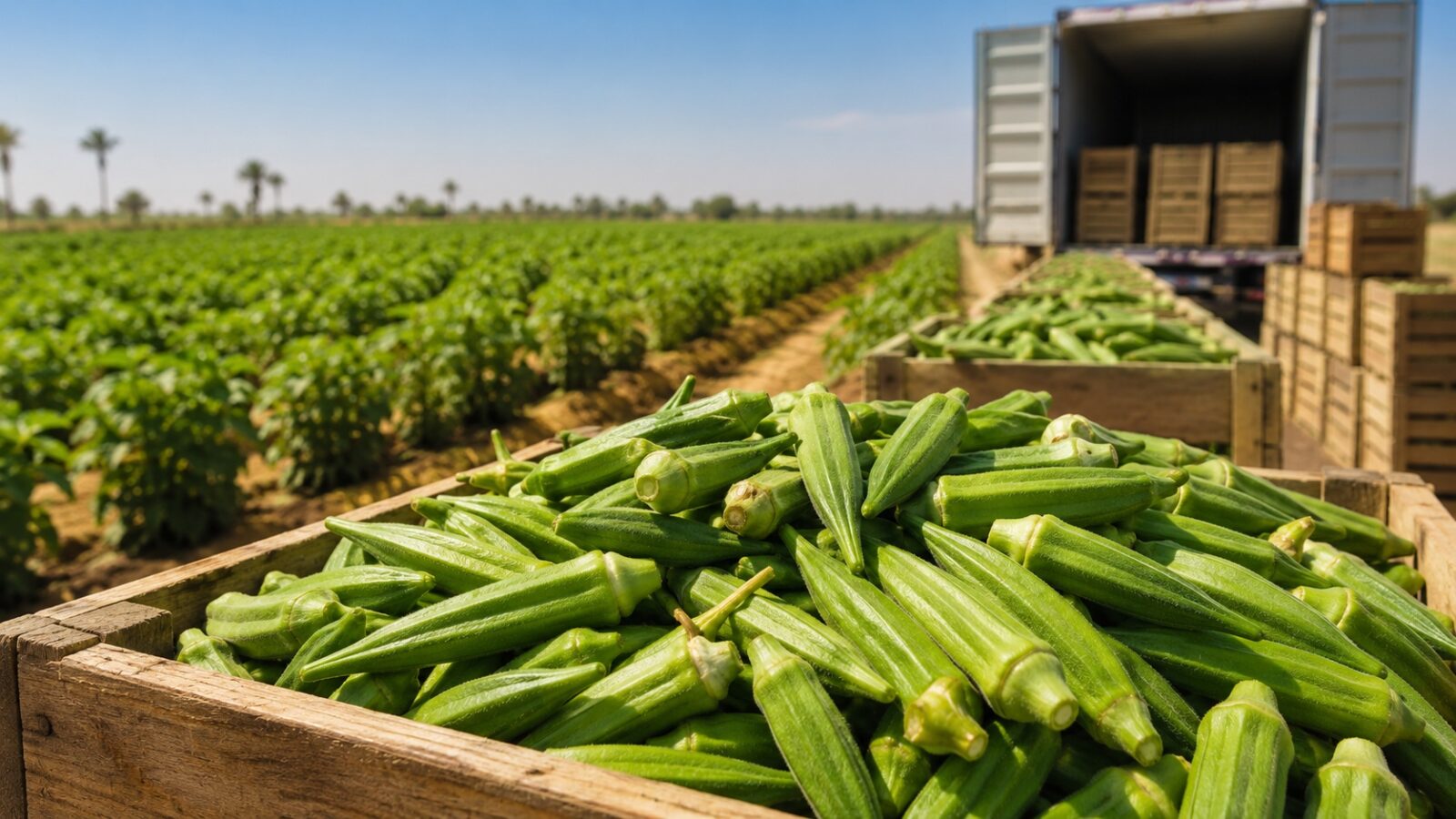
Baby okra: the premium Gulf grade — very small pods (roughly <4 cm), tender and uniform. Fine okra: small (roughly 4–6 cm), the mainstream retail size. Medium okra: larger pods for value/foodservice. Fruit is bright green, firm, blemish-free and free of woodiness. Packed in ventilated cartons (typically 3–5 kg) or punnets, pre-cooled and kept cold to protect shelf life.
Fresh okra is highly perishable and chilling-sensitive, so it moves fast: by air from Cairo (1–2 days) for premium baby grade, or by fast reefer sea to Jeddah/Dammam (3–5 days) for volume. It is held at 7–10°C at 90–95% RH — not colder, to avoid chilling injury. Rapid pre-cooling after harvest and an unbroken cold chain are essential to prevent darkening and toughening.
Saudi imports require a phytosanitary certificate from Egyptian plant quarantine, an SFDA-recognised health certificate, and a certificate of origin. Pesticide residues must meet GSO/Saudi MRLs — a key control point for okra — checked at port. Consignments follow Halal-compliant handling and Arabic labelling (product, origin, packer, net weight, lot). GLOBALG.A.P at farm level and lot traceability are expected by organised buyers.
| Period | Availability |
|---|---|
| May–October | Peak — open-field summer main crop |
| November–April | Protected-cultivation & southern supply |
Okra is a warm-season crop, so Egypt’s main volume runs May–October, with protected and southern cultivation extending fresh availability through much of the year for Gulf buyers.
Source & data: Egyptian fresh-okra wholesale ~US$1.08/kg (Dec 2025); Gulf states are the primary fresh-okra market. Source: Tridge fresh-okra market overview, 2025–26. HS code 0709.99 (other fresh vegetables, incl. okra). Country-level volumes vary seasonally and are confirmed at contracting.
PEI Trade — New Cairo, Egypt. Request a quote or okra spec sheet →