Address
Work Hours
Monday to Friday: 7AM - 7PM
Weekend: 10AM - 5PM
Address
Work Hours
Monday to Friday: 7AM - 7PM
Weekend: 10AM - 5PM


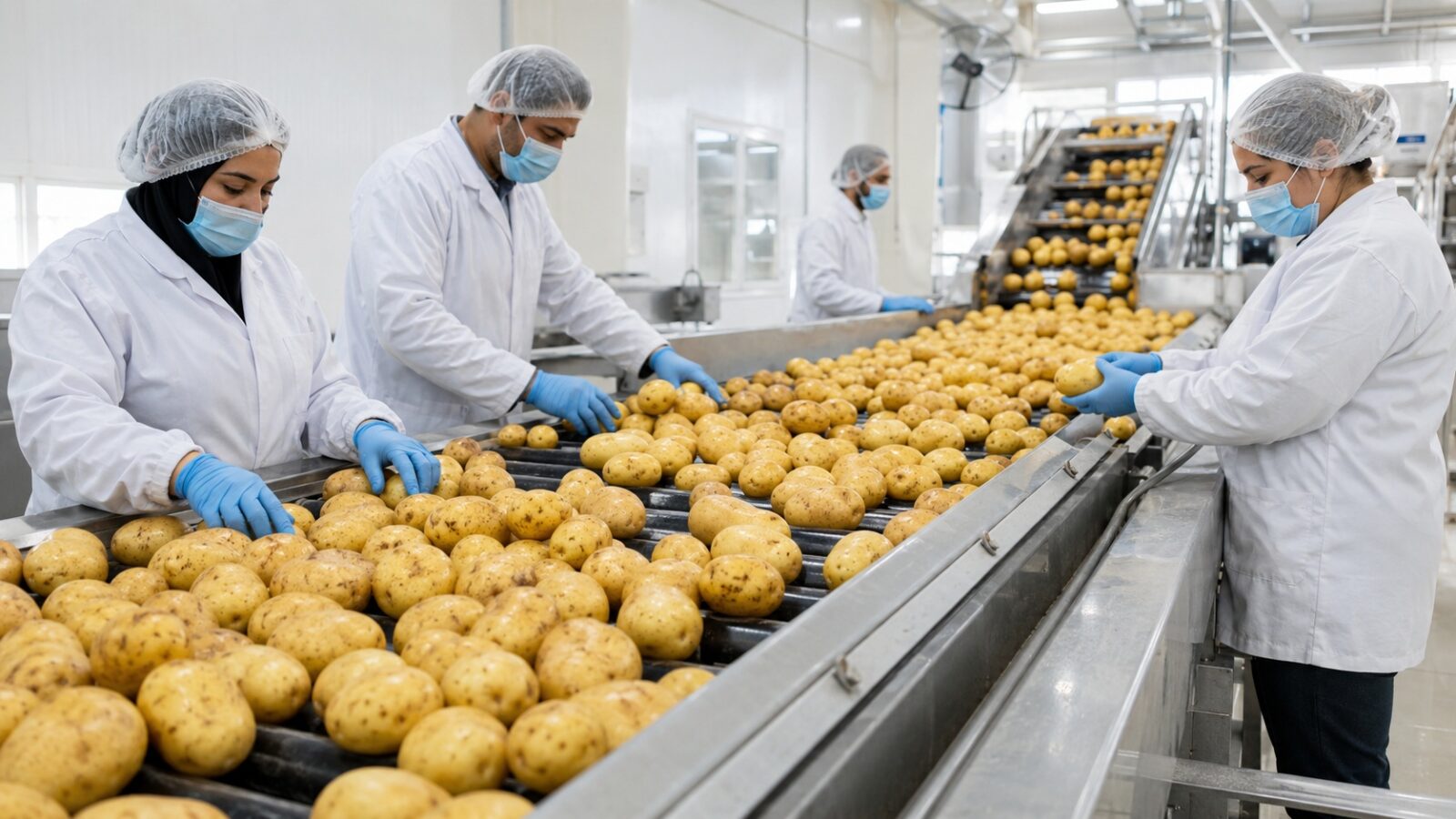
Potatoes carry stricter plant-health requirements than most Egyptian export crops, and the single biggest gate is brown rot. This guide sets out exactly what an importer and exporter need in place to move Egyptian potatoes legally and cleanly — phytosanitary certification, brown-rot-free sourcing, the eased EU rules, residue limits and the documents that travel with every consignment.
Quick answer: To export Egyptian potatoes you need a phytosanitary certificate confirming freedom from brown rot (Ralstonia solanacearum), with tubers sourced from designated pest-free / brown-rot-free areas; compliance with EU residue limits (MRLs, Regulation (EC) No 396/2005); and — for the EU — the conditions eased under Regulation 1289/2025 (higher volume thresholds, reduced inspection frequency). GLOBALG.A.P., ISPM 15 wood packaging and lot-coded traceability complete the baseline. Fresh ware potatoes are traded under HS code 0701. (Sources: European Commission; industry trade reporting, 2025.)
Brown rot (Ralstonia solanacearum) is the disease that governs the entire Egyptian potato export system. Importing authorities — the EU and Russia in particular — monitor for it closely, and a single detection can block a consignment or suspend an exporting area. Egypt manages this through a pest-free-area (PFA) system: potatoes destined for export are grown in officially designated, surveyed zones that are kept free of the pathogen, with sampling and testing before shipment. Sourcing from an approved area, with documentation to prove it, is non-negotiable.
Every consignment must travel with an official phytosanitary certificate issued by Egypt’s plant-quarantine authority (CAPQ), confirming the potatoes were inspected, sourced from approved areas and meet the importing country’s plant-health conditions. For the EU these conditions sit within plant-health law (Regulation (EU) 2019/2072) and the specific framework for Egyptian potatoes. The certificate is the document customs and border inspection check first.
In 2025 the EU eased its import conditions for Egyptian potatoes under Regulation 1289/2025, raising shipment thresholds and reducing inspection frequency. For exporters and importers this means smoother clearance and more headroom on volume — a meaningful boost — but the core obligations (pest-free-area sourcing, phytosanitary certification, residue compliance) remain fully in force.
Egyptian potatoes must meet EU maximum residue levels under Regulation (EC) No 396/2005. The EU has continued to lower MRLs and remove approvals for several active substances, so growing programs must use compliant, approved products and observe pre-harvest intervals. Note that the historic sprout suppressant chlorpropham (CIPC) is no longer permitted in the EU, so residues of it must effectively be absent — this directly shapes how export potatoes are treated in storage (see the packaging & cold-chain guide).
For EU and UK retail and processing buyers, GLOBALG.A.P. certification is the baseline for good agricultural practice, often with the GRASP social add-on. Food-safety management (HACCP, and where required ISO 22000 or a GFSI-recognised scheme such as BRCGS / IFS at the packhouse) and clear lot-coded traceability from field to carton complete the picture. Wood pallets and dunnage must be ISPM 15 compliant.
Post-Brexit, the UK requires a phytosanitary certificate and import pre-notification for Egyptian potatoes, plus the usual commercial documentation. As UK demand for Egyptian potatoes has grown, having clean PFA documentation and reliable certification is what keeps that channel open.
| Document | Purpose |
|---|---|
| Phytosanitary certificate | Confirms inspection, PFA sourcing & freedom from brown rot |
| Certificate of Origin | Proves Egyptian origin |
| EUR.1 movement certificate | Preferential tariff treatment where applicable |
| Commercial invoice & packing list | Customs valuation and contents |
| Bill of lading | Transport / title document |
| GLOBALG.A.P. certificate | Good agricultural practice assurance |
| ISPM 15 marked pallets | Compliant wood packaging |
A phytosanitary certificate confirming freedom from brown rot (Ralstonia solanacearum), with potatoes sourced from officially designated pest-free / brown-rot-free areas.
Regulation 1289/2025 eased import conditions – higher volume thresholds and reduced inspection frequency – while keeping the core plant-health and residue obligations.
EU maximum residue levels under Regulation (EC) No 396/2005. Approved products and pre-harvest intervals must be observed, and chlorpropham (CIPC) is no longer permitted in the EU.
For EU and UK retail and processing buyers it is effectively the baseline, usually alongside packhouse food-safety certification and lot traceability.
A phytosanitary certificate and import pre-notification, plus standard commercial documents.
How to cite this page
PEI Trade. “Egyptian Potato Export Requirements: Brown Rot, EU Rules & MRLs.” peitrade.com, 2026. https://peitrade.com/egyptian-potato-export-requirements/
This page is part of our Egyptian Potato Export Guide hub.
Export Egyptian potatoes the compliant way with PEI Trade. We source from brown-rot-free areas with full phytosanitary documentation, GLOBALG.A.P. handling and EU/UK-ready paperwork. Contact: [email protected] · WhatsApp +20 109 911 1918 · www.peitrade.com