Address
Work Hours
Monday to Friday: 7AM - 7PM
Weekend: 10AM - 5PM
Address
Work Hours
Monday to Friday: 7AM - 7PM
Weekend: 10AM - 5PM


Egypt has become one of the world’s most dependable sources of fresh potatoes. With large, consistent volumes, a counter-seasonal window that fills gaps left by other origins, and clean tubers grown on irrigated Delta and reclaimed-desert land, Egyptian potatoes now move in serious quantity to Russia, the EU, the UK, the Gulf and Asia. This guide is the hub for importers: what Egypt produces, when it ships, which markets it serves, the specifications buyers ask for, and the compliance that keeps shipments clean.
Quick answer: Egypt produces around 6.9–7 million tons of potatoes a year and is the world’s fourth-largest potato exporter and Africa’s largest producer. Potatoes are Egypt’s second-largest agricultural export, exceeding 1.3 million tons. The fresh export window runs roughly January to June, with cold storage extending availability into October. The dominant export variety is Spunta, alongside processing varieties for chips and fries. Top markets are Russia (Egypt is Russia’s leading potato supplier), the EU, the UK, the Gulf and a fast-growing list in Asia. (Sources: FAO, 2023/24; ITC Trade Map, 2025; Egyptian Ministry of Agriculture / EgyptToday, 2025.)
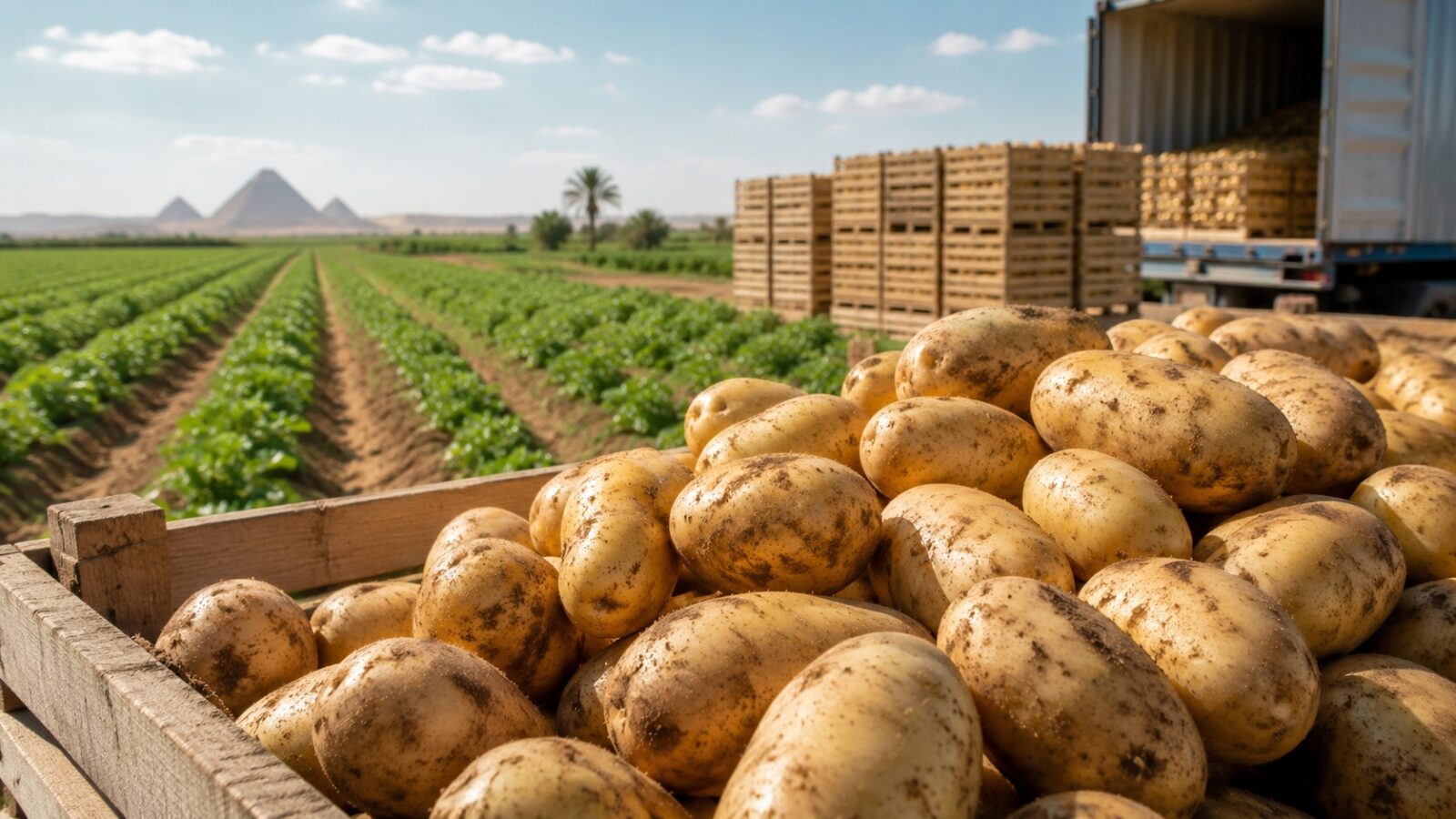
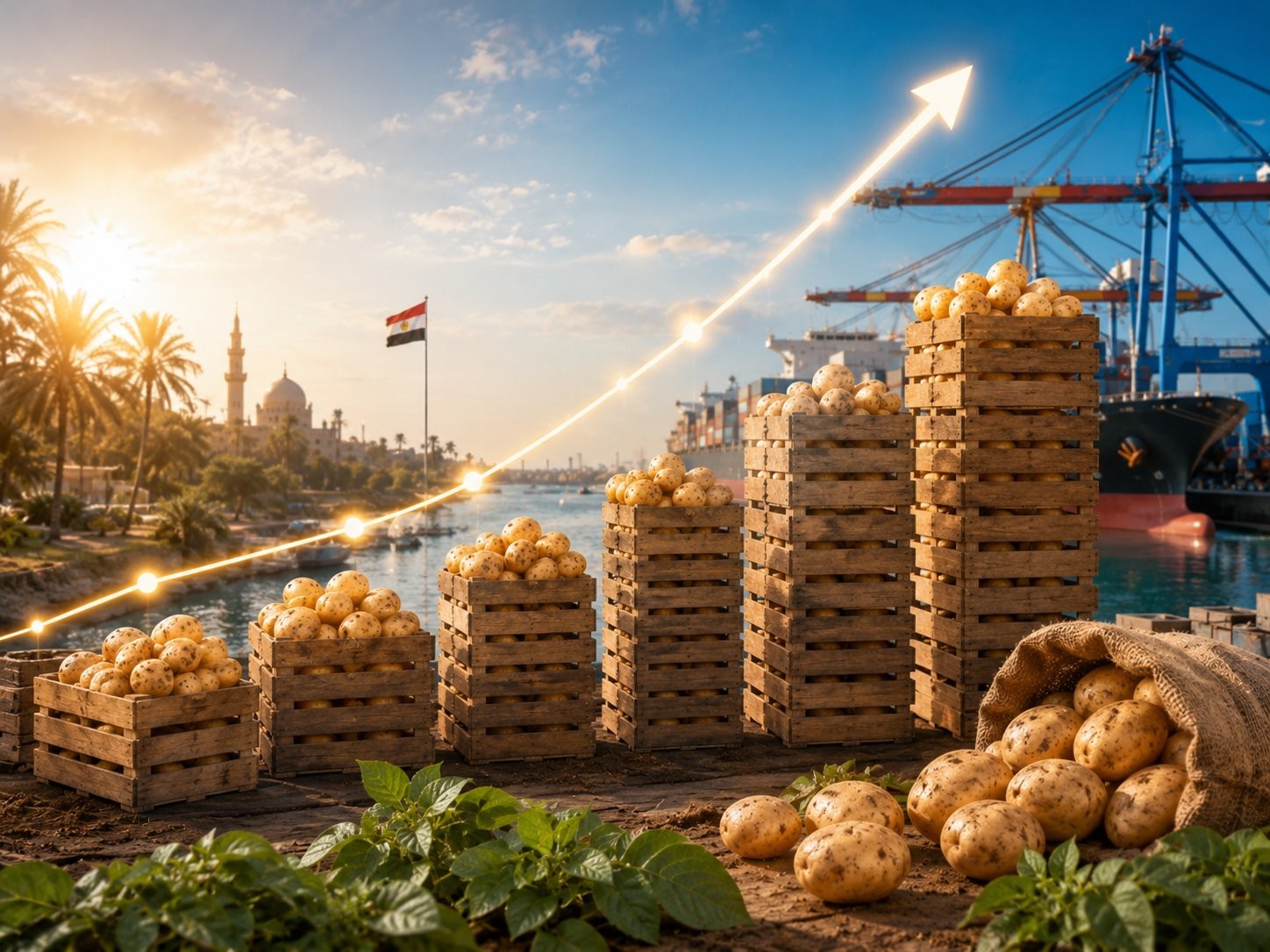
Egypt’s strength is reliable supply at the right time. Production is large — around 6.9–7 million tons a year (FAO, 2023/24), making Egypt Africa’s leading potato producer and the world’s fourth-largest exporter (ITC Trade Map, 2025) — and quality stays consistent even when competing origins fall short. When Russian or European harvests are hit by weather or seed shortages, Egyptian volume fills the gap quickly.
Egypt grows fresh (ware) varieties for the table and dedicated processing varieties for chips and fries. Most seed is of Dutch, French or German origin.
| Variety | Type / use | Notes |
|---|---|---|
| Spunta | Ware (fresh export) | The dominant Egyptian export variety; long oval tubers, light-yellow flesh |
| Cara | Ware (fresh) | White skin, stores well, popular for table markets |
| Diamant | Ware / fries | Versatile, firm; used fresh and for processing |
| Agria | Processing (French fries) | High dry matter, long tubers suited to fries |
| Lady Rosetta | Processing (chips / crisps) | Round, high dry matter; a crisping standard |
| Hermes | Processing (chips) | Widely used for crisps |
| Sagitta, Santana & others | Ware / fries | Including resilient varieties grown on reclaimed / saline land |
Egypt’s fresh potato export season runs from about January to June, and cold storage extends shipments into around October — so Egypt can supply across most of the year. The crop is grown in the Nile Delta (Beheira, Menoufia, Sharqia, Dakahlia, Gharbia) and Middle Egypt, plus expanding reclaimed-desert zones. Strict post-harvest handling and cold storage keep quality stable for long transit to distant markets.
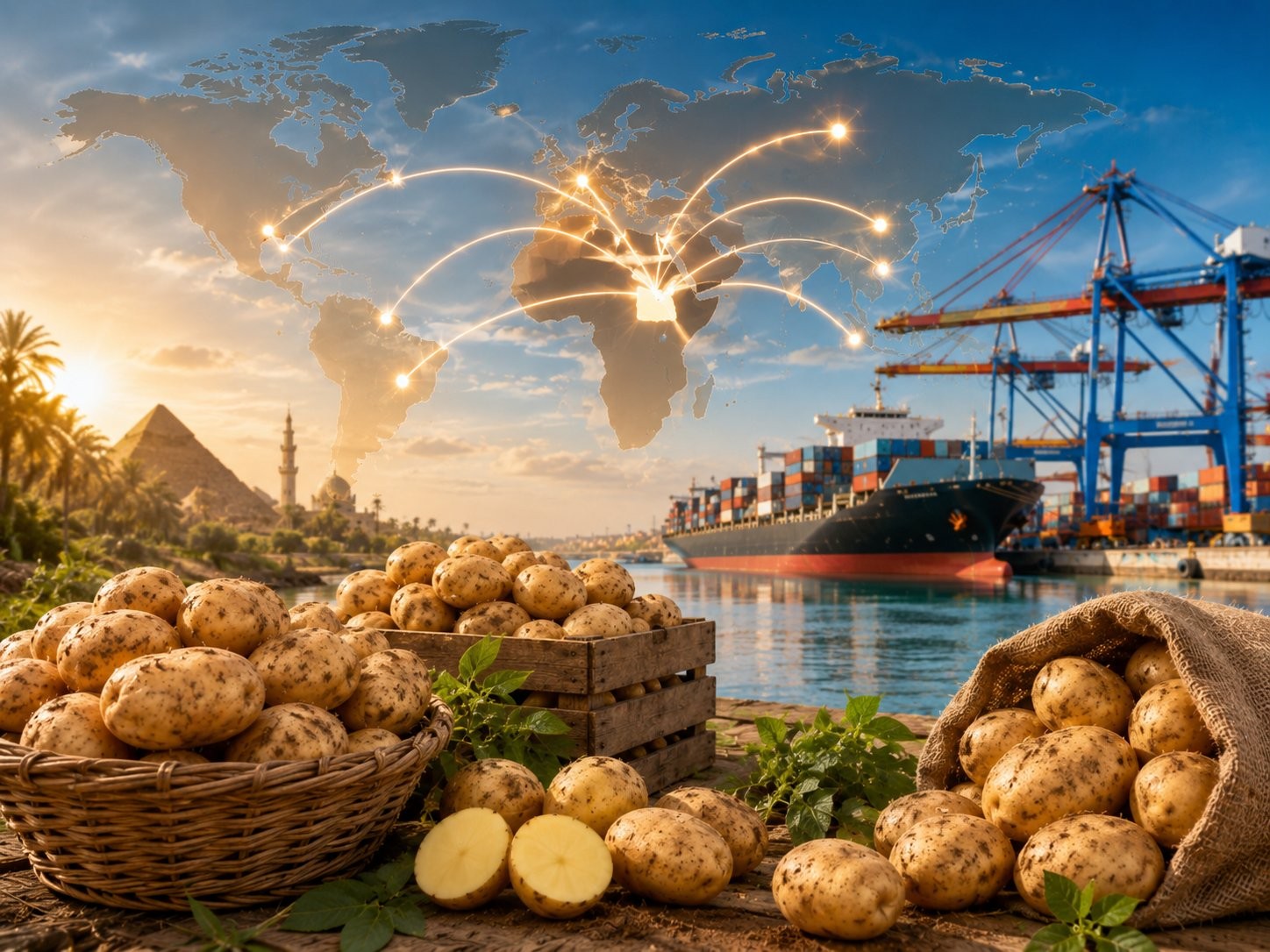
Egypt’s potato export map has broadened sharply in recent seasons:
Egyptian potatoes are graded and packed to the buyer’s program. Common B2B expectations include:
Fresh (ware) potatoes are traded under HS code 0701.90 (seed potatoes under 0701.10); processed potatoes fall under 2004.10 (frozen prepared) and 2005.20 (other prepared, including chips and flakes).
Potatoes carry specific phytosanitary requirements. The key concern is brown rot (Ralstonia solanacearum): Egypt ships from designated pest-free / brown-rot-free areas, supported by official inspection and a phytosanitary certificate. For the EU, import conditions were eased under Regulation 1289/2025, but consignments still require the phytosanitary certificate and must meet residue limits (MRLs under Regulation (EC) No 396/2005). GLOBALG.A.P. certification, ISPM 15-compliant wood packaging and clear lot-coded traceability complete the baseline for EU and UK programs. Note that Egyptian potatoes are not on the EU’s enhanced official-controls list for residues (Regulation (EU) 2019/1793); the binding EU requirement is plant-health (brown rot) under Regulation 1289/2025, not increased border checks.
This pillar links to detailed guides in the cluster:
Potatoes are Egypt’s second-largest agricultural export, with volumes exceeding 1.3 million tons, shipped mainly to Russia, the EU, the UK, the Gulf and Asia.
The fresh export season runs roughly from January to June, and cold storage extends availability into around October, giving near year-round supply.
Spunta is the dominant fresh (ware) export variety. Processing varieties such as Lady Rosetta and Hermes (chips) and Agria (fries) are also widely grown.
Russia is the largest market, with the EU, UK, Gulf states (Saudi Arabia, Kuwait, UAE) and Asian markets such as Malaysia also significant and growing.
A phytosanitary certificate confirming freedom from brown rot (sourcing from approved pest-free areas), compliance with EU MRLs, GLOBALG.A.P. certification and ISPM 15 wood packaging.
How to cite this page. Reusing a figure from this guide? Please cite it and link to this page as the source.
PEI Trade. “Egyptian Potato Export: The Complete Guide.” peitrade.com, 2026. https://peitrade.com/egyptian-potato-export-guide/
Source Egyptian potatoes with PEI Trade. We supply fresh (ware) and processing potatoes — Spunta and more — to Russian, EU, UK, Gulf and Asian buyers, with GLOBALG.A.P. handling, brown-rot-free sourcing, full documentation and cold-chain discipline. Contact: [email protected] · WhatsApp +20 109 911 1918 · www.peitrade.com