Address
Work Hours
Monday to Friday: 7AM - 7PM
Weekend: 10AM - 5PM
Address
Work Hours
Monday to Friday: 7AM - 7PM
Weekend: 10AM - 5PM


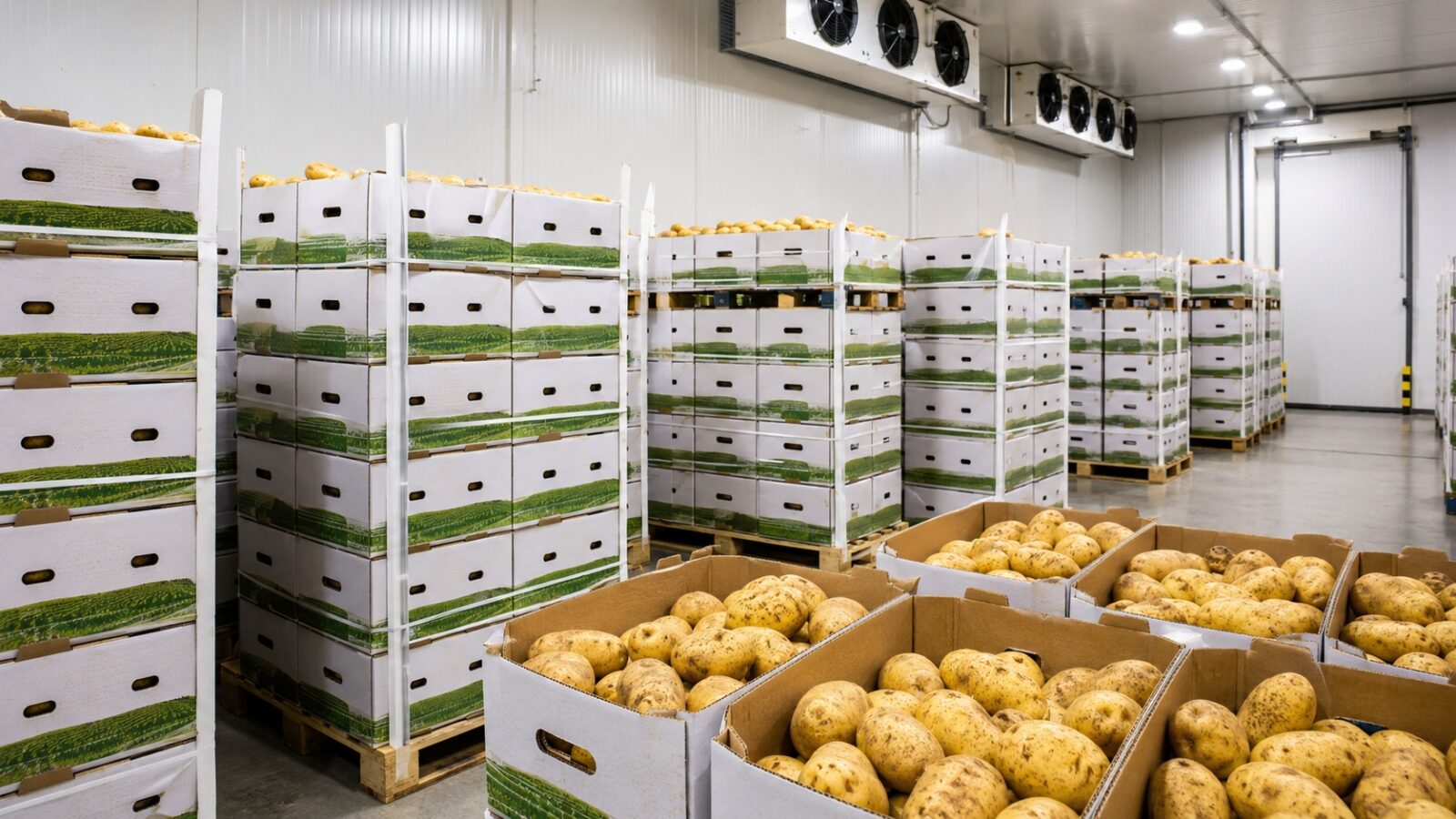
Potatoes are not shipped like fruit. Store them too cold and their starch turns to sugar, which darkens fries and chips; store them too warm and they sprout. Getting the Egyptian potato cold chain right — from curing through storage to the reefer — is what protects quality on long routes to Russia, the EU, the UK and the Gulf. This guide covers temperatures by end use, sprout control, packing formats and loading.
Quick answer: Egyptian export potatoes are cured after harvest, then held cool but not cold. Ware/table potatoes sit around 4–7°C at 90–95% RH; processing potatoes for chips/fries are kept warmer (~8–10°C) to avoid cold-induced sweetening; seed potatoes ~2–4°C. Sprouting is managed by temperature and approved suppressants (CIPC is banned in the EU, so alternatives such as 1,4-DMN, spearmint oil or ethylene are used). Pack in 25 kg mesh / net bags, big (jumbo) bags or cartons, ventilated to prevent condensation, and ship by reefer. (Exact setpoints depend on variety and end use.)
The key principle is cold-induced sweetening: below roughly 4°C, potatoes convert starch to reducing sugars, which caramelise during frying and produce dark, bitter chips and fries. That is why processing potatoes are deliberately stored warmer than you might expect. At the same time, warmth and light cause sprouting and greening. Good potato handling is therefore a balancing act — cool enough to stay dormant and firm, warm enough to protect fry colour — held at high humidity to prevent weight loss and shrivel.
| Use | Temperature | Humidity | Why |
|---|---|---|---|
| Table / ware | ~4–7°C | 90–95% | Freshness and firmness without sweetening |
| Processing (chips / fries) | ~8–10°C | 90–95% | Keeps reducing sugars low for light fry colour |
| Seed | ~2–4°C | 90–95% | Suppresses sprouting, preserves viability |
Before cold storage, freshly lifted potatoes are cured — held for roughly one to two weeks at warm temperatures (around 13–18°C) and high humidity so the skin sets and minor harvest wounds heal. Curing dramatically reduces rot and weight loss in storage and is the foundation of a long, clean shelf life.
Temperature is the first line of defence, but for longer storage Egypt also uses approved sprout suppressants. Because chlorpropham (CIPC) is no longer permitted in the EU, exporters rely on alternatives such as 1,4-dimethylnaphthalene (1,4-DMN), spearmint / mint oil, ethylene and similar treatments, combined with good ventilation. The choice must keep the consignment compliant with the destination’s residue rules.
Potatoes are washed or brushed to specification, kept out of light to prevent greening, and palletised for stable, ventilated loading.
Export potatoes ship in reefer containers with the set point matched to the product (cooler for ware, warmer for processing) and with fresh-air exchange to vent respiration moisture and CO₂ and avoid “sweating” (condensation). A 40 ft high-cube reefer typically carries on the order of 24 tons of bagged potatoes (roughly 20 pallets), depending on the pack. The aims in transit are stable temperature, high humidity, airflow and no physical damage.
Around 4-7 degrees C for table/ware potatoes, ~8-10 degrees C for processing potatoes (to protect fry colour) and ~2-4 degrees C for seed – all at 90-95% humidity.
Below about 4 degrees C potatoes convert starch to sugar (cold-induced sweetening), which darkens chips and fries, so they are kept cool rather than cold.
Mainly by temperature, plus approved suppressants. Since CIPC is banned in the EU, alternatives such as 1,4-DMN, spearmint oil and ethylene are used.
Commonly in 25 kg mesh/net bags, big (jumbo) bags for processing, or cartons and retail packs – washed or brushed, ventilated and palletised.
In reefer containers with the set point matched to the product and fresh-air exchange to prevent condensation; a 40 ft reefer holds roughly 24 tons depending on the pack.
How to cite this page
PEI Trade. “Egyptian Potato Packaging & Cold Chain.” peitrade.com, 2026. https://peitrade.com/egyptian-potato-packaging-cold-chain/
This page is part of our Egyptian Potato Export Guide hub.
Ship Egyptian potatoes that arrive in spec with PEI Trade. Curing, end-use-matched cold storage, compliant sprout control and reefer discipline — in mesh bags, jumbo bags or cartons to your program. Contact: [email protected] · WhatsApp +20 109 911 1918 · www.peitrade.com