Address
Work Hours
Monday to Friday: 7AM - 7PM
Weekend: 10AM - 5PM
Address
Work Hours
Monday to Friday: 7AM - 7PM
Weekend: 10AM - 5PM


Egypt grows two distinct kinds of potato: ware varieties for the fresh table market and dedicated processing varieties for chips (crisps) and French fries. Choosing the right one is the first decision in any potato program, because flesh colour, dry matter and size all change which market the fruit fits. This guide breaks down the main Egyptian potato varieties, what each is used for, and how to match them to your buyers.
Quick answer: The dominant Egyptian export variety is Spunta, a long, light-yellow-fleshed ware potato. Other ware varieties include Cara and Diamant; processing varieties include Lady Rosetta and Hermes (chips / crisps) and Agria (French fries). Most seed is of Dutch, French or German origin. Potatoes are Egypt’s second-largest agricultural export, exceeding 1.3 million tons. (Sources: FAO; PotatoPro; Egyptian Ministry of Agriculture, 2025.)
| Variety | Type / use | Skin & flesh | Notes |
|---|---|---|---|
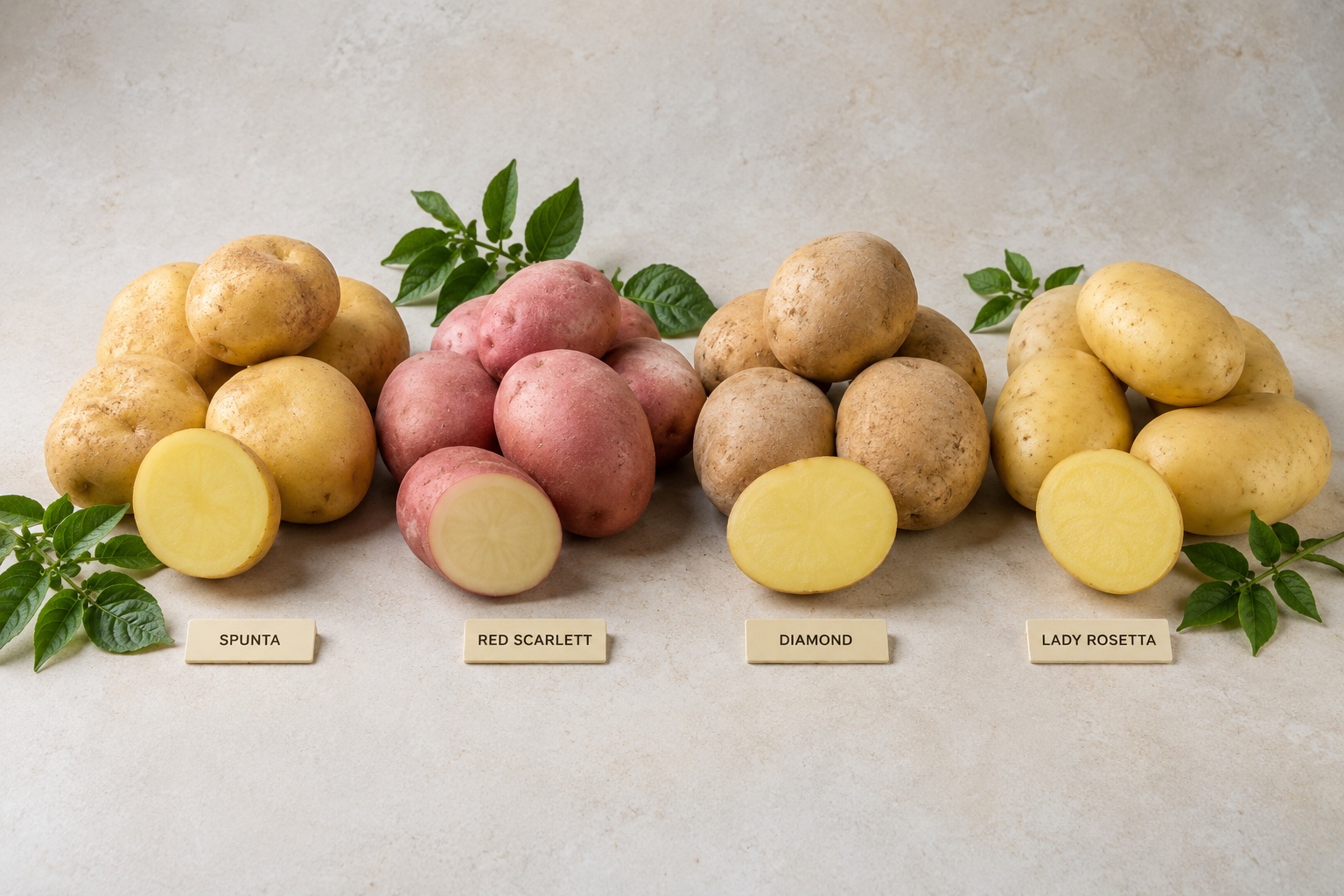
| Spunta | Ware (fresh export) | Yellow skin, light-yellow flesh | The dominant Egyptian export variety; long, large tubers |
| Cara | Ware (fresh) | Cream / white skin, light flesh | Stores well; reliable table variety |
| Diamant | Ware / multi-purpose | Yellow skin, light-yellow flesh | Firm, versatile for fresh and some processing |
| Lady Rosetta | Processing (chips / crisps) | Red skin, pale flesh | Round, high dry matter; an industry crisping standard |
| Hermes | Processing (chips / crisps) | Light-brown skin, pale flesh | High dry matter; widely used for crisps |
| Agria | Processing (French fries) | Yellow skin, deep-yellow flesh | Long tubers, high dry matter; a fries standard |
| Santana | Processing (French fries) | Yellow skin, light-yellow flesh | Oblong; suited to fries |
| Sagitta & resilient types | Ware / multi-purpose | Yellow skin | Grown including on reclaimed / saline land |
Ware potatoes are grown for the fresh market — sold loose or bagged for cooking at home or in foodservice. Spunta is by far the most important Egyptian export variety: its long, large, light-yellow-fleshed tubers travel well and suit the table markets of Russia, the Arab world and Europe. Cara and Diamant add white- and yellow-fleshed options with good storage and versatility. Ware buyers care most about size grading, clean skins (no greening or defects) and consistent appearance.
Processing varieties are bred for high dry matter and low sugars, which give crisp chips and golden fries without excess oil or dark colour:
For processing buyers, the specification is less about looks and more about dry matter, reducing-sugar levels and tuber length — all of which affect fry colour and texture.
The two categories are not interchangeable. A great table variety can fry poorly, and a crisping variety may look wrong on a retail shelf. The practical differences:
Start from the end use. For retail and foodservice table programs in Russia, the Gulf or Europe, Spunta is the natural first choice, with Cara or Diamant as alternatives. For a crisp line, specify Lady Rosetta or Hermes; for a fry plant, Agria. Flesh colour also matters by market — some buyers prefer light-yellow flesh, others whiter flesh — so confirm the preference before locking the variety. A good supplier will match variety, size and flesh colour to your destination.
Spunta – a long, light-yellow-fleshed ware potato – is the dominant Egyptian export variety, used widely for fresh table markets.
Lady Rosetta and Hermes are the main chip/crisp varieties; Agria (and similar varieties such as Santana) are used for French fries, thanks to their high dry matter.
Ware potatoes are grown for the fresh table market and judged on size and appearance; processing potatoes are bred for high dry matter and low sugars to make crisp chips and golden fries.
Most seed potatoes are of Dutch, French or German origin, with local seed-multiplication programs also in place.
Yes – resilient varieties such as Sagitta are grown on reclaimed and saltier soils to maintain yield and quality under stress.
How to cite this page
PEI Trade. “Egyptian Potato Varieties: Ware & Processing Export Guide.” peitrade.com, 2026. https://peitrade.com/egyptian-potato-varieties/
This page is part of our Egyptian Potato Export Guide hub.
Source the right Egyptian potato variety with PEI Trade. We supply ware varieties such as Spunta and processing varieties for chips and fries, matched to your market’s size and flesh-colour preferences, with GLOBALG.A.P. handling and full documentation. Contact: [email protected] · WhatsApp +20 109 911 1918 · www.peitrade.com