Address
Work Hours
Monday to Friday: 7AM - 7PM
Weekend: 10AM - 5PM
Address
Work Hours
Monday to Friday: 7AM - 7PM
Weekend: 10AM - 5PM


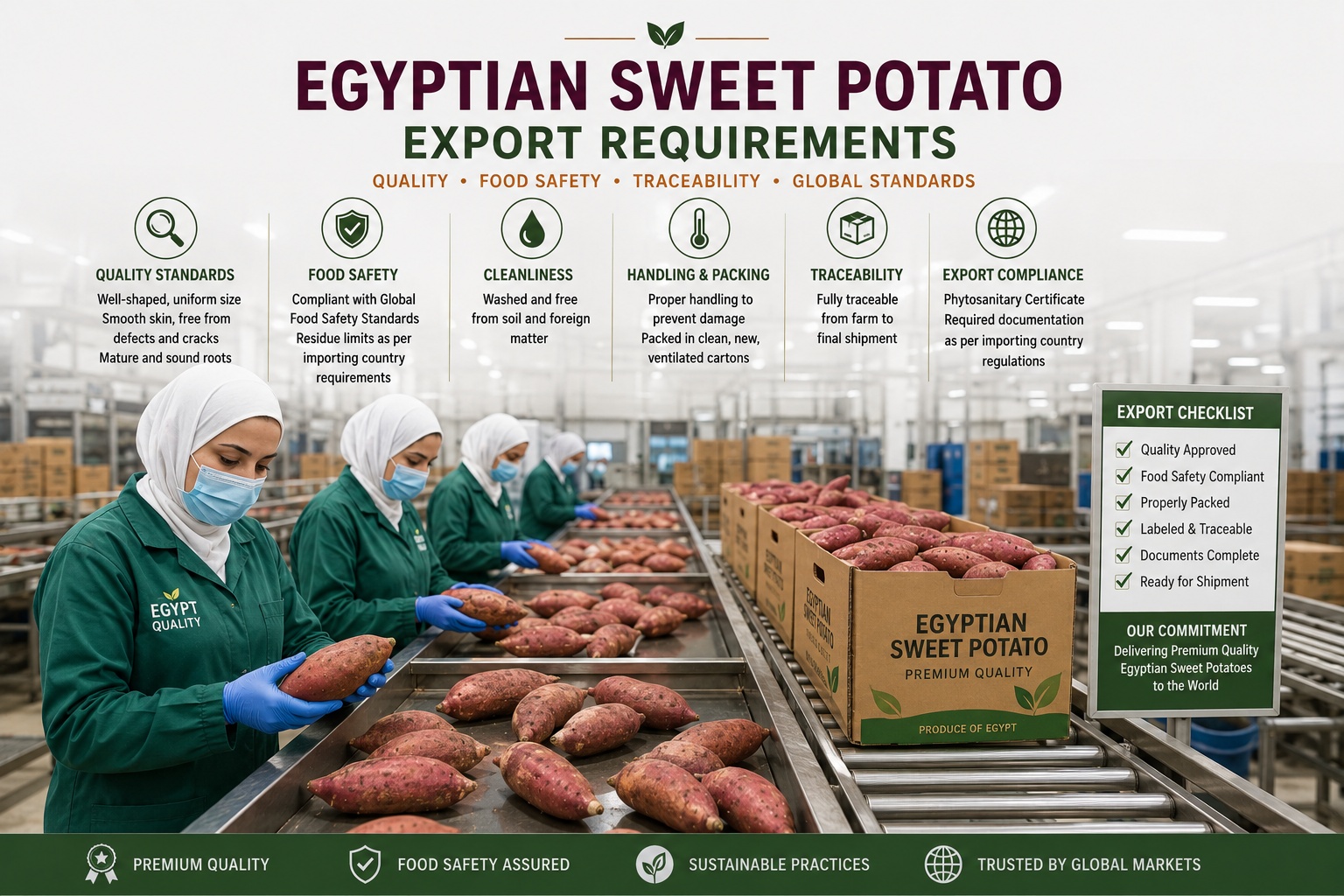
Sweet potato is a relatively clean export on the residue front, but it carries a specific plant-health burden: a regulated root pest and the soil cleanliness that comes with any underground crop. Add correct curing — which is both a quality and a shipment-integrity issue — and the compliance picture is clear. This guide sets out what an importer and exporter need in place to move Egyptian sweet potato cleanly.
Quick answer: Egyptian sweet potato needs a phytosanitary certificate (key quarantine pest: sweet potato weevil, Cylas formicarius, with soil/pest freedom), compliance with destination MRLs (EU: Regulation (EC) No 396/2005), and GLOBALG.A.P. certification with ISPM 15 wood packaging and traceability, plus standard commercial documents. Proper curing underpins quality and shelf life. Sweet potato trades under HS code 0714.20 and generally faces fewer residue issues than many crops.
Fresh sweet potato travels with an official phytosanitary certificate from Egypt’s plant-quarantine authority (CAPQ), confirming inspection and freedom from quarantine pests. The headline concern is the sweet potato weevil (Cylas formicarius), a serious regulated pest of the root, managed through monitored field programs, clean planting material and inspection. As an underground crop, soil freedom and cleanliness of the roots also matter at the border.
Sweet potato must meet destination MRLs — for the EU, Regulation (EC) No 396/2005 — but as a root crop with a peelable skin it generally presents lower residue risk than leafy or thin-skinned produce. Exporters still follow approved programs, pre-harvest intervals and, where required, residue testing. Sweet potato is not currently among the Egyptian products on the EU’s enhanced import-controls list (Regulation (EU) 2019/1793); verify the latest annex and any destination-specific checks before shipping.
Curing after harvest — a brief warm, humid treatment — heals harvest wounds and skin, reduces decay and dramatically improves storage and shipping. While not a “document,” it is central to delivering sound roots over a long supply chain, and buyers should confirm their supplier cures correctly.
For EU and UK retail, GLOBALG.A.P. certification is the baseline, frequently with the GRASP add-on, alongside packhouse food-safety management (HACCP) and clear lot-coded traceability from field to pack. Wood pallets, bins and dunnage must be ISPM 15 compliant.
| Document | Required? |
|---|---|
| Phytosanitary certificate | Yes (weevil & soil freedom) |
| Residue test report (MRLs) | As required by buyer/market |
| GLOBALG.A.P. certificate | Baseline for retail |
| Certificate of Origin / EUR.1 | Yes |
| Invoice, packing list, B/L | Yes |
| ISPM 15 marked pallets/bins | If wood used |
A phytosanitary certificate (weevil and soil freedom), MRL compliance, GLOBALG.A.P. for retail, ISPM 15 packaging and standard commercial documents.
The sweet potato weevil (Cylas formicarius), controlled through clean planting material, field programs and inspection.
Generally less than leafy or thin-skinned crops, as it is a root with peelable skin – but MRL compliance still applies.
Curing heals the skin and reduces decay, protecting shipment integrity over a long supply chain.
Sweet potato is HS 0714.20.
How to cite this page
PEI Trade. “Egyptian Sweet Potato Export Requirements.” peitrade.com, 2026. https://peitrade.com/egyptian-sweet-potato-export-requirements/
This page is part of our Egyptian Sweet Potato Export Guide hub.
Export Egyptian sweet potato the compliant way with PEI Trade. Phytosanitary documentation and weevil/soil control, MRL-compliant production, GLOBALG.A.P. handling, correct curing and complete export paperwork. Contact: [email protected] · WhatsApp +20 109 911 1918 · www.peitrade.com