Address
Work Hours
Monday to Friday: 7AM - 7PM
Weekend: 10AM - 5PM
Address
Work Hours
Monday to Friday: 7AM - 7PM
Weekend: 10AM - 5PM


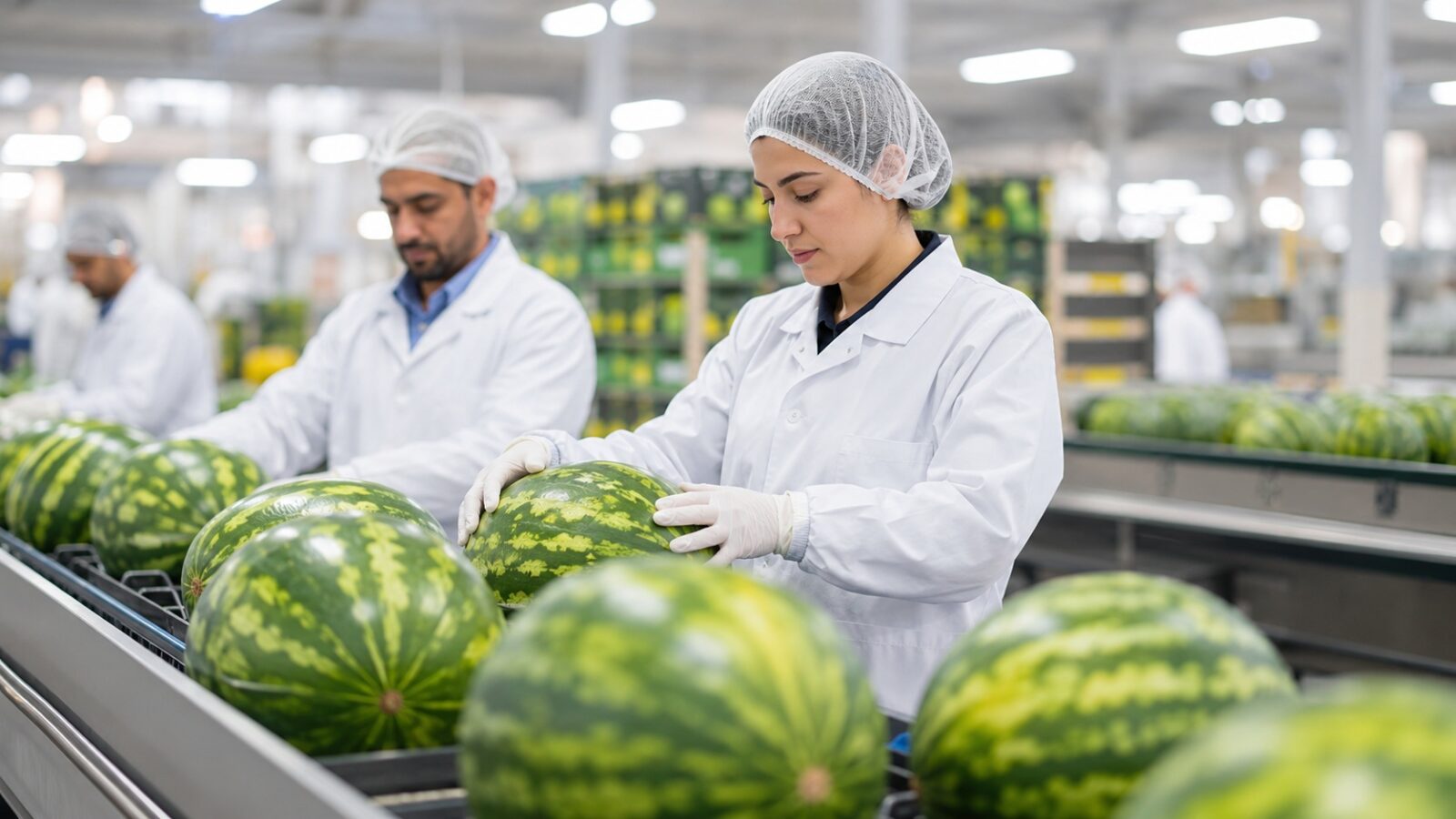
Watermelon is one of the more straightforward fresh exports on compliance — it carries fewer residue red-flags than crops like peppers or beans — but the fundamentals still apply: a phytosanitary certificate, MRL compliance, certification and clean documentation. This guide sets out what an importer and exporter need in place to move Egyptian watermelon cleanly.
Quick answer: Egyptian watermelon needs a phytosanitary certificate, compliance with destination MRLs (EU: Regulation (EC) No 396/2005), GLOBALG.A.P. certification for retail, and ISPM 15 wood packaging with traceability, plus standard commercial documents. Quality is judged on sweetness (Brix), size and rind integrity at inspection. Watermelon trades under HS code 0807.11. It generally faces fewer residue issues than peppers or beans, but full compliance still applies.
Fresh watermelon travels with an official phytosanitary certificate from Egypt’s plant-quarantine authority (CAPQ), confirming inspection and freedom from quarantine pests. Watermelon is not a typical host for the false codling moth that affects some other crops, but routine plant-health checks (including for fruit-fly and melon pests) and clean field practice still apply.
Watermelon must meet destination MRLs — for the EU, Regulation (EC) No 396/2005. Compared with high-scrutiny crops, watermelon generally presents lower residue risk, partly because the thick rind is not eaten. Even so, exporters follow approved spray programs, pre-harvest intervals and, where required, residue testing to guarantee compliance. Watermelon is not currently among the Egyptian products on the EU’s enhanced import-controls list (Regulation (EU) 2019/1793), but verify the latest annex and any destination-specific checks before shipping.
For EU and UK retail, GLOBALG.A.P. certification is the baseline, frequently with the GRASP add-on, alongside packhouse food-safety management (HACCP) and clear lot-coded traceability from field to pack. Wood pallets, bins and dunnage must be ISPM 15 compliant. Cut or processed melon would add full food-safety requirements.
Beyond paperwork, buyers and inspectors check Brix (sweetness, commonly a minimum around 10–12°), uniform size/weight, intact rind, good flesh colour, and absence of defects such as hollow heart or overripeness. Meeting an agreed Brix minimum is often the make-or-break quality point for watermelon.
| Document | Required? |
|---|---|
| Phytosanitary certificate | Yes |
| Residue test report (MRLs) | As required by buyer/market |
| GLOBALG.A.P. certificate | Baseline for retail |
| Certificate of Origin / EUR.1 | Yes |
| Invoice, packing list, B/L | Yes |
| ISPM 15 marked pallets/bins | If wood used |
A phytosanitary certificate, MRL compliance, GLOBALG.A.P. for retail, ISPM 15 packaging and standard commercial documents.
Generally less than crops like peppers or beans, partly because the rind is not eaten – but full MRL compliance still applies.
Brix (sweetness), size/weight uniformity, rind integrity, flesh colour and absence of defects like hollow heart.
Commonly a minimum around 10-12 degrees Brix, with the exact figure agreed in the specification.
Fresh watermelon is HS 0807.11.
How to cite this page
PEI Trade. “Egyptian Watermelon Export Requirements.” peitrade.com, 2026. https://peitrade.com/egyptian-watermelon-export-requirements/
This page is part of our Egyptian Watermelon Export Guide hub.
Export Egyptian watermelon the compliant way with PEI Trade. Phytosanitary documentation, MRL-compliant production, GLOBALG.A.P. handling, Brix-checked quality and complete export paperwork. Contact: [email protected] · WhatsApp +20 109 911 1918 · www.peitrade.com