Address
Work Hours
Monday to Friday: 7AM - 7PM
Weekend: 10AM - 5PM
Address
Work Hours
Monday to Friday: 7AM - 7PM
Weekend: 10AM - 5PM



Key definition: A Certificate of Origin (CO) is an official document that certifies the country where goods were produced. Customs authorities use it to apply the correct import duties and, under trade agreements, to grant preferential (reduced or zero) tariffs. It is usually issued or certified by a Chamber of Commerce in the exporting country.
A certificate of origin answers one question customs always asks: where do these goods come from? For fresh-produce exporters it determines the duty a buyer pays and whether a trade agreement applies. This page explains what a certificate of origin is, the difference between preferential and non-preferential types, and who issues it.
A certificate of origin states the country in which a consignment of goods was grown, produced, or manufactured. It travels with the shipping documents and is used at the destination to calculate duties and apply any trade-agreement benefits. It is separate from a phytosanitary certificate, which confirms plant health rather than origin.
There are two broad types of certificate of origin:
| Type | What it does | Example |
|---|---|---|
| Non-preferential | Certifies the country of origin; no tariff preference | Standard Certificate of Origin |
| Preferential | Grants reduced or zero import duty under a trade agreement | EUR.1 (Egypt–EU), Form A / GSP |
Preferential certificates can substantially lower the duty a buyer pays, which makes them valuable in price-competitive markets.
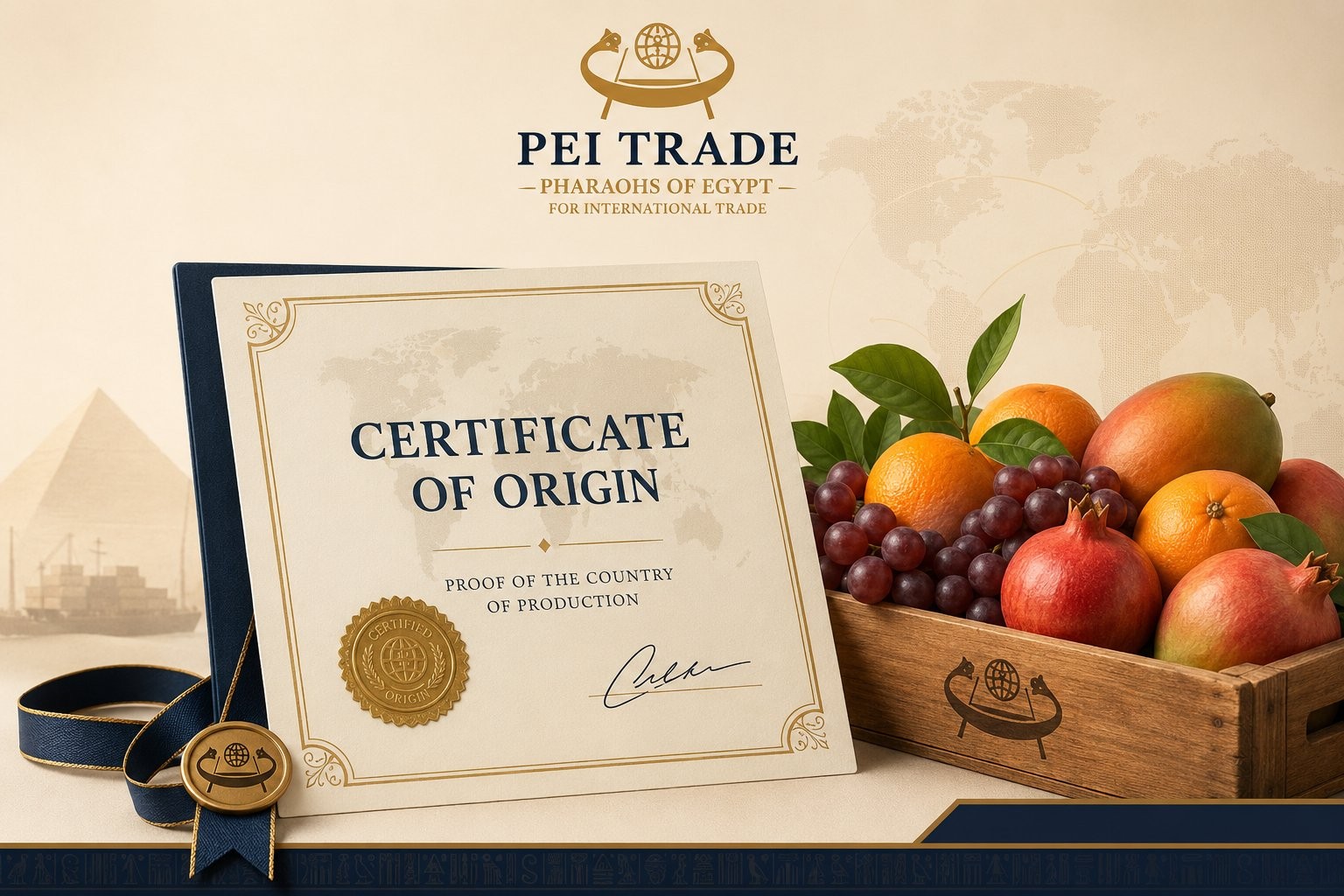
A certificate of origin is normally issued or stamped by an authorised body in the exporting country — most often a Chamber of Commerce. Preferential certificates issued under a specific trade agreement, such as EUR.1, follow that agreement’s procedure and are validated by the relevant authority.
Egyptian produce exports travel with a certificate of origin, and shipments to the EU can use the EUR.1 movement certificate for preferential tariff treatment under the Egypt–EU Association Agreement. Other agreements — GAFTA for Arab markets and COMESA for parts of Africa — offer their own preferences. For PEI Trade’s Egyptian produce, see our Egyptian Mango Export Guide and Egyptian Citrus Export Guide, or browse all export certifications.
PEI Trade. “Certificate of Origin Explained.” PEI Trade Export Knowledge Base. https://peitrade.com/knowledge-base/certifications/certificate-of-origin/
A certificate of origin is an official document that certifies the country where goods were produced. Customs use it to apply the correct import duties and to grant trade-agreement preferences.
A non-preferential certificate simply certifies the country of origin. A preferential certificate, such as EUR.1, grants reduced or zero import duty under a trade agreement.
It is normally issued or stamped by an authorised body in the exporting country, most often a Chamber of Commerce. Preferential certificates follow the relevant trade agreement’s procedure.
Customs authorities use it to determine the import duties that apply and to grant preferential tariffs under trade agreements, so it can directly affect the price the buyer pays.
Shipments to the EU can use the EUR.1 movement certificate, which grants preferential tariff treatment under the Egypt-EU Association Agreement.