Address
Work Hours
Monday to Friday: 7AM - 7PM
Weekend: 10AM - 5PM

Address
Work Hours
Monday to Friday: 7AM - 7PM
Weekend: 10AM - 5PM



Key definition: packaging and palletization are how fresh produce is protected, unitised and prepared for the reefer container. Good packaging shields the fruit from damage and lets cold air circulate; correct palletization makes the load stable, fills the container efficiently and keeps the cold chain working. Retail buyers specify both — carton format, count, net weight, labeling and pallet configuration — as part of the purchase agreement.
Even the best fruit arrives in poor condition if it is badly packed or loaded. Packaging protects produce from physical damage, allows the cold air in a reefer to reach every carton, and carries the information customs and buyers need. Palletization turns loose cartons into stable, efficient unit loads that fill the container and keep the cold chain unbroken. This reference explains the common carton and pallet formats, how a reefer is loaded, and the labeling that should appear on every carton and pallet. For the wider process, see how to import Egyptian produce.
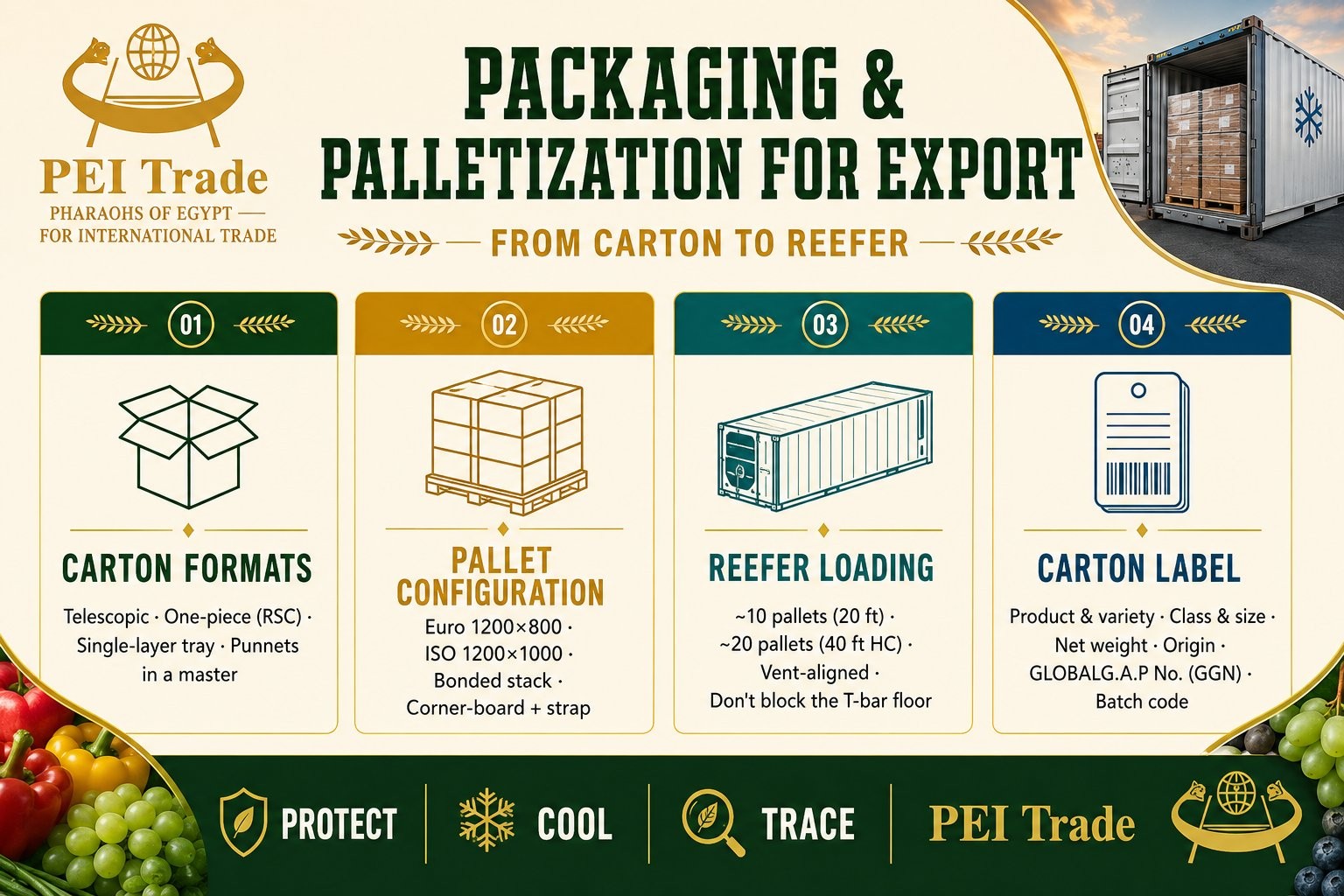
Packaging does three jobs at once. It protects the produce from crushing, vibration and moisture loss in transit; it enables cooling, because vented cartons let the reefer’s cold air pass through the stack and reach the fruit; and it carries information, from the variety and grade down to the traceability code. Because of this, buyers treat packaging as part of the specification: the carton format, the grade and size, the count per carton and the net weight are all agreed before the first order.
Most fresh produce ships in vented corrugated cartons, with the format chosen to suit the commodity and the buyer’s programme.
| Format | Typical use | Notes |
|---|---|---|
| Telescopic carton (lid + base) | Citrus, stone fruit, vegetables | Rigid and stackable, with ventilation holes |
| One-piece (RSC) carton | Many produce lines | Economical, with die-cut vents |
| Single-layer tray | Mango, premium and delicate fruit | Holds fruit in one layer to prevent bruising |
| Punnets / clamshells in a master | Grapes, berries, cherry tomatoes | Consumer packs grouped in a vented master carton |
| Returnable plastic crate (RPC) | Retailer programmes | Reusable, standard footprint, strong airflow |
Cartons are stacked onto pallets in a bonded pattern so the load is stable and can be handled, scanned and loaded as one unit. The pallet footprint depends on the destination market.
| Pallet | Footprint (mm) | Common in |
|---|---|---|
| Euro pallet (EPAL) | 1200 × 800 | EU retail supply chains |
| Standard / ISO pallet | 1200 × 1000 | International and general trade |
| Half / display pallet | 800 × 600 | In-store retail display |
The number of cartons per pallet is set by the carton footprint and the maximum load height, which in a reefer is limited by the airflow clearance under the ceiling. Cartons are aligned so their vents line up into continuous air channels, and the stack is often corner-boarded and strapped or stretch-wrapped (with vented film) for stability.
A reefer cools by pushing chilled air up through the T-bar floor and drawing it back along the ceiling, so the load must let that air circulate. As a rough planning guide:
| Reefer | Internal length (approx.) | Euro pallets, single tier (approx.) |
|---|---|---|
| 20-foot reefer | ~5.4 m | ~10 |
| 40-foot High-Cube reefer | ~11.6 m | ~20 |
The exact count depends on the pallet type and the carrier’s weight limit. When loading: keep cartons vent-aligned, never block the floor channels, stack only up to the red load line so air can return along the ceiling, and leave the front and rear airflow clearances. Produce that is pre-cooled and loaded at its target temperature lets the unit simply hold the temperature, rather than trying to pull heat out in transit — the reefer maintains the cold chain, it does not create it.
Every carton should carry a clear label so it can be identified, sorted and traced. A typical export carton label shows:
Each pallet usually carries a GS1 pallet label (often with an SSCC) summarising the product, carton count, weights and the same traceability references, so a whole pallet can be scanned and tracked. Wood pallets and crates must show the ISPM-15 mark confirming heat treatment or fumigation — customs can reject wood packaging that is unmarked.
Different crops need different packs. Some common Egyptian export examples:
PEI Trade packs to each buyer’s specification — carton format, count, net weight, labeling and GGN — and palletizes for the reefer so the load is stable and the cold chain stays intact from packhouse to destination. To agree a packing specification for your market, contact the export desk at [email protected] or +20 109 911 1918, or browse the full Export Knowledge Base and the export glossary.
PEI Trade. “Packaging and Palletization for Fresh Produce Export.” PEI Trade Export Knowledge Base. https://peitrade.com/knowledge-base/packaging-palletization-fresh-produce/
In vented cartons (telescopic, one-piece or single-layer trays) or in consumer punnets grouped in a vented master carton, sized so cold air can reach every unit, then stacked on pallets for the reefer container.
Roughly 10 Euro pallets in a 20-foot reefer and about 20 in a 40-foot High-Cube reefer, single tier. The exact number depends on the pallet type and the carrier’s weight limit.
ISPM-15 is the international standard requiring wood packaging such as pallets and crates to be heat-treated or fumigated and stamped, so they do not carry pests across borders. Customs can reject non-compliant wood packaging.
Product and variety, class and size or count, net weight, country of origin, the packhouse code and GLOBALG.A.P Number (GGN) where used, and a batch or traceability code.