Address
Work Hours
Monday to Friday: 7AM - 7PM
Weekend: 10AM - 5PM
Address
Work Hours
Monday to Friday: 7AM - 7PM
Weekend: 10AM - 5PM


Specifications for Egyptian globe artichoke: fresh head diameters and packing, IQF heart and quarter formats, the December to April window, and what importers should agree before the season opens.
Artichoke is one of the quieter lines in the Egyptian export mix, but it moves in serious volume to Southern Europe and the Gulf every winter, both as fresh heads and as frozen hearts. Buyers who plan it in August have the option of contracting; buyers who wait until January are usually buying whatever is left on the spot market at whatever the price happens to be that week.
The Egyptian crop is globe artichoke, grown mainly in Beheira, Kafr El Sheikh and the reclaimed land west of the Delta. Planting runs through late summer and early autumn. First cutting begins around late November, volume builds through December, and the season holds through to roughly April with the heaviest weeks in January and February. That window matters because it sits ahead of and alongside the Mediterranean crop, which gives importers a way to bridge supply before Italian and Spanish volume arrives.
Fresh export artichoke is graded by head diameter. The common export bands are 6 to 8 cm, 8 to 10 cm, 10 to 12 cm and above 12 cm, with the middle bands carrying most of the retail and food service demand. Class I (a grade tier from the applicable marketing standard, not a marketing term — see our Extra, Class I and Class II tolerances reference) heads should be compact, with tightly closed bracts, no bract separation at the tip, no browning at the cut, and a stem trimmed to the agreed length. Stem length is worth writing into the specification explicitly, because 2 cm and 10 cm are both perfectly normal depending on the destination market and they are not interchangeable at the shelf.
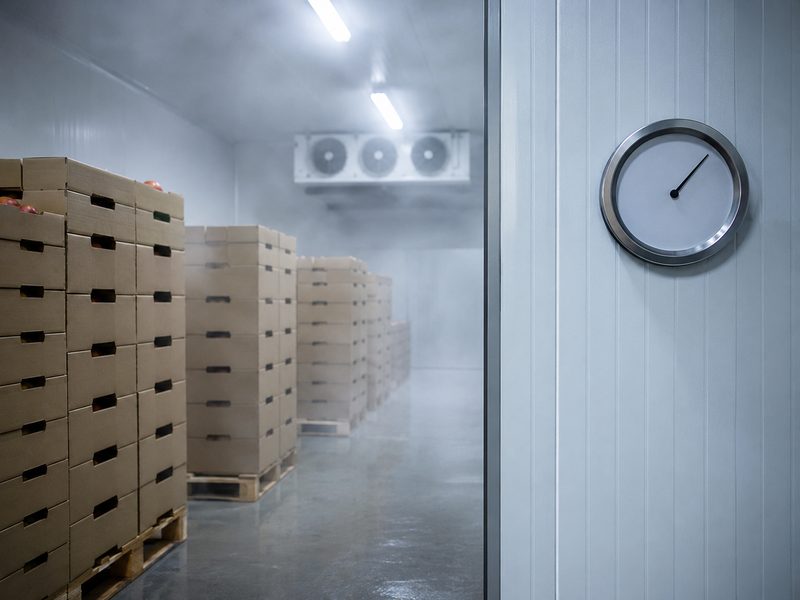
Fresh heads pack in ventilated corrugated cartons of 5 kg or 6 kg, single layer or two layer depending on head size, usually with a perforated liner. Field heat has to come out fast. Hydrocooling or forced-air cooling within a few hours of cutting is the difference between fruit that arrives tight and fruit that arrives open and dark at the cut end. Storage and transport run at 0 to 1 degree Celsius with 95 percent relative humidity.
The larger volume, and the easier one for most distributors, is frozen. Egyptian IQF artichoke ships as whole hearts, halves and quarters, blanched and individually quick frozen, packed in 1 kg or 2.5 kg polybags inside 10 kg master cartons, or in 10 kg bulk polybags for further processing. Heart diameter bands of 25 to 35 mm, 35 to 45 mm and 45 to 60 mm cover most requirements. Frozen product travels at minus 18 degrees Celsius and shares a container comfortably with other IQF lines, which is how many mid-volume buyers make the freight work. The same logic applies to the okra and molokhia programmes described in our IQF okra and molokhia guide for 2026/2027.
Agree the diameter band and its tolerance, the stem length, the carton and liner, the pallet configuration, the inspection point, and the delivery cadence across the season rather than a single lump. For frozen, add the blanching specification, the drained weight, and the microbiological limits your market requires. Certification expectations should be settled at the same time. Our reference on what GLOBALG.A.P, BRCGS and ISO 22000 each prove sets out which document answers which question.
PEI Trade supplies fresh and IQF artichoke to importers, wholesalers and food manufacturers, with third party pre-shipment inspection available on request. To discuss diameter bands, pack formats and shipping positions for the 2026/2027 season, message our export desk on WhatsApp at +20 10 9911 1918.
