Address
Work Hours
Monday to Friday: 7AM - 7PM
Weekend: 10AM - 5PM

Address
Work Hours
Monday to Friday: 7AM - 7PM
Weekend: 10AM - 5PM


Variety by variety guidance on Egyptian mandarins for 2026/2027: Baladi, Fremont and Murcott windows, count sizes, 10 kg and 15 kg carton formats, reefer settings and destination requirements.
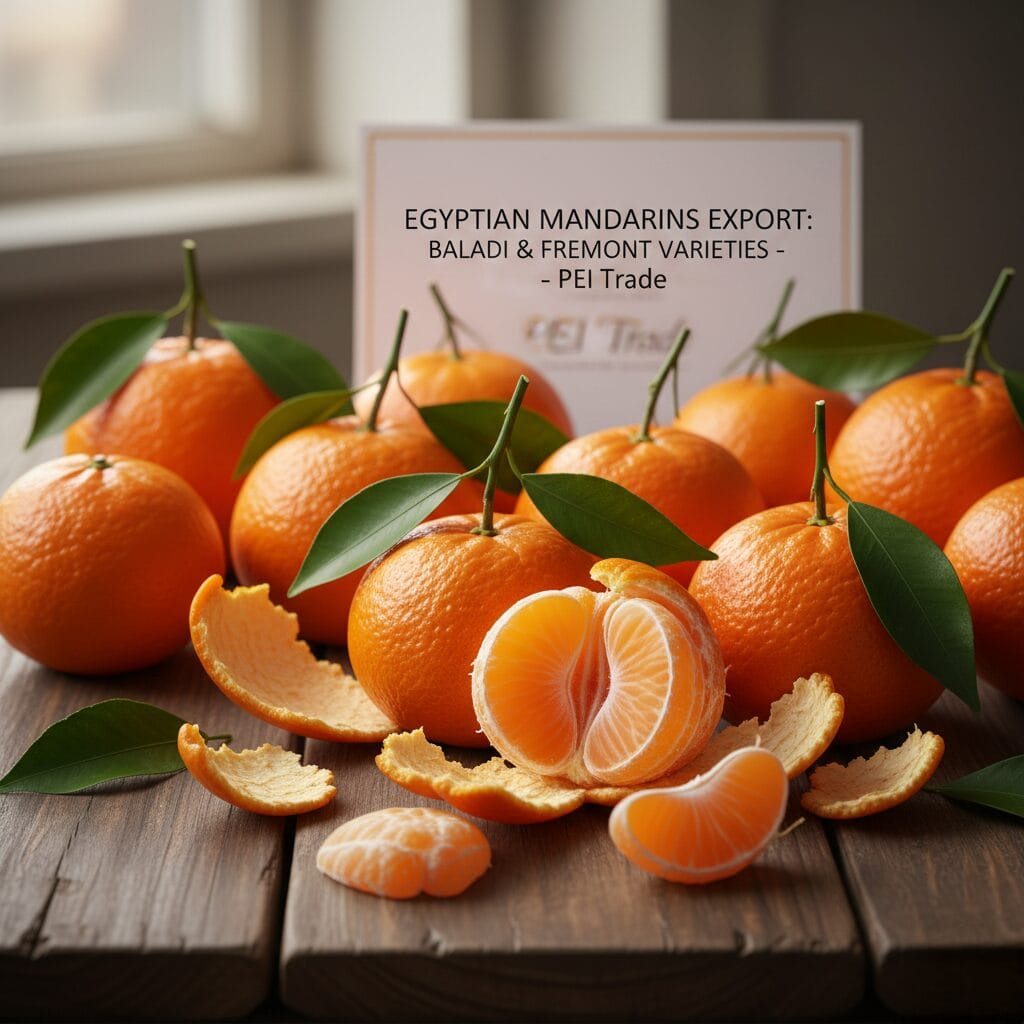
Mandarins are the part of the Egyptian citrus basket that buyers most often under-plan. Orange programmes get contracted early because Valencia and Navel volumes are large and predictable. Mandarin windows are shorter, variety specific and easier to miss. For the 2026/2027 season, three varieties account for almost all export volume, and each one behaves differently in transit and on the shelf.
Baladi is the traditional Egyptian mandarin and the earliest to arrive, typically from late October into December. It is aromatic, easy peeling and seeded, with thin skin that rewards careful handling. Regional markets in the Gulf, Iraq and East Africa take it in volume, and it performs well where flavour matters more than seedlessness.
Fremont follows from December into January. Deep orange, seedless to lightly seeded and considerably firmer than Baladi, it is the variety European retail buyers usually ask for when they specify an Egyptian mandarin. Firmness makes it the safer choice on longer sea legs.
Murcott, sometimes sold as Egyptian honey mandarin, runs from mid January through March and closes the season. Sugar levels are the highest of the three, skin adherence is tighter, and shelf life is the longest. Programmes into Russia, Eastern Europe and Central Asia are usually built around Murcott for exactly that reason.
Egyptian mandarins are sold by count per carton rather than by diameter alone. A 10 kg carton commonly runs 60, 72, 88, 100 or 125 fruit, corresponding to diameters from roughly 75 mm down to 50 mm. Gulf wholesale generally favours counts of 72 to 88. European retail leans smaller and more uniform, at 100 to 125, and applies tighter tolerance on colour break and blemish. Confirm the count before confirming the price, because a two step change in count moves the cost per carton more than most buyers expect.
The standard export unit is a 10 kg telescopic carton with corner vents, fruit cushioned in tissue or on moulded trays for the retail specification. A 15 kg open carton is available for wholesale and for markets that repack on arrival. Typical palletisation is 8 cartons per layer over 10 layers on a 120 x 100 cm pallet, giving 80 cartons and 800 kg. A 40 ft high cube reefer carries 20 pallets, close to 16 tonnes net on the 10 kg format. Own-brand carton printing is available with a lead time of about three weeks.
Mandarins are more chilling sensitive than oranges. Set point should be 4 to 5 degrees Celsius rather than the 3 degrees often used for Navel, with 90 to 95 percent relative humidity and 15 to 25 cubic metres per hour of fresh air exchange to clear ethylene and carbon dioxide. Degreening, where the destination requires it, is done with controlled ethylene at 20 to 25 parts per million before packing rather than in transit. Transit from Alexandria or Damietta runs six to eight days to the Western Mediterranean, ten to twelve to Northern Europe and Baltic ports, and five to seven to Jeddah and Jebel Ali.
Every shipment carries a phytosanitary certificate, certificate of origin, packing list and residue analysis matched to the destination MRL list. Cold treatment protocols apply on certain routes and need to be agreed before booking, not after. GLOBALG.A.P at farm level and ISO 22000 or BRCGS at the packhouse are standard, with SGS or Intertek inspection arranged on request.
Buyers building a full citrus programme should read this alongside our notes on contracting Valencia and Navel volume for 2026/2027 and on Egyptian lemon and lime specifications, since the three families share vessels and packhouse capacity through the same months.
Mandarin allocation for 2026/2027 is being assigned now. For counts, current pricing on FOB or CFR terms under Incoterms 2020, or a full specification sheet, contact our export desk on WhatsApp at +20 10 9911 1918.
