Address
Work Hours
Monday to Friday: 7AM - 7PM
Weekend: 10AM - 5PM

Address
Work Hours
Monday to Friday: 7AM - 7PM
Weekend: 10AM - 5PM


Kuwait is a strong Gulf market for Egyptian fresh okra (HS 0709.99). Okra — bamia — is a household and restaurant staple, and Kuwait imports nearly all its fresh vegetables. Egypt supplies the tender baby and fine calibres Kuwaiti buyers prefer, via fast air and reefer links. This guide covers grades, cold-chain logistics, KFDA/GSO requirements, seasonality and pricing for Kuwaiti importers and wholesalers.
Kuwait is a strong Gulf market for Egyptian fresh okra (bamia, HS 0709.99), importing nearly all its vegetables. Buyers prize baby/fine okra. Grades: baby, fine, medium. Ships by air (1–2 days) or reefer sea to Shuwaikh/Shuaiba (4–7 days) at 7–10°C. Imports need a phytosanitary certificate, KFDA/GSO-compliant labelling, MRL compliance and Halal handling.
With very limited agriculture, Kuwait relies on imports for fresh produce, and okra is a year-round favourite in Kuwaiti and expatriate kitchens. Egypt supplies the small, tender grades the market wants at competitive prices, and its fast air and reefer links preserve freshness. Egyptian okra competes here mainly on quality and calendar, making it a dependable supplier for Kuwaiti wholesalers and the HORECA trade.
| Market snapshot | Detail |
|---|---|
| Market profile | Import-dependent Gulf market |
| HS code | 0709.99 (other fresh vegetables — okra) |
| Preferred grade | Baby / fine (small, tender) |
| Routes | Air (1–2 days); reefer sea (4–7 days) |
| Cold chain | 7–10°C, 90–95% RH |
| Peak window | Broad supply; summer main crop |
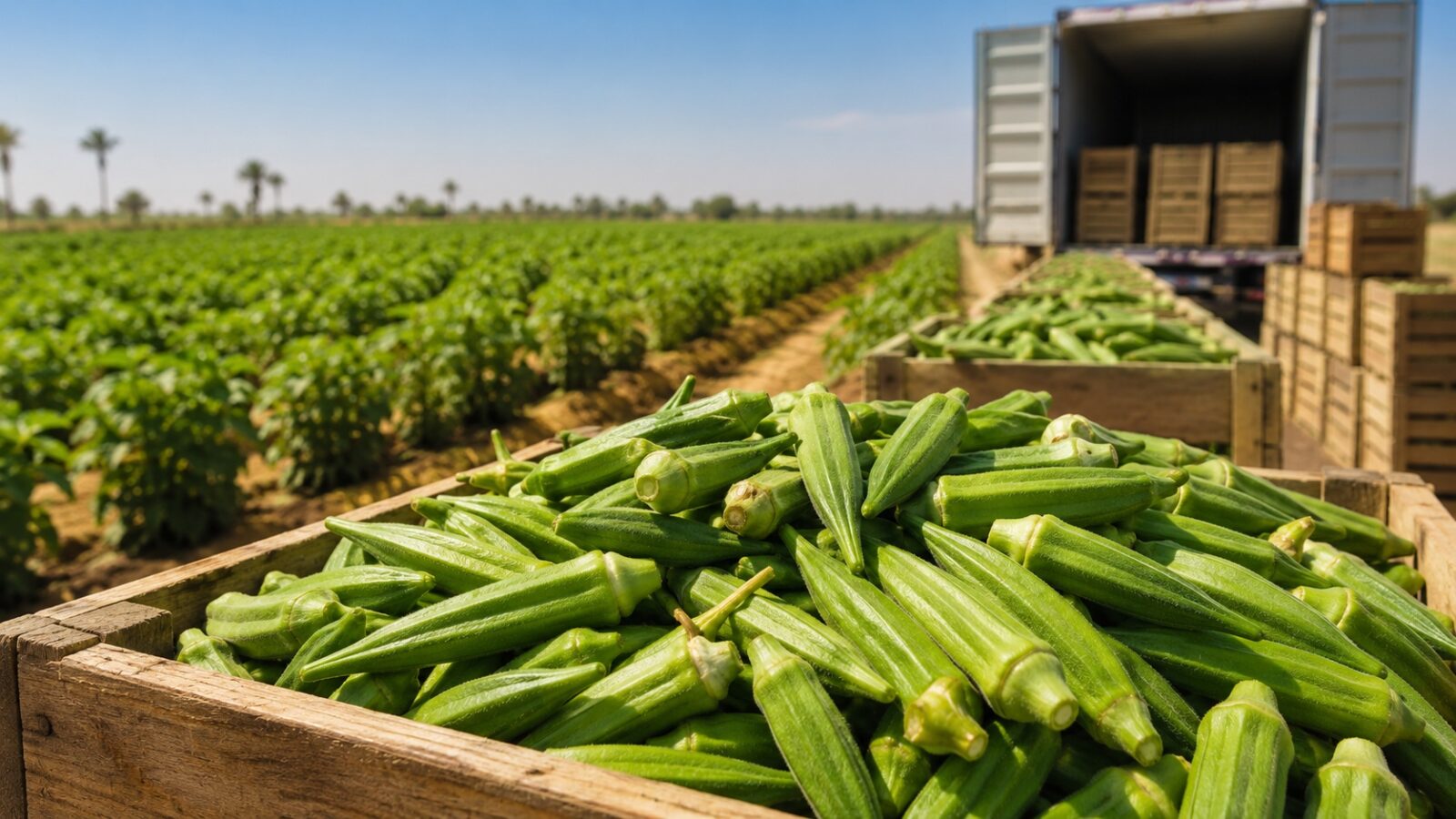
Baby okra: premium, very small pods (<4 cm), tender and uniform. Fine okra: small (4–6 cm), mainstream retail. Medium okra: larger pods for value and foodservice. Fruit is bright green, firm, blemish-free and non-woody. Packed in ventilated cartons (3–5 kg) or punnets, pre-cooled and kept cold to hold shelf life.
Fresh okra is perishable and chilling-sensitive, so premium baby grade moves by air from Cairo (1–2 days) and volume by reefer sea to Shuwaikh or Shuaiba (4–7 days). It is held at 7–10°C at 90–95% RH — not colder — to prevent chilling injury. Rapid pre-cooling and an unbroken cold chain keep pods green and tender to market.
Kuwaiti imports require a phytosanitary certificate from Egyptian plant quarantine, a certificate of origin, and compliance with KFDA/GSO food-safety and labelling standards (Arabic + English: product, origin, packer, net weight, lot). Pesticide residues must meet GSO MRLs — a key okra control — checked at port. Halal-compliant handling applies. Organised buyers require GLOBALG.A.P at farm level and lot traceability.
| Period | Availability |
|---|---|
| May–October | Peak — open-field summer main crop |
| November–April | Protected-cultivation & southern supply |
Egypt’s summer main crop plus protected and southern cultivation give Kuwaiti buyers fresh okra across much of the year.
Source & data: Egyptian fresh-okra wholesale ~US$1.08/kg (Dec 2025); Gulf states are the primary fresh-okra market. Source: Tridge fresh-okra market overview, 2025–26. HS code 0709.99 (other fresh vegetables, incl. okra). Country-level volumes vary seasonally and are confirmed at contracting.
PEI Trade — New Cairo, Egypt. Request a quote or okra spec sheet →