Address
Work Hours
Monday to Friday: 7AM - 7PM
Weekend: 10AM - 5PM

Address
Work Hours
Monday to Friday: 7AM - 7PM
Weekend: 10AM - 5PM


Saudi Arabia is Egypt’s leading Gulf market for oranges. In the 2024/25 season Egypt shipped about 246,421 tonnes of oranges to Saudi Arabia (worth roughly USD 114 million), placing it among Egypt’s very largest orange destinations alongside Russia and the Netherlands (FreshPlaza; OEC). The Gulf is also where the season begins: Egypt’s orange export programme typically opens with shipments to Saudi Arabia and its Gulf neighbours from mid-November, before turning to Russia, the EU and Asia. Even through Red Sea shipping disruption, the Saudi route was kept running by ferry — a measure of how strategic this market is. Supply moves on the short Red Sea route to Jeddah, with the season led by early Navel and carried into summer by Valencia. This guide covers the varieties and calibres that suit the Saudi market, shipping logistics, SFDA and GSO import requirements, the variety-by-window calendar, and how to open a supply program.
Saudi Arabia combines a large population, high per-capita fresh-fruit consumption and close proximity to Egypt, which together make it the anchor of the Gulf orange trade. Three things stand out. First, timing: the Egyptian export season conventionally opens with shipments to the Arabian Gulf, so Saudi Arabia is one of the first destinations served each year — an early-season market that sets the tone for the campaign. Second, proximity: the Red Sea crossing to Jeddah is short, and Gulf demand is efficiently supplied. Third, resilience of demand: even when Red Sea shipping was disrupted and freight costs rose sharply, exporters kept the Gulf supplied by ferry because the market remained too valuable to lose.
Like other premium destinations, the Gulf favours large, well-coloured fruit, so Saudi Arabia receives high-grade Navel early in the season and Valencia later. Success here rests on consistent large-caliber quality, an unbroken cold chain, correct SFDA and GSO compliance, and reliable Arabic labelling shipment after shipment.
Two varieties carry the Saudi programme: Navel early in the season for colour and size, and Valencia late for juice and shelf life. For the Gulf’s sweet-tooth demand, the low-acid Sukkari is a distinctive option in limited volumes.
| Variety | Profile | Best use | Saudi fit |
|---|---|---|---|
| Navel | Seedless, easy-peel, deep-orange colour, crisp and sweet; early season | Fresh retail / supermarket | ★★★ Large-caliber colour fruit for Gulf retail |
| Valencia | Juicy, rich colour, thin skin, some seeds; late-season, excellent shelf life | Fresh retail & juicing | ★★★ Late-season workhorse — carries the summer programme |
| Baladi (local) | Traditional, aromatic, deep colour; mid-season | Fresh & juicing | ★★ Solid mid-season option |
| Sukkari | Very sweet, low acidity; a Gulf-favoured sweet orange | Fresh (sweet-tooth demand) | ★★ Popular in the Gulf — available in limited export volumes |
For full variety detail and calibres see the complete Egyptian citrus export guide, and the dedicated profiles for Navel oranges and Valencia oranges.
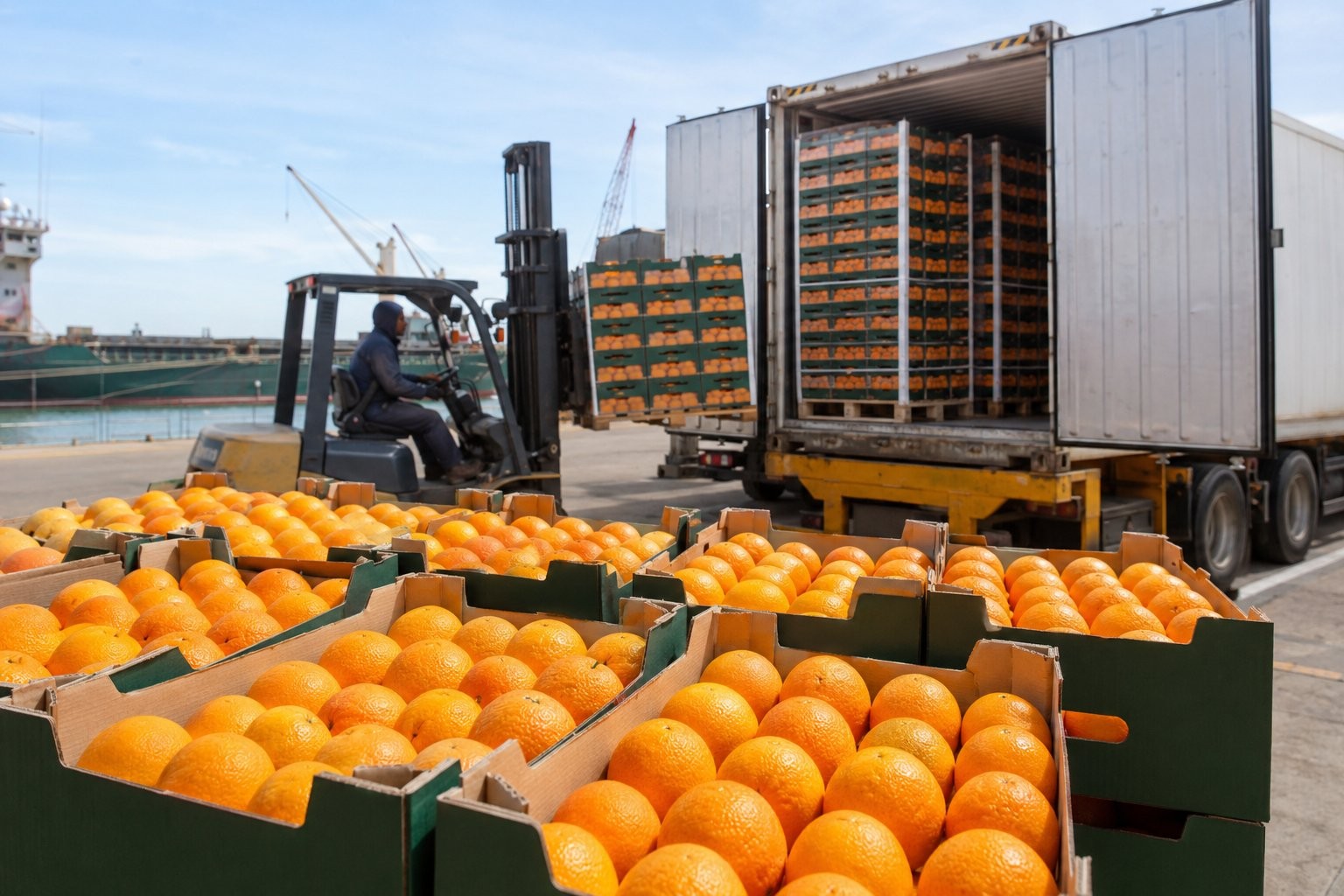
The Saudi route is the short Red Sea crossing. Fruit loads at Egyptian ports and moves by reefer sea freight and roll-on/roll-off (RoRo) ferry to Jeddah on the Red Sea coast, with onward distribution to Riyadh, Dammam and the Eastern Province. Transit is short, which suits fresh fruit; the Gulf lane was kept operating by ferry even during Red Sea disruption, though freight costs rose during that period.
Unlike mango, citrus is not treated with a hot-water dip. The main quarantine concern for Egyptian oranges is the Mediterranean fruit fly (Ceratitis capitata), and the accepted control is cold treatment (cold disinfestation) — holding fruit at low temperature for a defined period. Because oranges tolerate cold storage well, this integrates cleanly with the normal cold chain, and the consignment ships under a phytosanitary certificate certifying freedom from quarantine pests.
| Month | Available varieties (export) | Saudi notes |
|---|---|---|
| Nov–Dec | Navel (early, from mid-Nov) | Gulf ships first — season opens with early large-caliber fruit |
| Jan–Feb | Navel (peak) | Core Navel window for Gulf retail |
| Mar–Apr | Navel (late) → Valencia begins | Transition; peak shipment months |
| May | Valencia (peak) | Late-season juice & shelf-life fruit |
| Jun–Jul | Valencia (late) | Summer programme closes the season |
Windows shift year to year with weather and colour development. See the Egyptian citrus export report 2026 for volumes and destinations, and the citrus & mango price index for price context.
In the 2024/25 season Egypt shipped about 246,421 tonnes of oranges to Saudi Arabia, worth roughly USD 114 million — placing it among Egypt’s largest orange markets and its leading Gulf destination.
The Egyptian export season opens with the Gulf — Saudi Arabia is typically among the first markets served from mid-November — then moves to Russia, the EU and Asia, running through to late July with the help of cold storage.
Across the Red Sea by reefer sea freight and RoRo ferry to Jeddah, with onward road distribution to Riyadh, Dammam and the Eastern Province, carried at about 5–7 °C. The Gulf route was kept running by ferry even during Red Sea disruption.
SFDA registration and a Saber Certificate of Conformity, compliance with GSO standards (pesticide MRLs and GSO 9:2022 labelling), a phytosanitary certificate certifying freedom from quarantine pests, and Arabic labelling with country of origin.
No. Fresh fruit is inherently halal, so formal halal certification is not required for fresh oranges; halal certification applies to meat and processed food products.
Planning to supply Saudi Arabia? PEI Trade supplies large-caliber Egyptian Navel and Valencia oranges graded for Gulf retail, with cold-chain management on the Red Sea route to Jeddah and full SFDA, Saber and GSO documentation. Tell us your target volumes, calibres and delivery window, and we’ll structure a compliant, well-timed offer.
PEI Trade. “Egyptian Orange Exports to Saudi Arabia: Egypt’s #1 Gulf Citrus Market.” peitrade.com, 2026, https://peitrade.com/egyptian-orange-exports-to-saudi-arabia/
Sources: FreshPlaza (Egypt 246,421 t oranges to Saudi Arabia, 2024/25); OEC (Saudi Arabia ~USD 114M, 2024); USDA FAS Citrus Annual (Egyptian season opens with the Gulf; Saudi Arabia a top destination; Gulf route maintained by ferry through Red Sea disruption); SFDA / SASO (Saber Certificate of Conformity, food import registration); GSO (Gulf standards — MRLs GSO 2532, labelling GSO 9:2022). Figures cover HS 080510 (oranges), season 2024/25 — distinct from mango HS 080450.
[email protected] · WhatsApp +20 109 911 1918 · www.peitrade.com · Brand: nile-prime.com · Ports: Alexandria, Damietta, Sokhna, Port Said (Incoterms 2020)