Address
Work Hours
Monday to Friday: 7AM - 7PM
Weekend: 10AM - 5PM

Address
Work Hours
Monday to Friday: 7AM - 7PM
Weekend: 10AM - 5PM


Watermelon breaks the usual cold-chain rule: it must not be stored cold. It is a warm-season, chilling-sensitive fruit, so the job is to keep it cool-but-not-cold and to handle a heavy, easily-cracked melon gently. Get it right and Egyptian watermelon travels well by sea with good shelf life. This guide covers the watermelon cold chain from harvest to reefer, and packing.
Quick answer: Watermelon is chilling-sensitive and held warm — about 10–15°C at 85–90% RH — not near 0°C, because cold storage causes pitting, rind breakdown and loss of flavour. Shelf life is relatively good (around 2–3 weeks in proper conditions). Melons are shipped by reefer at ~10–13°C, packed in bulk bins or cartons (mini melons in cartons), and handled gently to avoid cracking and bruising. Watermelon trades under HS code 0807.11.
Unlike most produce, watermelon is damaged by cold. Stored below about 7–10°C, it develops surface pitting, rind breakdown, off-flavours and faster decay once removed. So the target is a moderate 10–15°C at 85–90% RH — cool enough to slow ageing, warm enough to avoid chilling injury. This is the single most important handling fact for watermelon.
Melons are harvested in warm conditions, so they are brought down from field heat to storage temperature — but only to the moderate target, not deep-chilled. Because the fruit is dense, it cools slowly; rushing it to cold temperatures does more harm than good. Done correctly, watermelon holds its eating quality for the journey.
| Parameter | Recommendation |
|---|---|
| Storage temperature | ~10–15°C (never near 0°C) |
| Humidity | ~85–90% RH |
| Shelf life | ~2–3 weeks in proper conditions |
| Shipping | Reefer at ~10–13°C |
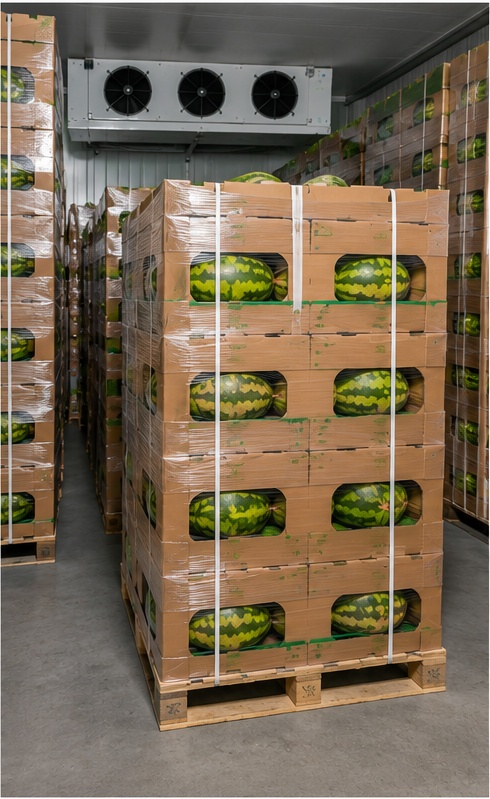
| Packaging | Bulk bins / cartons; mini in cartons |
Because melons are heavy and can crack or bruise, they are handled gently, cushioned, and stacked to avoid pressure damage. Each melon’s rind integrity is part of the grade.
Watermelon ships by reefer at ~10–13°C with airflow and logged temperature — carefully avoiding cold setpoints that cause chilling injury. The relatively good shelf life makes sea freight practical for the main markets. A temperature recorder in the container gives the buyer proof the chain stayed in the correct warm range.
Warm – around 10-15 degrees C at 85-90% humidity – not near 0 degrees C, because watermelon is chilling-sensitive and damaged by cold.
Around 2-3 weeks in proper (warm) storage conditions.
Cold causes pitting, rind breakdown, off-flavours and faster decay – classic chilling injury.
In bulk bins or cartons (mini melons in cartons), shipped by reefer at ~10-13 degrees C with logged temperature.
They are heavy and can crack or bruise; rind integrity is part of the grade and protects shelf life.
How to cite this page
PEI Trade. “Egyptian Watermelon Packaging & Cold Chain.” peitrade.com, 2026. https://peitrade.com/egyptian-watermelon-packaging-cold-chain/
This page is part of our Egyptian Watermelon Export Guide hub.
Ship Egyptian watermelon that arrives in spec with PEI Trade. Correct warm cold-chain handling, careful packing in bins and cartons, and logged reefer transit — for seedless, mini and seeded melons. Contact: [email protected] · WhatsApp +20 109 911 1918 · www.peitrade.com