Address
Work Hours
Monday to Friday: 7AM - 7PM
Weekend: 10AM - 5PM
Address
Work Hours
Monday to Friday: 7AM - 7PM
Weekend: 10AM - 5PM



Key definition: HACCP (Hazard Analysis and Critical Control Points) is a preventive food-safety management system that identifies biological, chemical, and physical hazards and controls them at defined critical control points. Built on seven principles set out by the Codex Alimentarius, it is widely required by importers and food authorities, and is the foundation for broader schemes such as ISO 22000.
HACCP certification shows that a packing or handling operation controls food-safety risks systematically rather than relying on end-product testing alone. For fresh-produce exporters it is a core assurance buyers look for. This page explains what HACCP covers, its seven principles, and how it applies to produce export.
HACCP is a preventive system: instead of catching problems after the fact, it maps where food-safety hazards can enter the process and puts controls at those points. It addresses three kinds of hazard — biological (bacteria, pathogens), chemical (pesticide residues, cleaning agents), and physical (foreign objects). The points in the process where a control is essential to keep a hazard in check are the critical control points (CCPs).
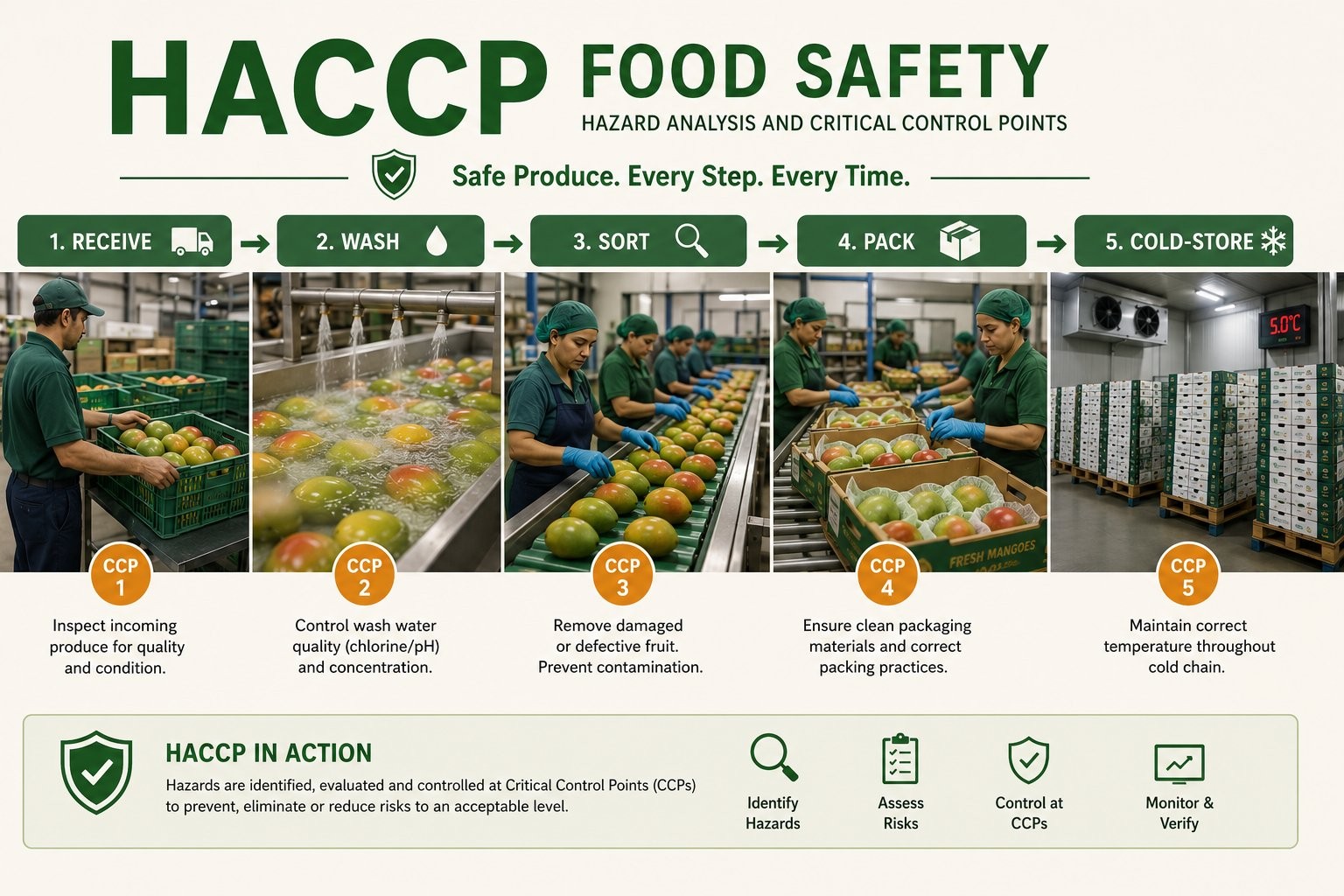
In fresh-produce export, HACCP is applied mainly in the packhouse and handling chain — receiving, washing, sorting, packing, and cold storage — where typical CCPs include wash-water quality, temperature control, and checks for physical contaminants. A documented HACCP system is often required by importers and food authorities, and it is the foundation that broader management systems such as ISO 22000 and the major GFSI schemes build on.
A HACCP-based food-safety system is standard practice in the packhouses of established Egyptian exporters, working alongside farm-level GLOBALG.A.P certification. For PEI Trade’s Egyptian produce, see our Egyptian Mango Export Guide and Egyptian Citrus Export Guide, or browse all export certifications.
PEI Trade. “HACCP Certification Explained.” PEI Trade Export Knowledge Base. https://peitrade.com/knowledge-base/certifications/haccp/
HACCP certification confirms that an operation runs a Hazard Analysis and Critical Control Points system, a preventive food-safety approach that identifies biological, chemical, and physical hazards and controls them at critical control points.
They are: conduct a hazard analysis; determine the critical control points; establish critical limits; establish monitoring; establish corrective actions; establish verification; and establish record-keeping and documentation.
A critical control point is a step in the process where control is essential to prevent, eliminate, or reduce a food-safety hazard to an acceptable level, such as wash-water quality or temperature control.
Many importers and food authorities require a documented HACCP-based system, and it is also the foundation for ISO 22000 and the major GFSI food-safety schemes.
HACCP is the method for analysing and controlling hazards, while ISO 22000 is a full food-safety management system for the whole organisation that is built around HACCP principles.