Address
Work Hours
Monday to Friday: 7AM - 7PM
Weekend: 10AM - 5PM
Address
Work Hours
Monday to Friday: 7AM - 7PM
Weekend: 10AM - 5PM



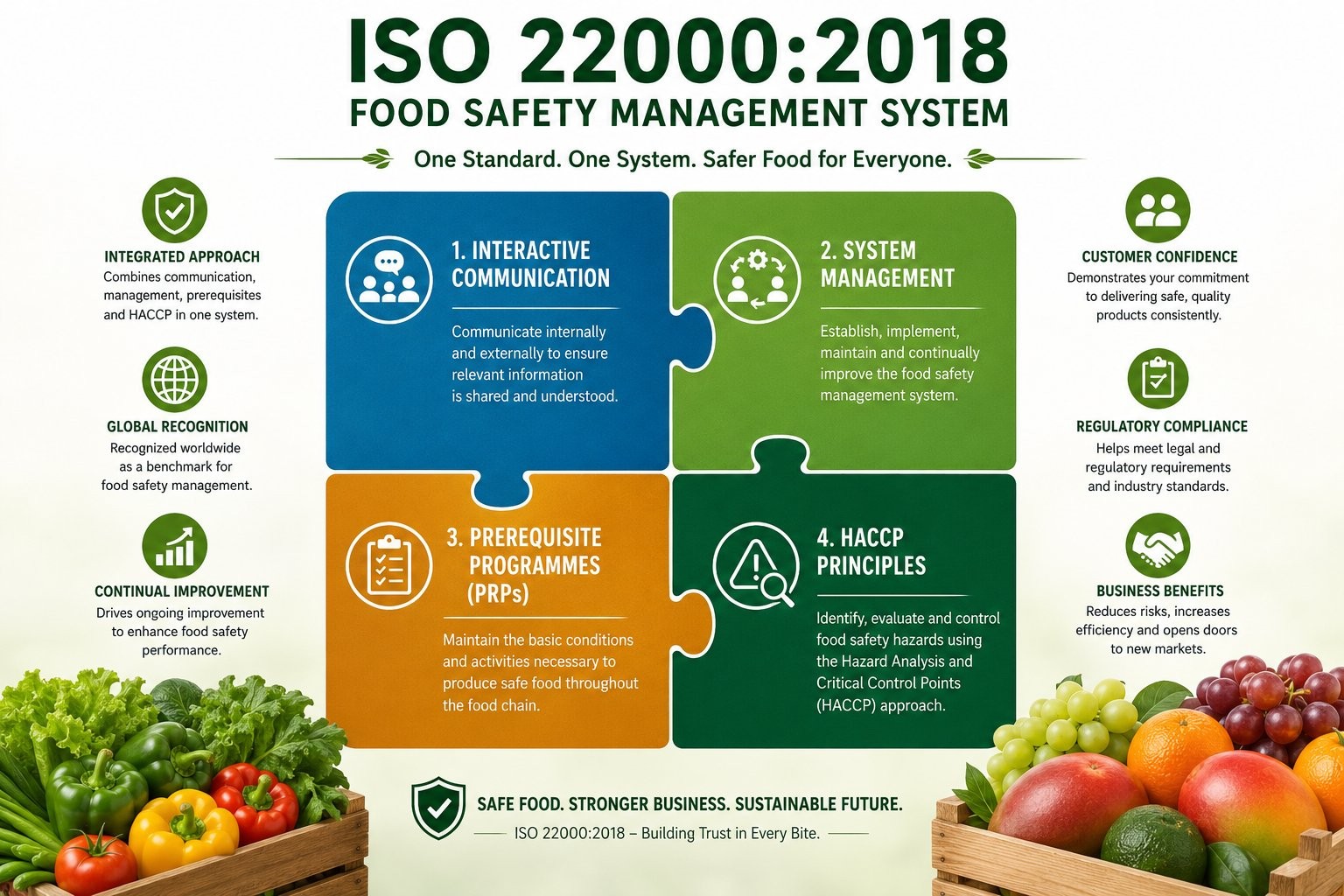
Key definition: ISO 22000 is the international standard for a Food Safety Management System (FSMS). It combines interactive communication, system management, prerequisite programmes, and HACCP principles into one framework that any organisation in the food chain can be certified against. The current version is ISO 22000:2018.
Where HACCP controls hazards in the process, ISO 22000 certification wraps those controls inside a complete, audited management system — with leadership, planning, and continual improvement built in. It signals to buyers that food safety is managed organisation-wide, not just on the packing line. This page explains what ISO 22000 covers and how it relates to HACCP and FSSC 22000.
ISO 22000 builds a food-safety management system from four connected elements:
It applies risk-based thinking at two levels: business risk to the management system, and food-safety hazard control through HACCP.
HACCP is the method for analysing and controlling food-safety hazards. ISO 22000 is the broader management system that contains HACCP and adds management structure, prerequisite programmes, communication, and continual improvement. In short: every ISO 22000 system uses HACCP, but HACCP on its own is not a full management system. See our HACCP guide.
FSSC 22000 is a certification scheme built on ISO 22000 plus sector-specific prerequisite programmes. It is recognised by the Global Food Safety Initiative (GFSI), which many large retailers require — so exporters targeting those buyers often pursue FSSC 22000 rather than ISO 22000 alone.
Egyptian exporters often run an ISO 22000 or FSSC 22000 system alongside farm-level GLOBALG.A.P and HACCP to satisfy demanding retail buyers. For PEI Trade’s Egyptian produce, see our Egyptian Mango Export Guide and Egyptian Citrus Export Guide, or browse all export certifications.
PEI Trade. “ISO 22000 Certification Explained.” PEI Trade Export Knowledge Base. https://peitrade.com/knowledge-base/certifications/iso-22000/
ISO 22000 certification confirms that an organisation runs a food-safety management system to the international ISO 22000 standard, combining interactive communication, system management, prerequisite programmes, and HACCP principles.
It covers four connected elements: interactive communication along the supply chain, a structured management system, prerequisite programmes for basic hygiene, and HACCP-based hazard control.
HACCP is the method for analysing and controlling hazards. ISO 22000 is a full management system that contains HACCP and adds management structure, prerequisite programmes, communication, and continual improvement.
FSSC 22000 is a certification scheme built on ISO 22000 plus sector-specific prerequisite programmes, and it is recognised by the Global Food Safety Initiative (GFSI), which many large retailers require.
ISO 22000 is not legally required, but it is often expected by buyers; some major retailers specifically require a GFSI-recognised scheme such as FSSC 22000.