Address
Work Hours
Monday to Friday: 7AM - 7PM
Weekend: 10AM - 5PM
Address
Work Hours
Monday to Friday: 7AM - 7PM
Weekend: 10AM - 5PM



Key definition: ISPM-15 is the international standard regulating wood packaging material (pallets, crates, and dunnage made of solid wood) in international trade. It requires the wood to be treated — by heat treatment or fumigation — and stamped with the official IPPC mark, so that timber pests are not spread between countries. It is issued under the International Plant Protection Convention (IPPC).
Most countries will not clear a shipment whose solid-wood pallets or crates do not carry a valid ISPM-15 mark. For produce exporters that means the packaging itself — not just the fruit — has to meet a phytosanitary standard. This page explains what ISPM-15 covers, how the wood is treated and marked, and how it applies to produce export.
ISPM-15 applies to solid-wood packaging used to ship goods — pallets, crates, boxes, and dunnage. Manufactured wood-based materials such as plywood and OSB are exempt, because their production already destroys pests. Compliant wood must be treated and marked before it can be used in export packaging.
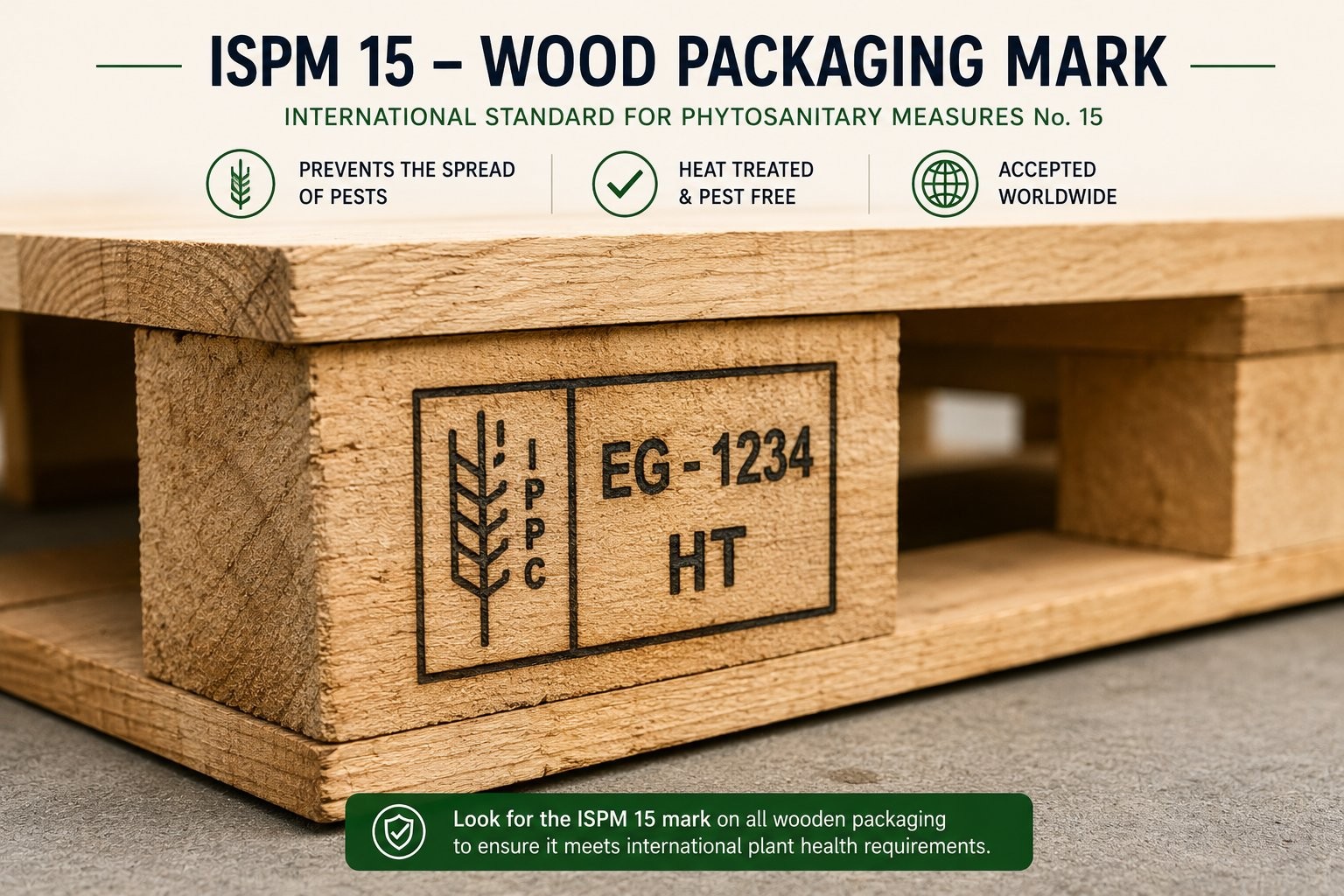
Wood is made compliant by one of the approved treatments, then stamped with the IPPC mark — a wheat-stalk symbol with the country code, the producer or treatment-provider code, and the treatment code.
| Treatment | Mark code | Method |
|---|---|---|
| Heat treatment | HT | Wood core heated to at least 56°C for 30 minutes (most widely used) |
| Methyl bromide | MB | Fumigation with methyl bromide |
The mark must be legible, permanent, and not hand-drawn. Heat treatment (HT) is the most common method worldwide.
For fresh-produce shipments, every wooden pallet and crate must carry a valid ISPM-15 mark, or the consignment can be held or rejected at the destination. Exporters either buy pre-treated, marked pallets or use exempt materials such as plastic pallets or processed-wood board.
Egyptian exporters ship most fresh produce on ISPM-15-compliant pallets, or on plastic pallets where the buyer prefers them. For PEI Trade’s Egyptian produce, see our Egyptian Mango Export Guide and Egyptian Citrus Export Guide, or browse all export certifications.
PEI Trade. “ISPM-15 Wood Packaging Explained.” PEI Trade Export Knowledge Base. https://peitrade.com/knowledge-base/certifications/ispm-15/
ISPM-15 is the international standard that requires solid-wood packaging used in trade, such as pallets and crates, to be treated against pests and marked with the IPPC stamp.
The mark shows the wood was treated to the standard. It carries the IPPC wheat-stalk symbol, the country code, the producer or treatment-provider code, and the treatment code (such as HT for heat treatment).
The two main approved treatments are heat treatment, where the wood core reaches at least 56 degrees Celsius for 30 minutes, or fumigation with methyl bromide.
No. Manufactured or processed wood such as plywood and OSB is exempt, because the manufacturing process already destroys pests.
Most countries require ISPM-15 for solid-wood packaging, and non-compliant pallets or crates can cause a shipment to be held or rejected at the border.