Address
Work Hours
Monday to Friday: 7AM - 7PM
Weekend: 10AM - 5PM

Address
Work Hours
Monday to Friday: 7AM - 7PM
Weekend: 10AM - 5PM


Last updated: 2 November 2026
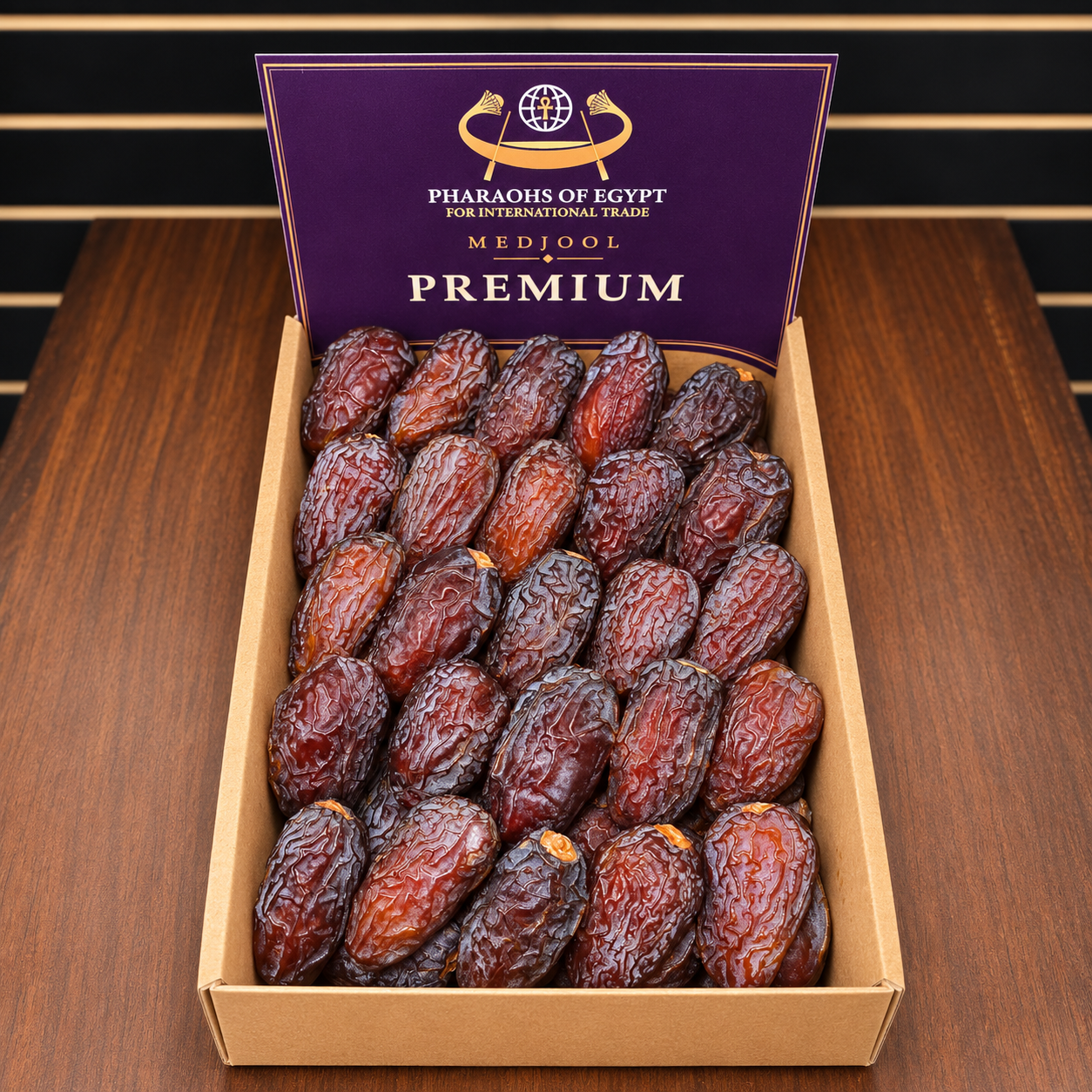
PEI Trade exports Egyptian Medjool dates by the container to registered importers. We offer three grades (Premium, Delight and Classic), defined by skin separation, in six sizes from Babysmall to SuperJumbo and a Mix of sizes, packed in 5 kg cartons or in 8 kg cartons of 250 g, 500 g or 1 kg packs. A 40 ft high-cube reefer holds about 20 to 20.5 tonnes in 5 kg cartons, and every price is quoted per order.
This guide puts the specifications importers ask us about in one place: fruit weight by size, what each grade means, container loads, shipping documents, payment terms and what we need to send a quote. The tables carry the numbers; the text explains how to use them.
Medjool is written many ways, and this page covers all of them: Medjoul, Majdool, Majdoul, Medjul and Mejhoul; مجدول in Arabic; королевские финики (“royal dates”) in Russian; Medjul hurma in Turkish; মেডজুল খেজুর in Bengali; मेडजूल खजूर in Hindi; and kurma Medjool in Malay and Indonesian.
In this guide
Size and grade are two separate choices. Size is the weight of a single fruit; grade is how far the fruit’s skin has lifted away from the flesh. Every quote names both, for example “Premium, Jumbo, 5 kg carton”.
| Size | Fruit weight (g) | Fruits per kg (approx.) | Premium | Delight | Classic |
|---|---|---|---|---|---|
| Babysmall | 8–13 | 77–125 | Yes | Yes | Yes |
| Small | 14–16 | 63–71 | Yes | Yes | Yes |
| Medium | 17–18 | 56–59 | Yes | Yes | Yes |
| Large | 19–21 | 48–53 | Yes | Yes | Yes |
| Jumbo | 22–23 | 43–45 | Yes | Yes | Yes |
| SuperJumbo | 24–27 | 37–42 | Yes | Yes | Yes |
| Mix | Mixed sizes, Small to SuperJumbo | – | Yes | Yes | Yes |
Fruit weight is given in grams per fruit because that is the only fair way to compare sizes between packers: size names are not standardised across origins. Our Medjool specification is 18–27% moisture (18–22% for Premium on request). Sugar has no fixed figure: it rises as moisture falls, and it is measured on samples. Grades are explained in detail below, and the pack options and container loads are in the packing table.
Egypt is the world’s largest date producer. FAO data, reported by Databoks, put its 2023 crop at 1.87 million tonnes, ahead of Saudi Arabia at 1.64 million and Algeria at 1.32 million (FAO data via Databoks). For the 2026/27 season, an Egyptian industry estimate reported by FreshPlaza puts the national crop at 2.1 million tonnes across all varieties (FreshPlaza, 1 Sep 2026).
Medjool is a smaller, fast-growing part of that crop. In July 2026, the commercial manager of an Egyptian Medjool grower told FreshPlaza that the country’s Medjool harvest is projected to reach at least 60,000 tonnes, and that demand remains active in his company’s main export markets in Europe, East Asia and the CIS (FreshPlaza, 13 Jul 2026).
What this means for an importer:
For the other Egyptian varieties and the wider dates trade, see our Egyptian dates export guide.
We sort Egyptian Medjool into six sizes: Babysmall, Small, Medium, Large, Jumbo and SuperJumbo. We also pack a Mix of sizes, from Small to SuperJumbo, in every grade. Each size is a band of fruit weight in grams, shown in the first table: Babysmall 8–13 g, Small 14–16 g, Medium 17–18 g, Large 19–21 g, Jumbo 22–23 g and SuperJumbo 24–27 g. Weights are rounded to the nearest gram: a fruit of up to 18.5 g counts as Medium, and up to 23.5 g as Jumbo.
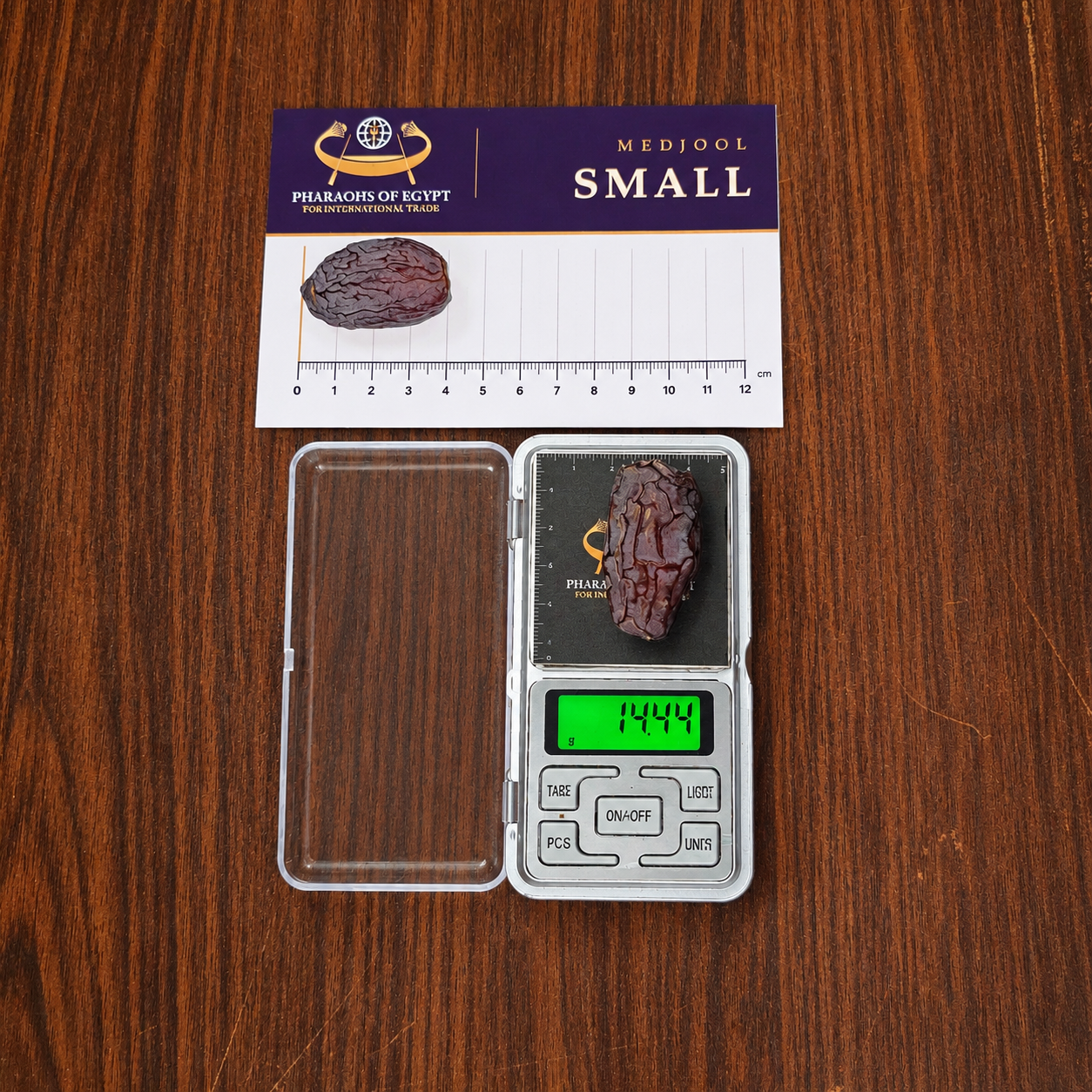
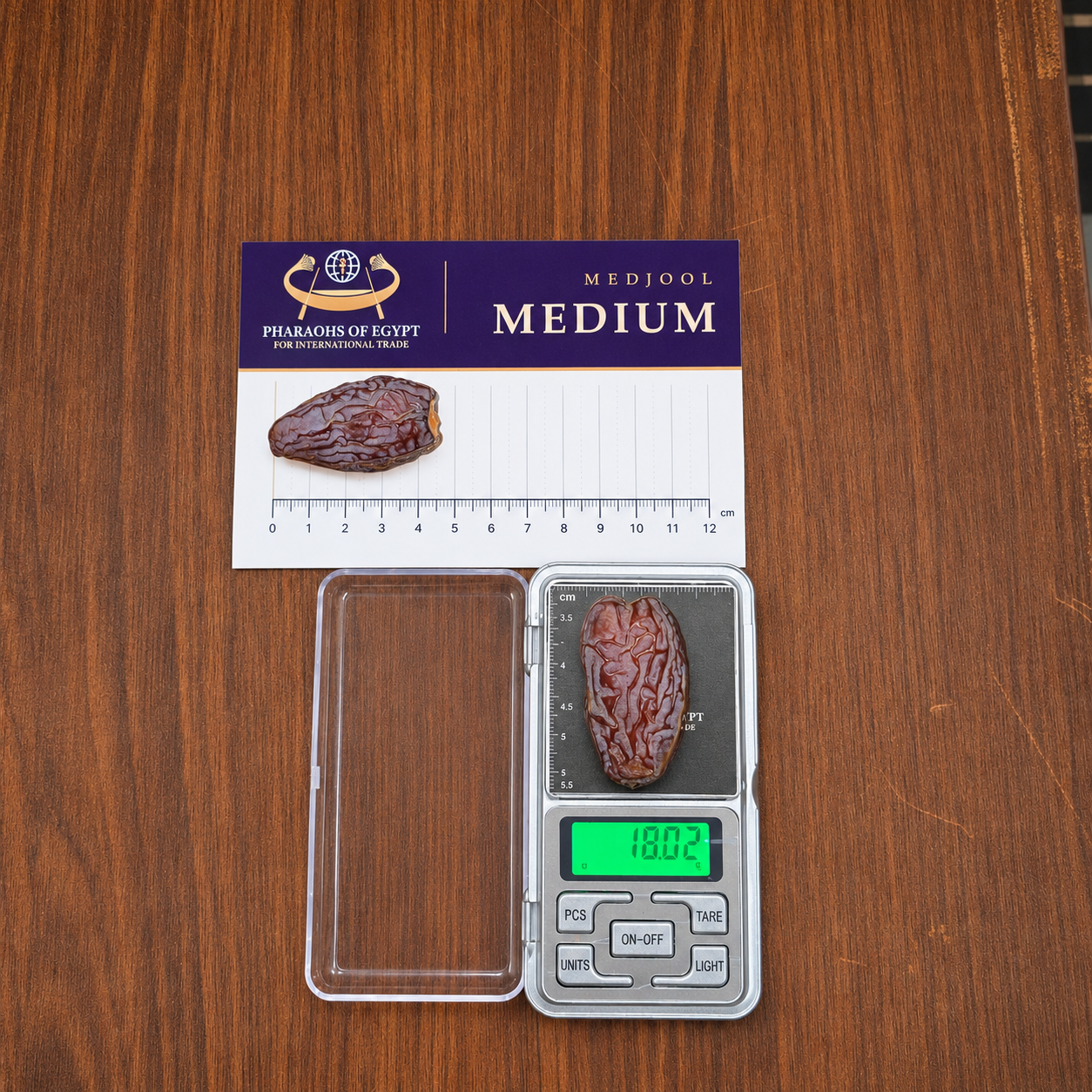
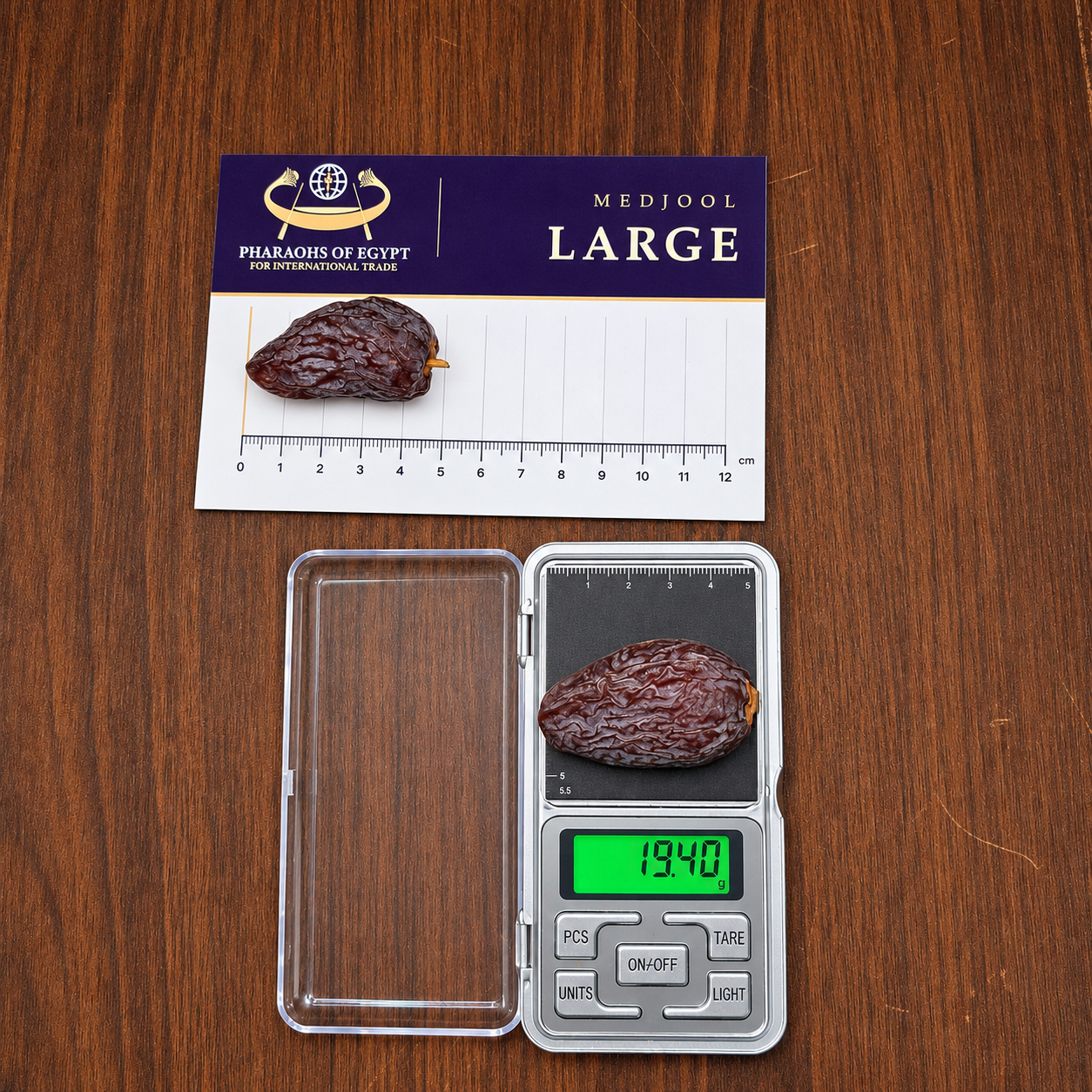
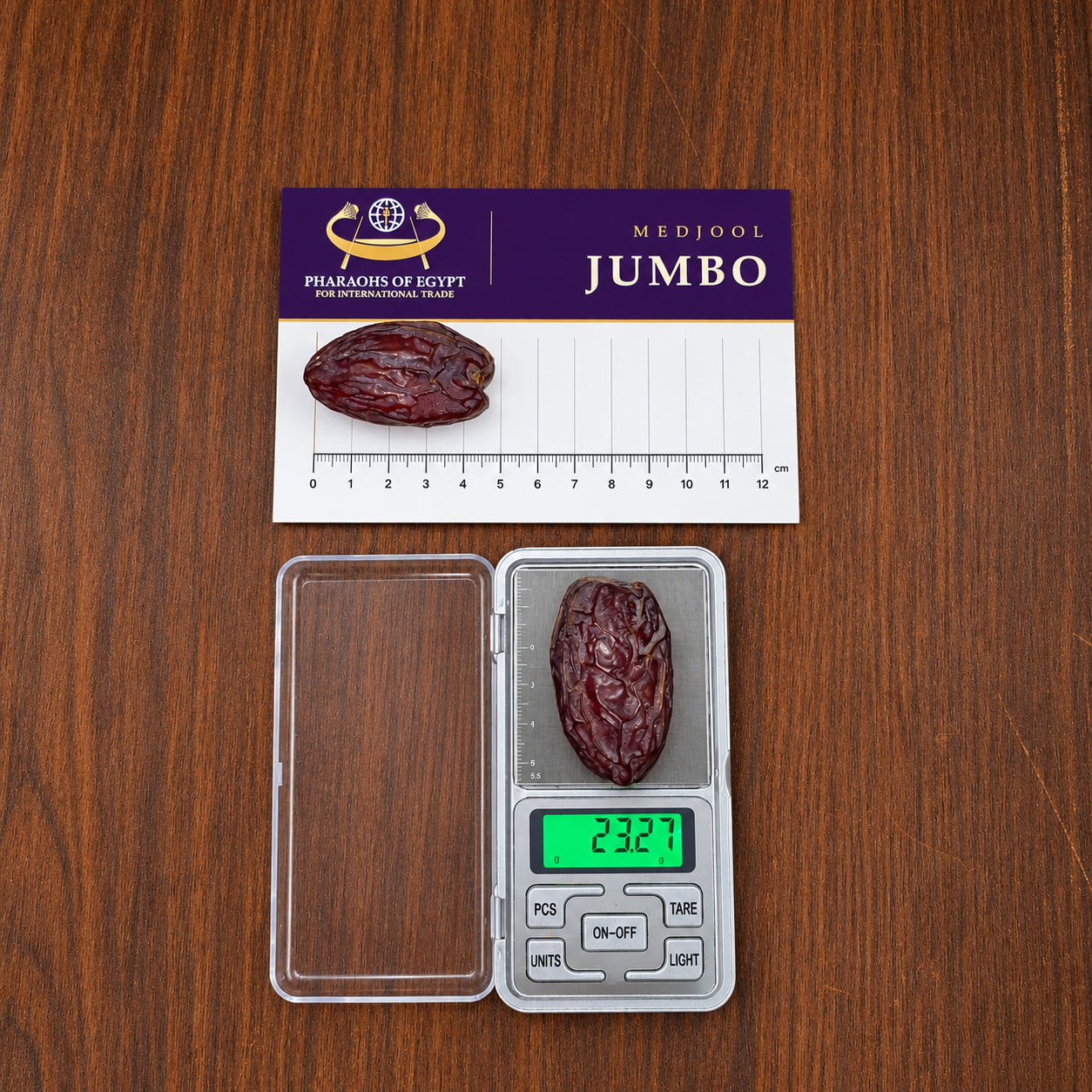
Buyers often ask for “Super Jumbo” or “Jumbo” by name, but packers in different origins use the same name for different weights. Ask any supplier for the weight per fruit in grams, or the number of fruits per kilogram, and compare offers on that basis. To check a size on arrival, weigh 100 fruits taken from several cartons and divide by 100.
The table below maps the names and spellings buyers send us to the product and sizes on this page.
| What buyers write | Language or use | What it means here |
|---|---|---|
| Medjool, Medjoul, Majdool, Majdoul, Medjul | English and trade spellings | The Medjool variety |
| Mejhoul, Majhoul | Morocco and French-speaking markets | The Medjool variety |
| مجدول، المجدول | Arabic | The Medjool variety |
| Меджул, королевские финики (“royal dates”) | Russian | Medjool |
| Medjul hurma, Mecdul hurma, Mejdul hurma | Turkish | Medjool |
| মেডজুল খেজুর | Bengali | Medjool (খেজুর, khejur, alone means any dates) |
| मेडजूल खजूर | Hindi | Medjool (खजूर, khajur, alone means any dates) |
| Kurma Medjool | Malay and Indonesian | Medjool (kurma means dates) |
| Super Jumbo, Super Jambo | Size | Our SuperJumbo size |
| Jumbo, Large, Medium, Small | Size | Our sizes of the same name |
| Babysmall, Mix | Size | Our Babysmall size, and our Mix of sizes from Small to SuperJumbo |
| A, B, C grade | Grade | The letters on our grade photos and videos: A = Premium, B = Delight, C = Classic |
| Tamr, dry dates | Product type | What we ship: cured Medjool with 18–27% moisture |
| Rutab, fresh dates | Product type | Not this product |
Our grade describes skin separation: how far the skin of a fruit has lifted away from the flesh. It is measured on the fruit itself, not as a tolerance across the lot.
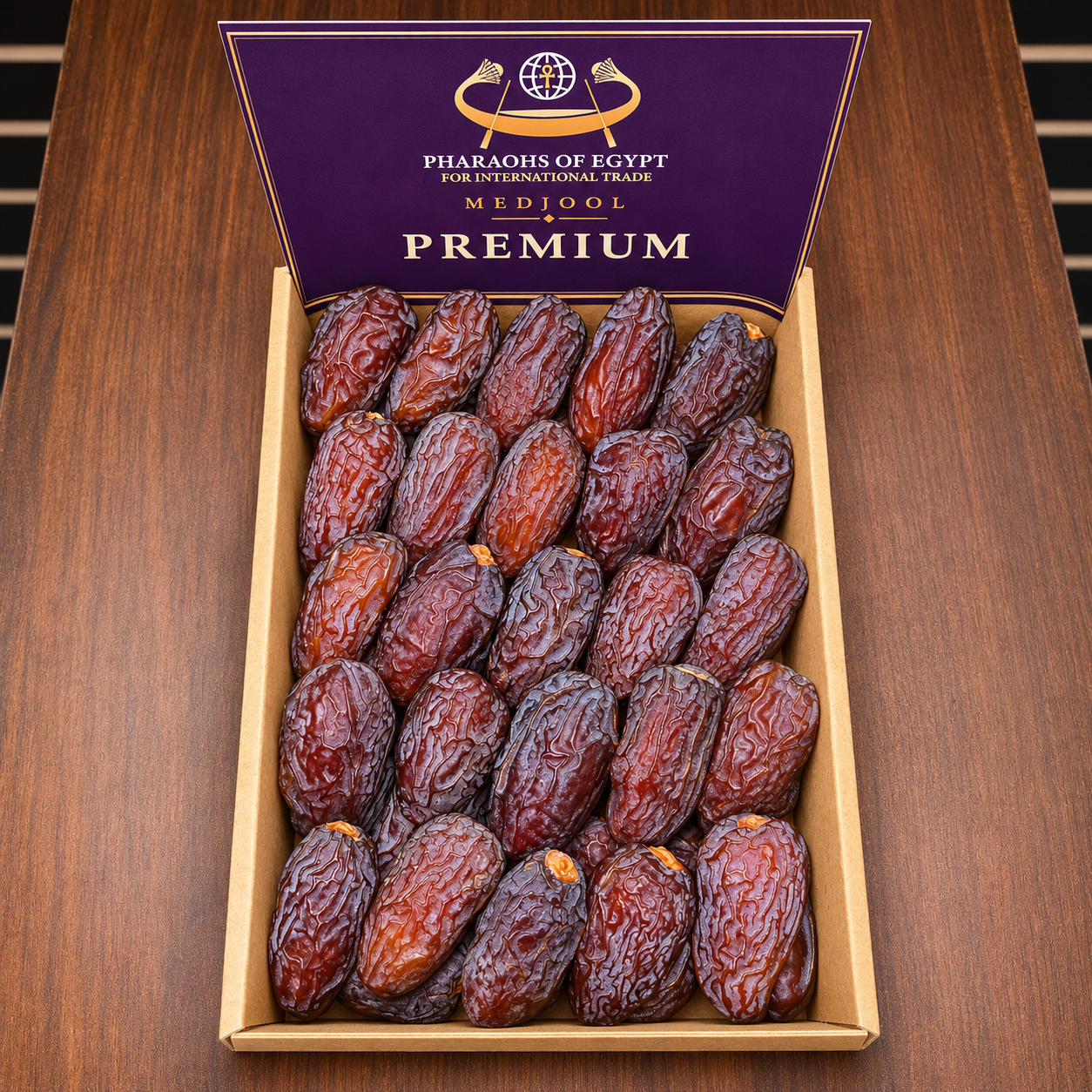
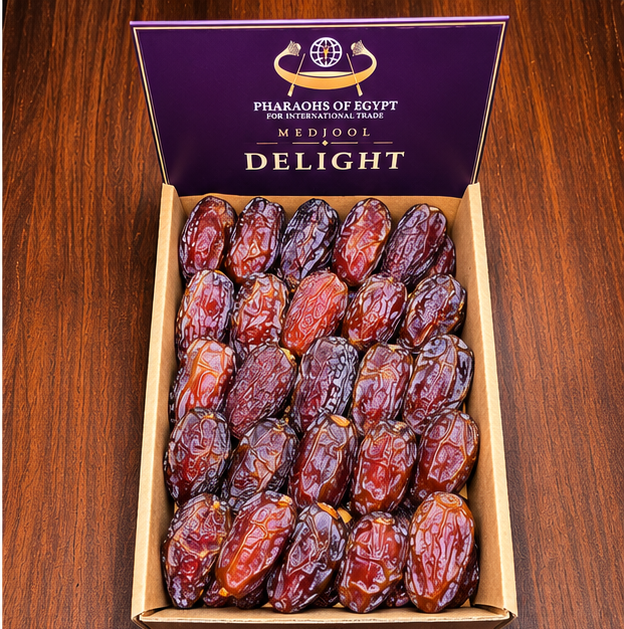
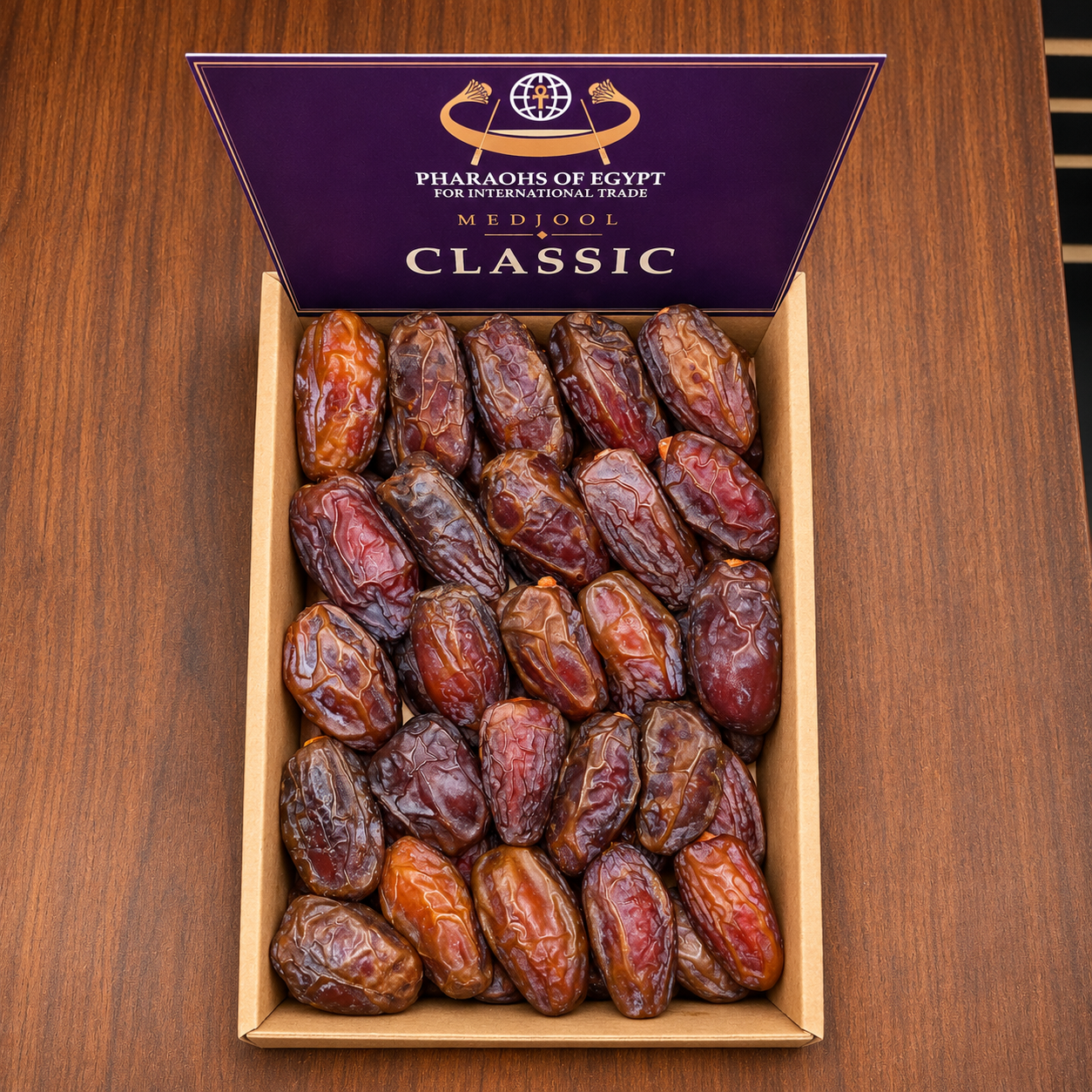
The grade is printed on every carton. All three grades are available in every size and in the Mix; availability for your shipping month is confirmed with each quote. We don’t publish lot tolerances, crop year or shelf life; ask us and we will check what can be confirmed for your order. Each grade has its own photos and videos, and we send them on request for the grade you are considering.
Egyptian Medjool is available in every month of the 2026/27 season:
Ramadan 2027 is expected to begin around 8 February 2027, subject to moon sighting (The National). To plan an arrival, add about two days to prepare and load the container, the sea transit, which depends on the shipping line and the destination port and is given with our quote, and the time your port needs for clearance and inland delivery. Importers supplying Ramadan should fix the shipping month when they confirm the order.
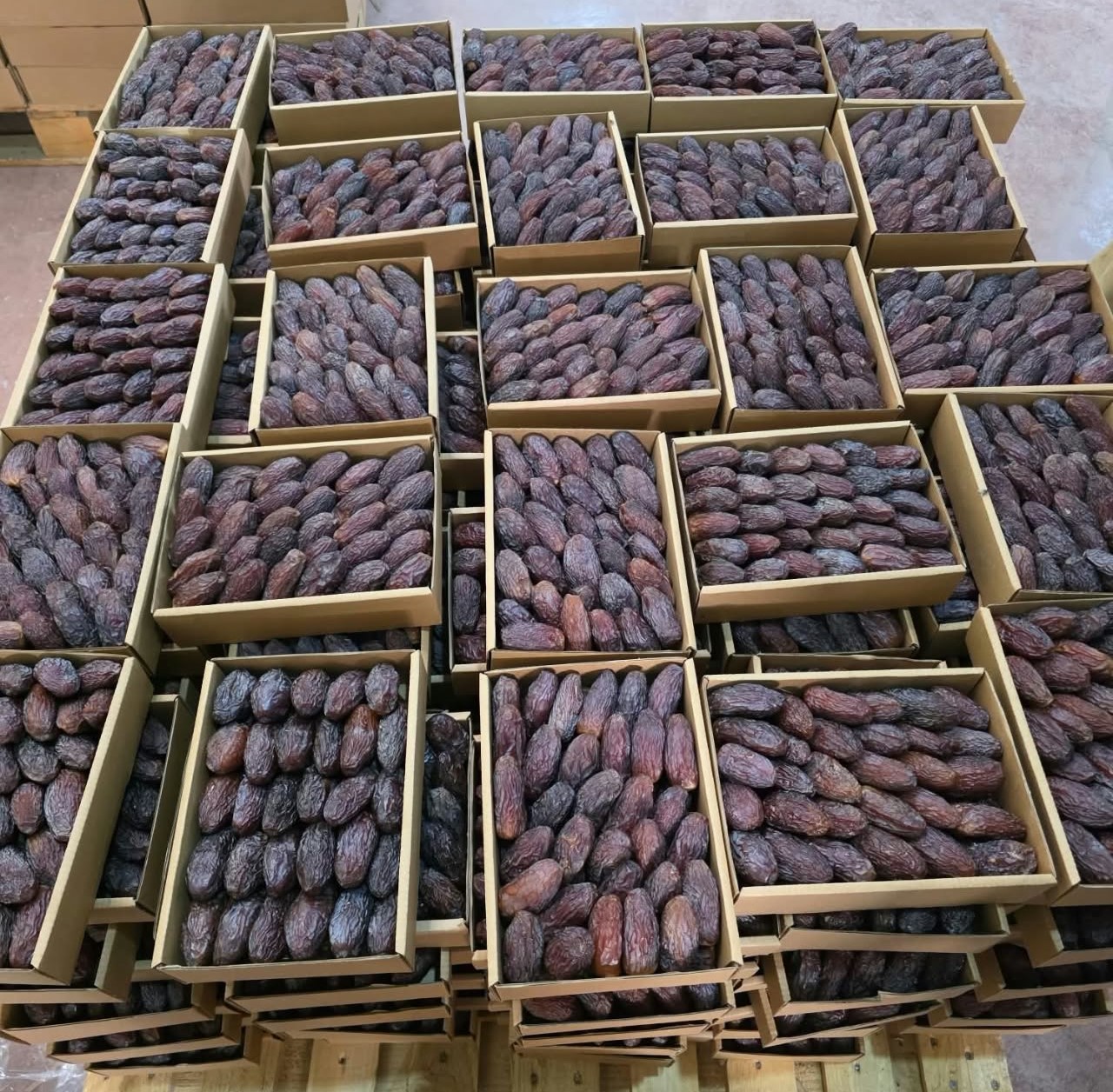
Egyptian Medjool comes in two master cartons: a 5 kg carton, and an 8 kg carton that holds smaller consumer packs of 250 g, 500 g or 1 kg.
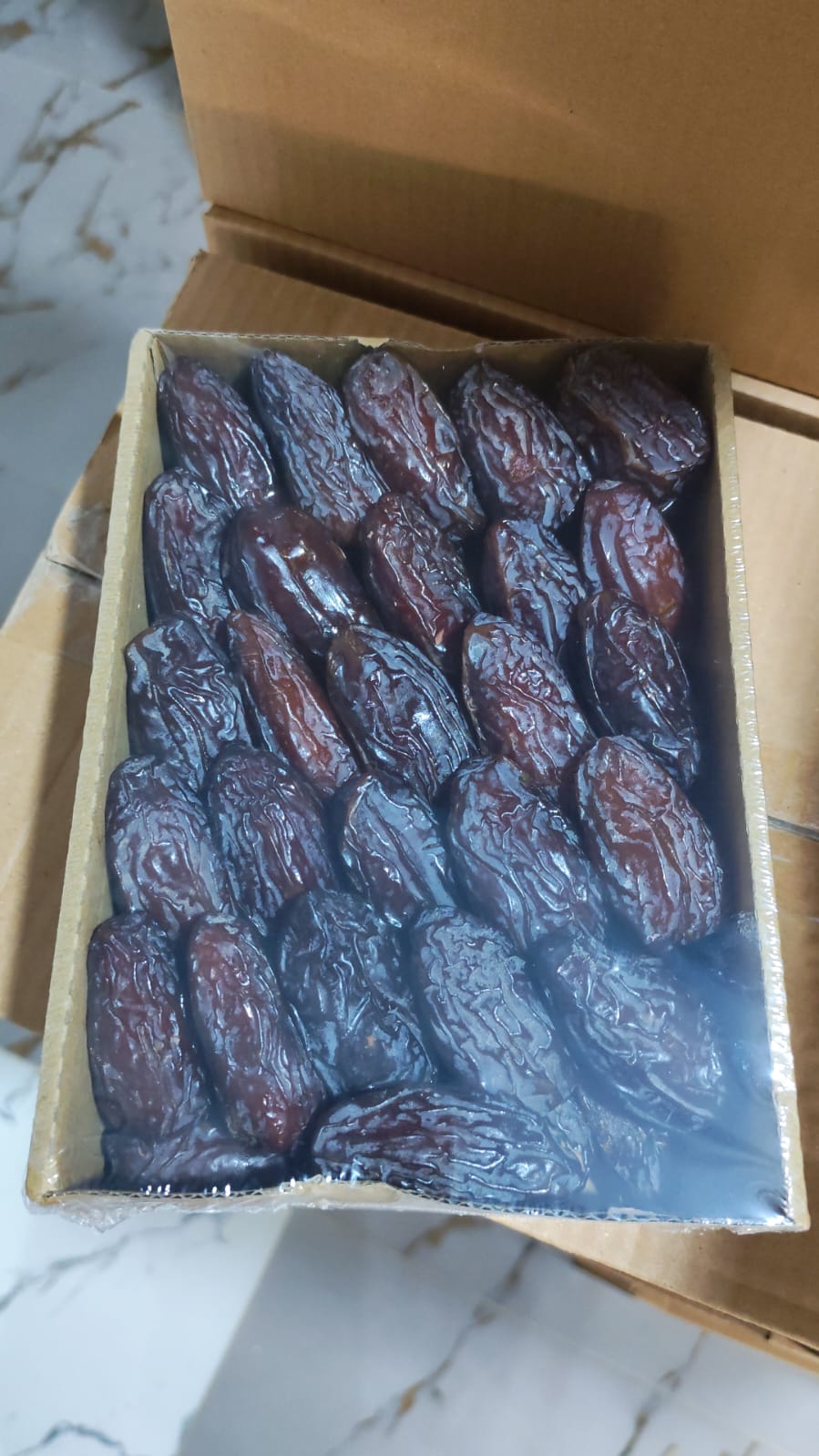
| Pack | Inside each carton | Net / gross weight per carton | Cartons per 40 ft HC reefer (approx.) | Net tonnes per container (approx.) |
|---|---|---|---|---|
| 5 kg carton | 5 kg of dates | 5 kg / 5.5 kg | 4,000–4,100 | 20–20.5 |
| 8 kg carton of 500 g packs | 16 packs of 500 g (570 g gross each) | 8 kg / 10 kg | about 2,500 | about 20 |
| 8 kg carton of 250 g packs | 32 packs of 250 g (270 g gross each) | 8 kg / 10 kg | about 2,500 | about 20 |
| 8 kg carton of 1 kg packs | 8 packs of 1 kg (1.10 kg gross each) | 8 kg / 10 kg | about 2,500 | about 20 |
Loads are for a 40 ft high-cube reefer and are approximate; the packing list for each shipment confirms the exact count.
Labels and private label
Every Medjool shipment travels with a phytosanitary certificate, a fumigation certificate and a certificate of origin, together with the commercial shipping documents in the table below.
| Document | What it shows | When and how |
|---|---|---|
| Phytosanitary certificate | The consignment was inspected for plant health | Issued by Egypt’s agricultural quarantine at the port when the container ships. A specific wording or your L/C number can be added on request, subject to approval |
| Certificate of origin | The dates are of Egyptian origin | Every shipment |
| Bill of lading | The carrier’s receipt for the goods and title to them | Every shipment |
| Commercial invoice | Goods, quantity, value and delivery terms | Every shipment |
| Packing list | Number of cartons, net and gross weights | Every shipment |
| Fumigation certificate | The fruit was fumigated before shipment | Every shipment, issued to the rules of the destination country |
Import rules differ by country, so confirm your own requirements with your customs broker before you order. We can share copies of earlier shipping documents so you can see what arrives with a container.
We don’t publish a price list. Medjool prices move during the season and depend on the details of each order, so every price is quoted individually. A quote depends on:
FOB or CIF. Under FOB, the goods are loaded on the vessel at the Egyptian port and the buyer pays the freight, insurance and everything after. A CIF price includes the goods, packing and loading, the container, sea freight and marine insurance to the named destination port. Under both terms, unloading, port charges, import duties and taxes, customs clearance and inland transport are paid by the buyer.
Payment. 50% advance, 50% against a copy of the shipping documents.
Proforma invoice. Before shipping we issue a proforma invoice in English. For it we need the importer’s full company name, email, phone number and full address.
Ask every exporter the same eight questions, and get the answers in writing before you pay a deposit:
An exporter who answers all eight clearly gives you a basis to compare offers like for like. For an overview of the companies in this trade, see our list of Egyptian dates exporters.
For the other date varieties we ship, see our Egyptian dates product page.
Each of our six sizes is a band of fruit weight: Babysmall 8–13 g, Small 14–16 g, Medium 17–18 g, Large 19–21 g, Jumbo 22–23 g and SuperJumbo 24–27 g. Mix is a blend of Small to SuperJumbo. Compare offers by grams per fruit or fruits per kilogram, because a name such as “Jumbo” means different weights at different packers.
In a 40 ft high-cube reefer, about 4,000–4,100 cartons of 5 kg (about 20–20.5 tonnes net), or about 2,500 cartons of 8 kg (about 20 tonnes net). The packing list confirms the exact count.
One full container, normally a 40 ft reefer. A 20 ft reefer is possible only on the few sailings priced for it. Smaller trial quantities: contact us and we will check them order by order.
No. We export by the container to registered importers and don’t sell retail. The 1 kg and 5 kg sizes are pack formats inside a container order.
About two days to prepare and load the container, plus the sea transit, which depends on the shipping line and the destination port. We give the transit time with each quote; sailing times are approximate and not guaranteed.
50% advance, 50% against a copy of the shipping documents.
Yes. You pay the DHL courier cost and the sample ships after payment. Tell us the grades, sizes and kilos you want and your full address.
It is the same Medjool variety. Size names and grading systems differ between packers and origins, so compare offers by fruit weight in grams, skin separation and moisture rather than by size names.
This season we offer Medjool and Saidi. For any other variety, ask us and we will confirm whether we can supply it.
A phytosanitary certificate, a fumigation certificate issued to the rules of the destination country, and a certificate of origin, with the bill of lading, commercial invoice and packing list.
Yes. Your company details can go on the carton label once you confirm the wording, your logo on the packs or a full private-label carton from a minimum quantity we confirm per order.
They are cured dry dates (tamr) with 18–27% moisture, not fresh rutab, and they are of Egyptian origin.
To quote, we need four things:
Add the shipping month and the number of containers if you know them. We reply with a price for your exact specification.