Address
Work Hours
Monday to Friday: 7AM - 7PM
Weekend: 10AM - 5PM

Address
Work Hours
Monday to Friday: 7AM - 7PM
Weekend: 10AM - 5PM


Dates have two clocks: a fixed autumn harvest, and a year-round supply made possible because dry dates store so well. Layered on top is the single biggest demand event of the year — Ramadan. This guide sets out the Egyptian date export season: when each type is harvested, how storage extends availability, and how to plan around the Ramadan peak.
Quick answer: The Egyptian date harvest runs from about August to November, with soft Zaghloul peaking around September–October and semi-dry/dry varieties following. Dry dates ship year-round from storage, while soft fresh dates are seasonal. Demand spikes around Ramadan (which moves ~11 days earlier each year), so order timing should be planned against it. (Soft Zaghloul peaks September–October; exact harvest windows shift year to year with weather.)
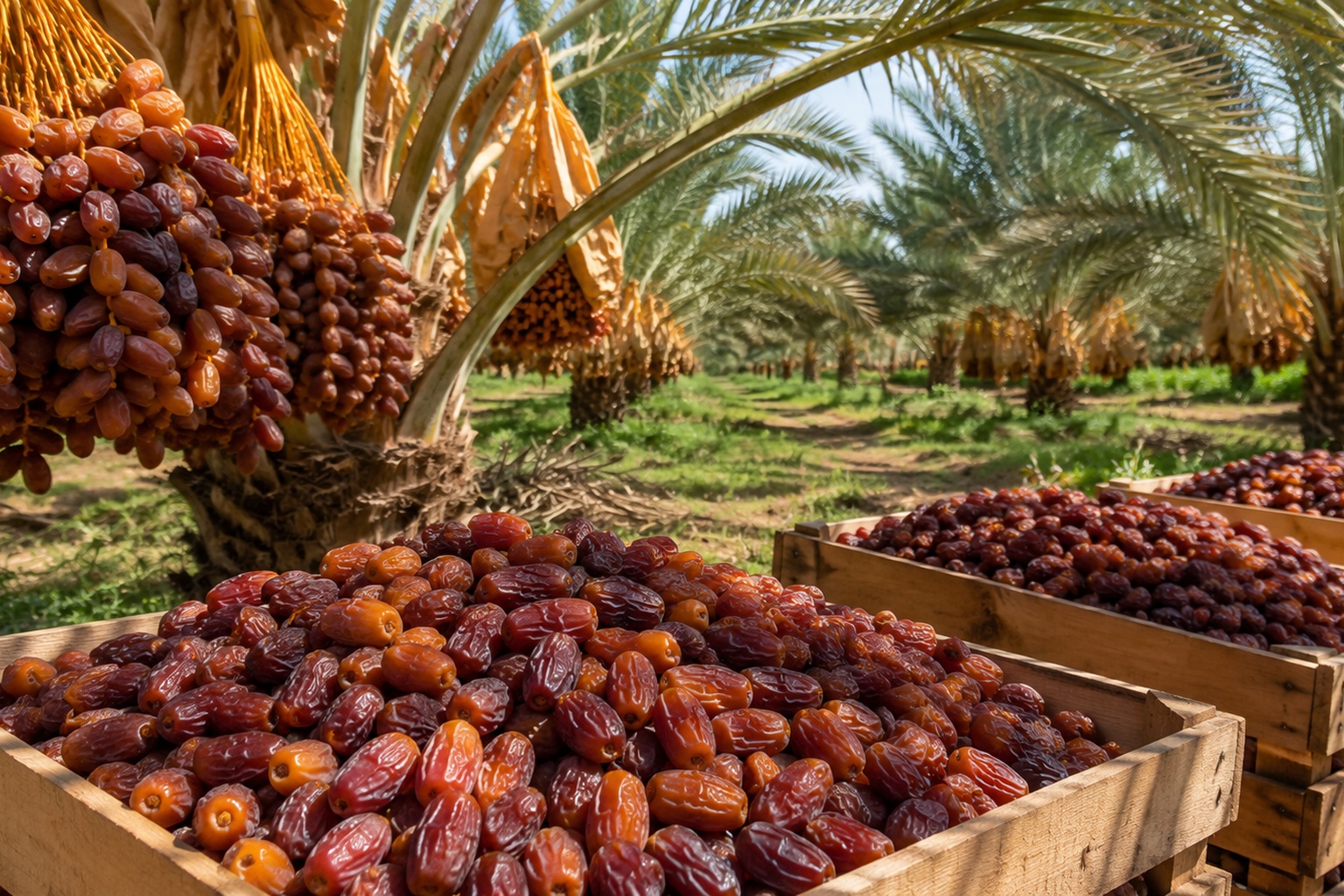
Date palms are hand-harvested once a year as the fruit ripens through late summer and autumn. Fresh soft dates (Zaghloul, Hayany) must move quickly in season, while semi-dry and dry dates are dried, cured and placed into storage. Because dry dates keep for many months, exporters can supply them across the whole year, smoothing the single annual harvest into year-round availability.
| Month | Harvest / availability |
|---|---|
| July–Aug | Early fresh (khalal) dates begin (e.g. Barhi) |
| Sep–Oct | Main harvest; soft Zaghloul peak; semi-dry begins |
| Oct–Nov | Dry varieties (Siwi etc.) harvested & cured |
| All year | Dry dates & date paste shipped from storage |
The fresh window is short and seasonal. Early khalal (crunchy) dates such as Barhi appear from mid-summer, and the soft Zaghloul and Hayany peak around September–October. These must be cooled and moved quickly, so fresh-date programs are planned tightly around the harvest.
Once dried and cured, Siwi and other dry dates store for many months, so exporters ship them throughout the year to Morocco, South and Southeast Asia. For an importer of dry dates, availability is effectively continuous — the constraint is total crop size, not the calendar.
Dates are central to Ramadan, and demand — especially in Gulf and Muslim-majority markets — surges in the run-up. Because Ramadan moves about 11 days earlier each year on the Gregorian calendar, the demand peak shifts annually, so confirm the dates for your target year and place orders well ahead to secure supply and shipping.
Roughly August to November, with soft Zaghloul peaking around September-October and dry varieties harvested into November.
Dry dates and date paste are shipped year-round from storage; soft fresh dates are seasonal.
Dates are central to Ramadan, so demand spikes beforehand; since Ramadan moves earlier each year, order timing should track it.
Early crunchy khalal dates such as Barhi begin around mid-summer (July-August).
Yes – weather shifts the dates, so confirm the program window with your supplier.
How to cite this page
PEI Trade. “Egyptian Dates Export Season & Calendar.” peitrade.com, 2026. https://peitrade.com/egyptian-dates-export-season/
This page is part of our Egyptian Date Export Guide hub.
Plan your Egyptian date program with PEI Trade. Seasonal fresh dates and year-round dry and premium dates — timed to your market and to Ramadan — with full documentation and halal certification. Contact: [email protected] · WhatsApp +20 109 911 1918 · www.peitrade.com