Address
Work Hours
Monday to Friday: 7AM - 7PM
Weekend: 10AM - 5PM
Address
Work Hours
Monday to Friday: 7AM - 7PM
Weekend: 10AM - 5PM


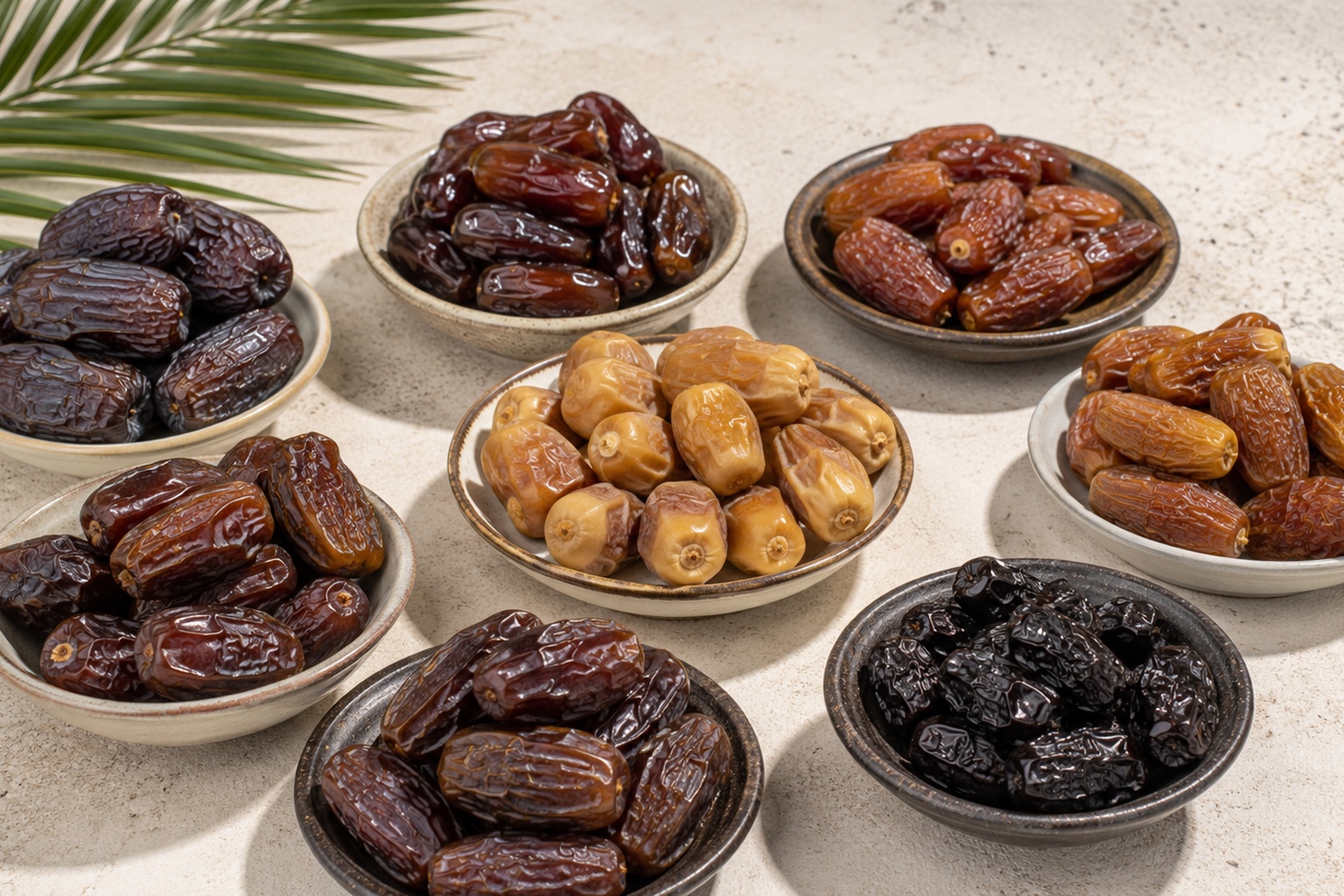
Egypt’s date varieties are best understood by moisture: soft (wet), semi-dry and dry. That single property decides how a date is eaten, how long it keeps and which market it suits — a soft Zaghloul is a fresh, perishable delicacy, while a dry Siwi keeps for a year and travels the world. This guide breaks down the main Egyptian date varieties by type and how to match them to your buyers.
Quick answer: Egypt’s key export date is the dry Siwi (long shelf life, shipped to South/Southeast Asia and Morocco). Medjool and Barhi lead the premium segment. Zaghloul (red, crunchy) and Hayany are the famous soft fresh dates; Saidy, Amhat and Bartamuda are semi-dry. Soft dates need refrigeration; dry dates are shelf-stable.
| Variety | Type | Character & use |
|---|---|---|
| Siwi | Dry / semi-dry | From Siwa; the main export date; long shelf life |
| Medjool | Soft (premium) | Large, soft, premium; EU & Gulf retail |
| Barhi | Soft (premium) | Sweet; eaten fresh (khalal/rutab) and as soft dates |
| Zaghloul | Soft (fresh) | Red, crisp, semi-sweet; iconic fresh date |
| Hayany (Hayani) | Soft (fresh) | Red to black, soft; fresh eating |
| Samani | Soft / semi-dry | Dark, sweet; fresh and processed |
| Saidy (Saidi) | Semi-dry | Sweet, versatile; storage & export |
| Amhat, Bartamuda | Semi-dry / dry | Upper-Egypt varieties; storage & export |
| Sakkoti, Malakabi, Gondaila | Dry | Aswan / Upper-Egypt dry dates; long shelf life |
Siwi — from the Siwa oasis — is the most important Egyptian export date. As a dry/semi-dry date it has a long shelf life, ships at ambient temperature and is in steady demand across Morocco, Indonesia, Malaysia, Bangladesh and India. Other Upper-Egypt dry varieties (Sakkoti, Malakabi, Gondaila) serve similar markets. Dry dates are the backbone of Egypt’s date export trade.
Medjool — large, soft and rich — is the premium date the world knows, and Egyptian production from reclaimed-desert projects is rising fast, targeting EU and Gulf retail. Barhi is prized both as a soft date and eaten fresh at the crunchy khalal stage. These varieties are where Egypt is adding the most export value.
The soft varieties — Zaghloul (red and crisp), Hayany and Samani — are famous fresh dates, eaten in season and needing refrigeration. The semi-dry group — Saidy, Amhat, Bartamuda — sits in the middle: sweet, versatile, and suited to both storage and export.
Start from type and market. For shelf-stable volume into South/Southeast Asia or Morocco, specify dry Siwi. For premium retail in the EU or Gulf, Medjool (or Barhi). For regional fresh demand in season, the soft Zaghloul and Hayany. Then agree grade, size, moisture and whether pitted — and confirm halal certification where the market requires it.
The dry Siwi date from Siwa, thanks to its long shelf life and steady demand in South/Southeast Asia and Morocco.
Yes – premium Medjool production is expanding rapidly in reclaimed-desert projects, aimed at EU and Gulf retail.
Zaghloul (red and crisp) and Hayany are the iconic soft fresh dates; they need refrigeration.
It is moisture content: soft dates are moist and perishable, dry dates are low-moisture and shelf-stable, and semi-dry sit in between.
Dry dates such as Siwi store longest and ship at ambient temperature; soft dates need a cold chain.
How to cite this page
PEI Trade. “Egyptian Date Varieties: Siwi, Medjool & More.” peitrade.com, 2026. https://peitrade.com/egyptian-date-varieties/
This page is part of our Egyptian Date Export Guide hub.
Source the right Egyptian date variety with PEI Trade. Dry Siwi, premium Medjool and Barhi, and soft Zaghloul and Hayany — matched to your market, grade and packing, with phytosanitary, food-safety and halal documentation. Contact: [email protected] · WhatsApp +20 109 911 1918 · www.peitrade.com