Address
Work Hours
Monday to Friday: 7AM - 7PM
Weekend: 10AM - 5PM

Address
Work Hours
Monday to Friday: 7AM - 7PM
Weekend: 10AM - 5PM


Dates sit between fresh produce and processed food, so their export requirements combine plant-health rules, residue limits, a strong focus on storage-pest control, and — for most key markets — halal certification. This guide sets out what an importer and exporter need in place to move Egyptian dates cleanly.
Quick answer: To export Egyptian dates you need a phytosanitary certificate, compliance with destination MRLs, and effective storage-pest control — chiefly against the carob / date moth (Ectomyelois ceratoniae) and stored-product beetles — by cleaning, freezing, controlled atmosphere or approved fumigation. Packed and processed dates need HACCP with ISO 22000 / FSSC 22000 or BRCGS, and halal certification is required for Gulf and Muslim-market buyers. Dates trade under HS code 0804.10.
Every consignment travels with an official phytosanitary certificate from Egypt’s plant-quarantine authority (CAPQ), confirming inspection and freedom from quarantine pests. For dates the central plant-health issue is insect infestation, so inspection and documented pest treatment are what underpin the certificate.
Dates are prone to infestation by the carob / date moth (Ectomyelois ceratoniae) and stored-product beetles, which can develop in the fruit before or after harvest. Control is essential and is achieved by:
The chosen method must leave the dates compliant with the destination’s residue rules.
Egyptian dates must meet destination MRLs (for the EU, under Regulation (EC) No 396/2005) and contaminant limits. For dried fruit, buyers may also check for mycotoxins and ensure any fumigant or treatment residues are within permitted levels.
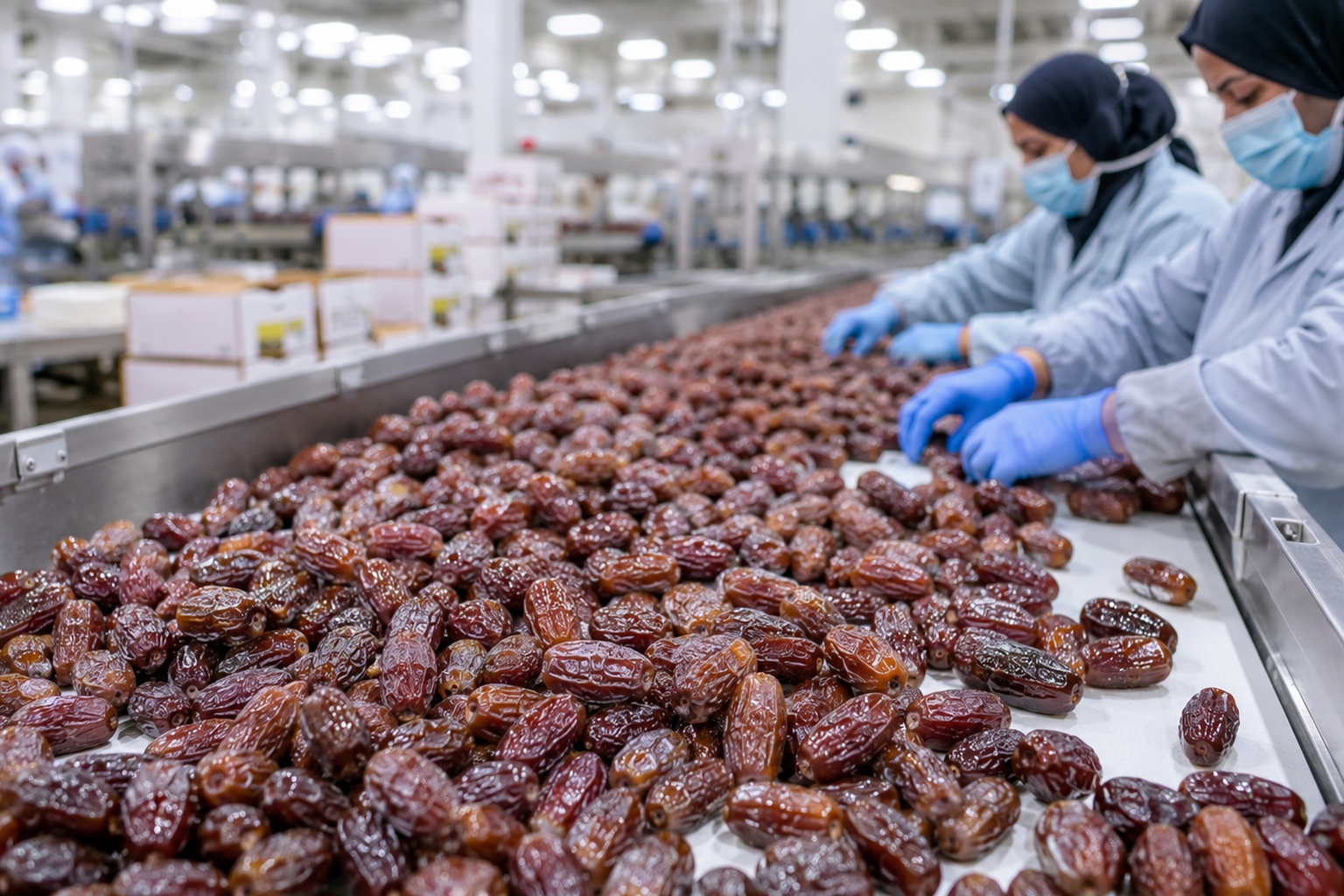
Pitted dates, date paste, diced dates and retail packs are processed foods: the baseline is HACCP, with EU and many other buyers expecting a GFSI-recognised scheme — ISO 22000 / FSSC 22000 or BRCGS — plus metal detection, hygiene and traceability at the packing facility.
For Gulf, North African and Southeast Asian Muslim-majority markets, halal certification of the packing/processing facility is commonly required — particularly important given dates’ central role in Ramadan.
| Document | Purpose |
|---|---|
| Phytosanitary certificate | Confirms inspection & freedom from pests |
| Halal certificate | Required for many Gulf / Muslim markets |
| Certificate of Origin | Proves Egyptian origin |
| Health / free-sale certificate | Often required for processed dates |
| Food-safety certificate (ISO 22000 / BRCGS) | Packed / processed product assurance |
| Residue / treatment report | MRL & treatment compliance |
| Invoice, packing list, B/L | Customs & transport |
Storage-pest control – against the carob/date moth (Ectomyelois ceratoniae) and stored-product beetles – by cleaning, freezing, controlled atmosphere or approved fumigation.
Yes – every consignment requires an official phytosanitary certificate confirming inspection and freedom from pests.
For Gulf, North African and many Southeast Asian markets, yes – halal certification of the facility is commonly required.
HACCP plus a GFSI scheme such as ISO 22000 / FSSC 22000 or BRCGS, with hygiene, metal detection and traceability.
Dates, fresh or dried, fall under HS code 0804.10.
How to cite this page
PEI Trade. “Egyptian Dates Export Requirements.” peitrade.com, 2026. https://peitrade.com/egyptian-dates-export-requirements/
This page is part of our Egyptian Date Export Guide hub.
Export Egyptian dates the compliant way with PEI Trade. Phytosanitary documentation, residue-safe pest treatment (freezing / controlled atmosphere), food-safety certification for packed and processed dates, and halal certification for Gulf and Muslim markets. Contact: [email protected] · WhatsApp +20 109 911 1918 · www.peitrade.com