Address
Work Hours
Monday to Friday: 7AM - 7PM
Weekend: 10AM - 5PM
Address
Work Hours
Monday to Friday: 7AM - 7PM
Weekend: 10AM - 5PM


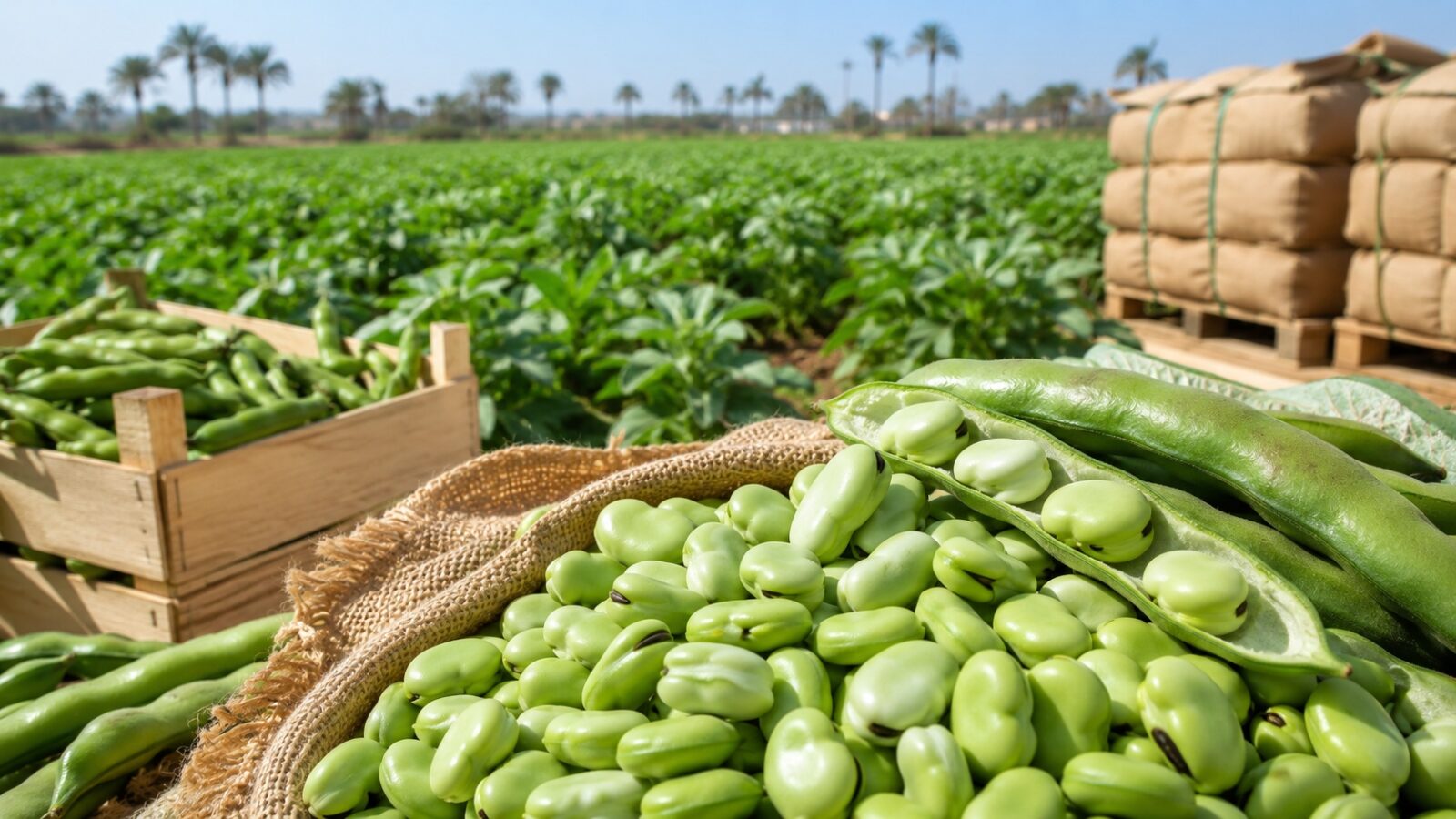
Faba beans — broad beans, the heart of ful medames — are Egypt’s signature legume and national dish. Demand is so large that Egypt is in fact the world’s biggest importer of faba beans: domestic production cannot cover consumption, so the country buys heavily from Australia, the UK, France and others. Egypt’s own export role is therefore in value-added and frozen faba — frozen green broad beans (IQF), and processed/re-graded dried beans, split and falafel-grade product — supplied mainly to Middle Eastern and diaspora markets. This guide is the hub for importers: what Egypt supplies, when it ships, the markets it serves, the specifications buyers ask for and the compliance behind every consignment.
Quick answer: Egypt is the cultural home of faba (broad) beans and the world’s largest importer of them — buying on the order of 300,000+ tonnes a year (well over half of global faba-bean imports) because home production cannot meet demand for ful medames, and domestic output has been declining. Egypt’s own exports are therefore concentrated in frozen green broad beans (shelled, IQF) and value-added/processed dried product (re-graded whole, split/decorticated, falafel-grade). The green crop is winter–spring; dried and frozen ship year-round from storage. Dried broad beans trade under HS 0713.50, frozen under HS 0710.29 and fresh under HS 0708.90. Main markets are the Middle East & Gulf and Arab diaspora communities in the EU, UK and North America. (Sources: FAO, 2023; ITC Trade Map, 2025.)
| Form | Description | Main use |
|---|---|---|
| Dried whole (large) | Large-seeded broad beans | Ful medames, stews |
| Dried whole (baladi/small) | Small Egyptian type | Ful & falafel base |
| Split / decorticated | Skin removed, split | Falafel (ta’ameya), purees |
| Frozen green (IQF) | Immature green beans, shelled | Cooked green vegetable |
The green broad-bean crop is the cool season (winter–spring). Dried beans are harvested, dried and stored, shipping year-round; frozen green beans are processed in season and held at −18°C for year-round supply. Growing spans the Delta, Beheira and Upper Egypt, though the domestic crop has been shrinking as imports fill the gap. Exact windows shift year to year with planting and weather.
Dried broad beans trade under HS 0713.50, frozen under HS 0710.29 and fresh under HS 0708.90.
Dried beans require pest freedom (notably bruchid weevils), controlled moisture and cleanliness, often with fumigation or controlled-atmosphere treatment and a phytosanitary certificate; GLOBALG.A.P. at farm level and HACCP in processing support retail entry. Frozen green beans are a processed food needing HACCP plus a GFSI scheme (BRCGS / ISO 22000) and an unbroken cold chain. Destination MRLs (EU: Regulation (EC) No 396/2005) and ISPM 15 packaging apply. Egyptian faba beans are not on the EU’s enhanced official-controls list (Regulation (EU) 2019/1793), so they are not subject to increased border checks.
Frozen green broad beans (IQF) and value-added dried product – whole (large and baladi), split/decorticated and falafel-grade.
Ful medames and stews (whole dried), falafel (split/decorticated), and as a cooked green vegetable (frozen).
The cool season – winter to spring; dried and frozen ship year-round.
Primarily an importer – Egypt is the world’s largest buyer of faba beans for domestic ful consumption. Its exports are concentrated in frozen green broad beans and value-added/processed dried product for diaspora and regional markets.
Dried under HS 0713.50, frozen under HS 0710.29 and fresh under HS 0708.90.
How to cite this page. Reusing a figure from this guide? Please cite it and link to this page as the source.
PEI Trade. “Egyptian Faba Beans Export: The Complete Guide.” peitrade.com, 2026. https://peitrade.com/egyptian-faba-beans-export-guide/
Source Egyptian faba beans with PEI Trade. Frozen green broad beans and value-added dried product — whole, baladi and split — to Middle East, Gulf and diaspora buyers, with size grading, pest-free dried storage, phytosanitary documentation and HACCP/BRCGS cold chain for frozen. Contact: [email protected] · WhatsApp +20 109 911 1918 · www.peitrade.com