Address
Work Hours
Monday to Friday: 7AM - 7PM
Weekend: 10AM - 5PM

Address
Work Hours
Monday to Friday: 7AM - 7PM
Weekend: 10AM - 5PM


Table grapes are a high-value, closely-watched crop on the plant-health side, with specific pest and residue requirements for the EU and UK. This guide sets out what an importer and exporter need in place to move Egyptian grapes cleanly — phytosanitary certification, the key pest concerns, residue limits (including the sulphur dioxide used in packing), and certification.
Quick answer: To export Egyptian grapes you need a phytosanitary certificate (consignments free from quarantine pests — the key concern is false codling moth, Thaumatotibia leucotreta), compliance with EU residue limits (MRLs, Regulation (EC) No 396/2005, including limits on sulphur dioxide from SO₂ pads), and GLOBALG.A.P. certification with ISPM 15 wood packaging and lot-coded traceability. Fresh grapes trade under HS code 0806.10. (Confirm current EU pest-control conditions for Egyptian grapes.)
Every consignment travels with an official phytosanitary certificate from Egypt’s plant-quarantine authority (CAPQ), confirming inspection and freedom from quarantine pests. For grapes the headline concern for the EU is false codling moth (Thaumatotibia leucotreta), a regulated pest for which the EU requires defined control and inspection measures; mealybug and grape berry moth are also watched. Growers manage these through monitored field programs and pre-export inspection. Under EU plant-health law (Regulation (EU) 2019/2072), host consignments must meet defined special requirements for false codling moth — typically origin from a pest-free area or place of production, or an approved systems approach combining monitored field control, pre-export inspection and, where required, cold treatment; confirm the conditions in force for Egyptian grapes for the season.
Egyptian grapes must meet EU maximum residue levels under Regulation (EC) No 396/2005. Approved products and pre-harvest intervals must be observed, and buyers routinely request residue test reports. A grape-specific point: sulphur dioxide (SO₂) from the generator pads used to control Botrytis in transit is itself regulated, so the dosing must keep residues within permitted limits.
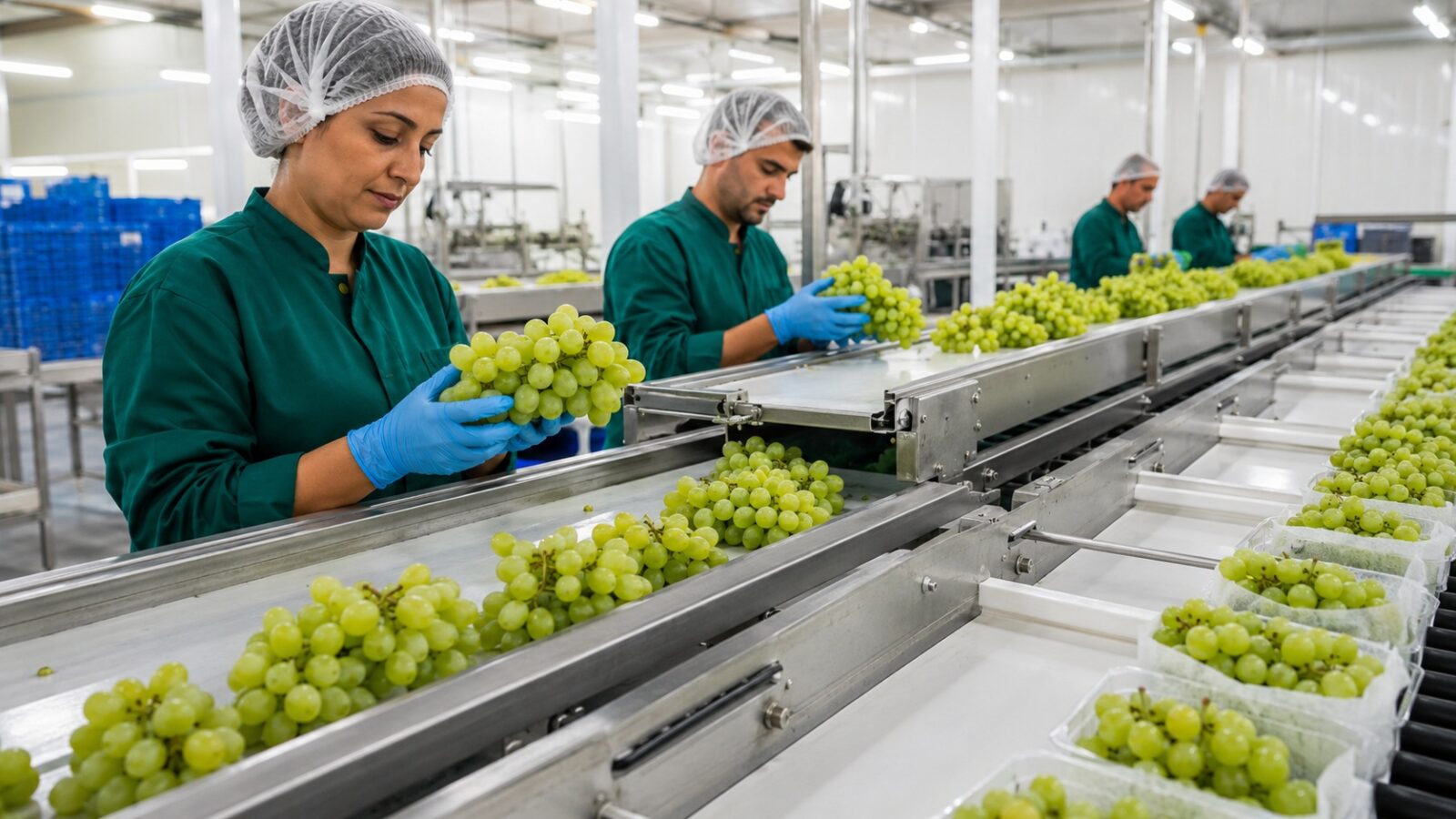
For EU and UK retail, GLOBALG.A.P. certification is the baseline, frequently with the GRASP social add-on, alongside packhouse food-safety management (HACCP, and where required a GFSI scheme such as BRCGS / IFS) and clear lot-coded traceability from vineyard to carton. Wood pallets and dunnage must be ISPM 15 compliant.
Beyond compliance, EU buyers apply a marketing standard for table grapes: minimum Brix (sugar) or sugar/acid ratio, even colour, well-formed intact bunches, and berry-size grading. Meeting these consistently is what protects price and avoids claims.
The UK requires a phytosanitary certificate and import pre-notification, plus standard commercial documents, with the same pest and residue expectations as the EU.
| Document | Purpose |
|---|---|
| Phytosanitary certificate | Confirms inspection & freedom from quarantine pests (FCM) |
| Certificate of Origin | Proves Egyptian origin |
| EUR.1 movement certificate | Preferential tariff treatment where applicable |
| Commercial invoice & packing list | Customs valuation and contents |
| Bill of lading | Transport / title document |
| GLOBALG.A.P. certificate | Good agricultural practice assurance |
| Residue test report | MRL compliance (incl. SO₂) |
| ISPM 15 marked pallets | Compliant wood packaging |
False codling moth (Thaumatotibia leucotreta), a regulated EU quarantine pest, along with mealybug and grape berry moth; control and inspection measures are required.
A phytosanitary certificate, certificate of origin, EUR.1 (where applicable), invoice and packing list, bill of lading, GLOBALG.A.P. certificate, residue report and ISPM 15 pallets.
SO2 pads control Botrytis (grey mould) in transit, but SO2 residues are regulated under EU MRLs, so dosing must stay within limits.
For EU and UK retail it is effectively the baseline, usually with packhouse food-safety certification and lot traceability.
A minimum Brix or sugar/acid ratio, even colour, intact bunches and berry-size grading under the EU marketing standard.
How to cite this page
PEI Trade. “Egyptian Grape Export Requirements.” peitrade.com, 2026. https://peitrade.com/egyptian-grape-export-requirements/
This page is part of our Egyptian Grape Export Guide hub.
Export Egyptian grapes the compliant way with PEI Trade. Phytosanitary documentation and false-codling-moth control, GLOBALG.A.P. handling, residue (incl. SO₂) compliance and EU/UK-ready paperwork. Contact: [email protected] · WhatsApp +20 109 911 1918 · www.peitrade.com