Address
Work Hours
Monday to Friday: 7AM - 7PM
Weekend: 10AM - 5PM

Address
Work Hours
Monday to Friday: 7AM - 7PM
Weekend: 10AM - 5PM


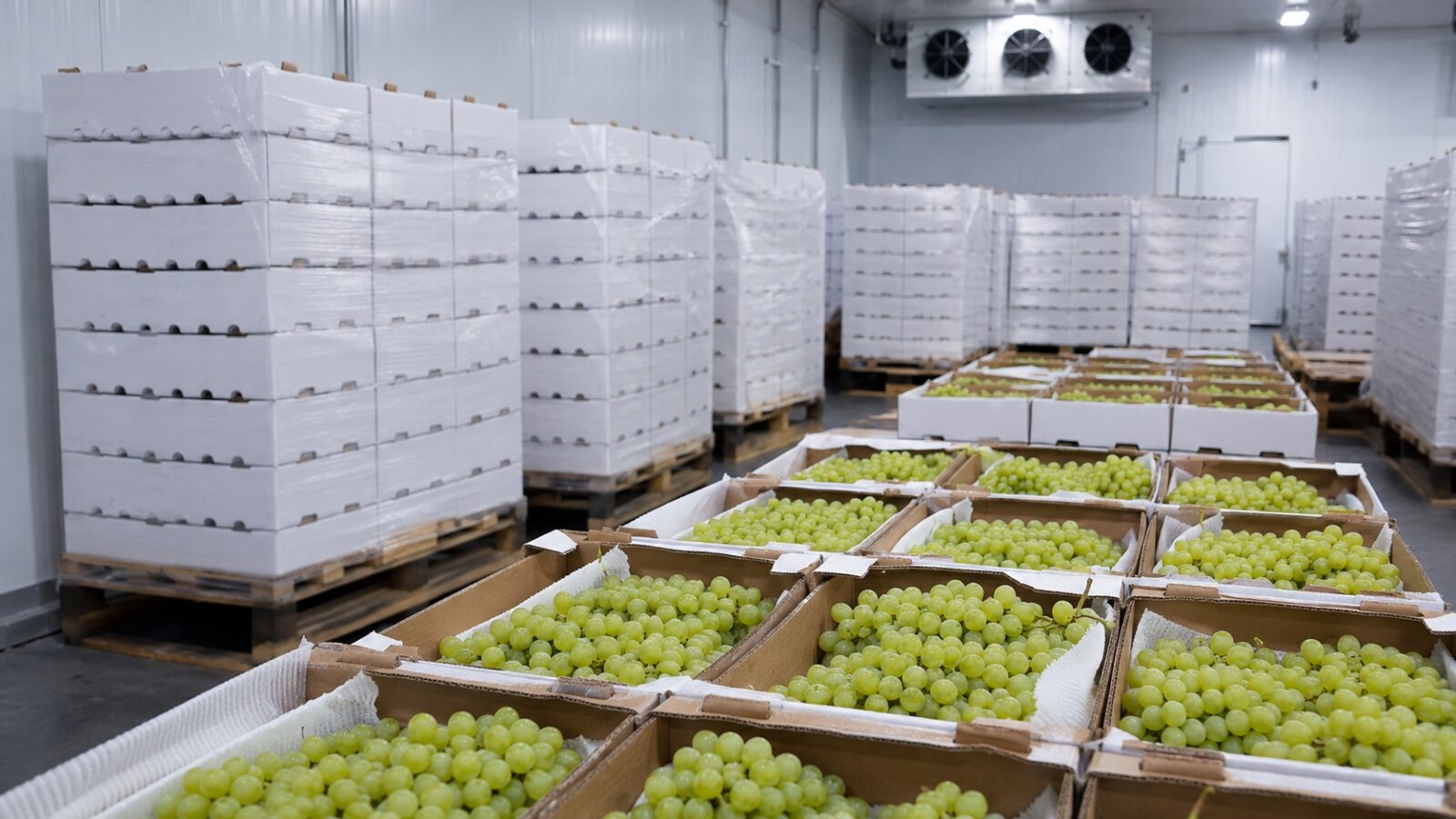
Table grapes are highly perishable and bruise and shatter easily, so the cold chain and packing decide whether they arrive as premium fruit or as a claim. Grapes also need something most produce does not: sulphur dioxide protection against grey mould. This guide covers the Egyptian grape cold chain from harvest to reefer, including SO₂ pads and packing formats.
Quick answer: Egyptian export grapes are forced-air pre-cooled immediately after harvest and held at about 0°C (−0.5 to 0°C) at 90–95% RH. Sulphur-dioxide (SO₂) generator pads are placed in the boxes to control Botrytis (grey mould) in transit. Grapes are packed as bunches or in 500 g punnets / clamshells, usually in 4.5–5 kg cartons with a liner, then palletised and shipped by reefer at ~0°C. Speed of cooling after harvest is the single biggest quality factor.
Grapes start to deteriorate the moment they are picked, so Egyptian fruit is moved quickly to forced-air pre-cooling to pull out field heat within hours. Fast cooling slows respiration and decay and locks in the crisp texture and bunch appearance buyers pay for. Any delay between harvest and cooling shows up as soft berries and stem browning on arrival.
Grapes are held very cold — around 0°C, often slightly below (−0.5°C) — at 90–95% relative humidity. Grapes have a low freezing point thanks to their sugar, so this near-zero range is safe and gives the best shelf life while preventing water loss and stem drying.
| Parameter | Target | Why |
|---|---|---|
| Temperature | ~0°C (−0.5 to 0°C) | Maximum shelf life; safe above grape freezing point |
| Humidity | 90–95% RH | Prevents berry shrivel and stem drying |
| Botrytis control | SO₂ generator pad in box | Suppresses grey mould in transit |
| Pre-cooling | Forced-air, within hours | Removes field heat fast |
Grapes are uniquely prone to Botrytis cinerea (grey mould), which spreads in storage and transit. The standard defence is a sulphur-dioxide (SO₂) generator pad placed inside the box, which slowly releases SO₂ to suppress mould. Dosing is managed so the fruit is protected while SO₂ residues stay within the destination’s permitted limits (see the requirements guide).
Boxes use a perforated liner to hold humidity while allowing the SO₂ to work, and grapes are handled gently to avoid berry drop (shatter) and bruising.
Grapes ship in reefer containers at ~0°C with the cold chain pre-set and monitored, and (for premium long-haul lots) sometimes by airfreight. The container is pre-cooled, airflow kept steady, and temperature logged end to end. A temperature recorder in the load gives the buyer proof the chain held.
Around 0 degrees C, often slightly below (minus 0.5 degrees C), at 90-95% humidity – safe because grapes have a low freezing point.
Sulphur-dioxide generator pads release SO2 inside the box to control Botrytis (grey mould) during storage and transit, dosed to stay within residue limits.
As 500 g punnets/clamshells in master cartons, or loose bunches in 4.5-5 kg cartons with a liner and SO2 pad.
Grapes are highly perishable; removing field heat within hours preserves texture, colour and bunch appearance and prevents decay.
By reefer at ~0 degrees C with monitored, logged temperature (sometimes airfreight for premium lots).
How to cite this page
PEI Trade. “Egyptian Grape Packaging & Cold Chain.” peitrade.com, 2026. https://peitrade.com/egyptian-grape-packaging-cold-chain/
This page is part of our Egyptian Grape Export Guide hub.
Ship Egyptian grapes that arrive in spec with PEI Trade. Rapid pre-cooling, near-zero cold storage, correct SO₂ protection and reefer discipline — in punnets or cartons to your program. Contact: [email protected] · WhatsApp +20 109 911 1918 · www.peitrade.com