Address
Work Hours
Monday to Friday: 7AM - 7PM
Weekend: 10AM - 5PM

Address
Work Hours
Monday to Friday: 7AM - 7PM
Weekend: 10AM - 5PM


Russia is the single largest market for Egyptian oranges. In the 2024/25 season Egypt shipped about 247,628 tonnes of oranges to Russia (worth roughly USD 146 million), keeping it Egypt’s number-one orange destination even after a softer year (FreshPlaza; OEC). Egypt is the world’s second-largest orange exporter, and Russia’s scale, its supermarket-driven retail, and long-standing trade ties make it the anchor of the export programme. One preference defines the lane: Russian importers want large-caliber fruit, so the biggest, best-coloured oranges are directed here. Supply runs on reefer sea freight from Alexandria across the Mediterranean and Black Sea, with the season opening on early Navel from mid-November and carrying through to late-season Valencia. This guide covers the varieties and calibres that suit the Russian market, shipping logistics, import and food-safety requirements, the variety-by-window calendar, and how to open a supply program.
Russia has structurally established itself as the primary destination for Egyptian oranges. Three things drive it: market size — a large population with steady, supermarket-led citrus consumption; geographical proximity — a short reefer run from Alexandria across the Mediterranean and Black Sea; and established trade ties — Egyptian exporters and Russian importers have worked together for years, so documentation, logistics and expectations are well understood. The export season itself often opens with the Gulf, then moves to Russia, then the EU and Asia.
The defining feature of the Russian lane is caliber. Russian importers have a clear preference for large oranges, so exporters allocate their biggest, best-coloured fruit here — in a season where large sizes can be scarce, that allocation decision is central. Success in Russia is about consistently delivering large-caliber, well-coloured fruit, an unbroken cold chain, and clean phytosanitary and residue compliance shipment after shipment.
Two varieties carry the Russian programme: Navel early in the season for colour and size, and Valencia late for juice and shelf life. The table below leads with those two; Baladi and Salustiana serve mid-season and juicing demand.
| Variety | Profile | Best use | Russia fit |
|---|---|---|---|
| Navel | Seedless, easy-peel, deep-orange colour, crisp and sweet; early season | Fresh retail / supermarket | ★★★ Early large-caliber colour fruit — ideal for Russian retail |
| Valencia | Juicy, rich colour, thin skin, some seeds; late-season, excellent shelf life | Fresh retail & juicing | ★★★ Late-season workhorse — carries the summer programme |
| Baladi (local) | Traditional, aromatic, deep colour; mid-season | Fresh & juicing | ★★ Solid mid-season option |
| Salustiana | Seedless, very juicy, low acidity; mid-season | Juicing & fresh | ★ Juice-oriented / niche demand |
For full variety detail and calibres see the complete Egyptian citrus export guide, and the dedicated profiles for Navel oranges and Valencia oranges.
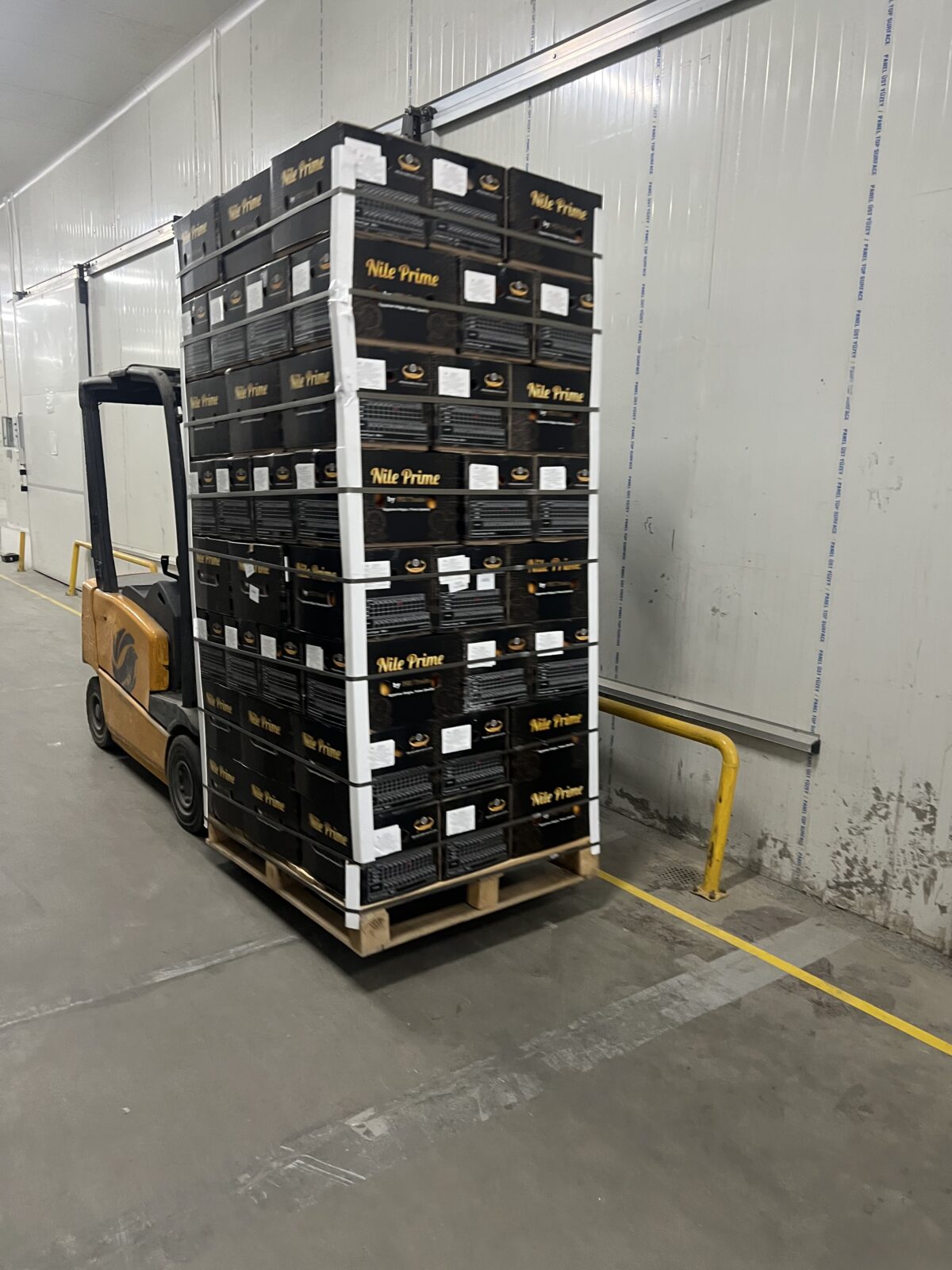
The workhorse route is reefer sea freight from Alexandria to Russia’s Black Sea port of Novorossiysk — the main gateway for imported citrus — with St Petersburg on the Baltic as the secondary route. Transit runs roughly 10–25 days depending on routing. Citrus stores well cold, so sea freight is the economic default; a controlled cold chain protects colour, firmness and shelf life on arrival.
Unlike mango, citrus is not treated with a hot-water dip. The main quarantine concern for Egyptian oranges entering Russia is the Mediterranean fruit fly (Ceratitis capitata), and the accepted control is cold treatment (cold disinfestation) — holding fruit at low temperature for a defined period, typically carried out in-transit within the reefer container so the disinfestation window and the sea voyage overlap. Because oranges tolerate cold storage well, this integrates cleanly with the normal cold chain.
| Month | Available varieties (export) | Russia notes |
|---|---|---|
| Nov–Dec | Navel (early, from mid-Nov) | Season opens; early large-caliber colour fruit |
| Jan–Feb | Navel (peak) | Core Navel window — large calibers to Russian supermarkets |
| Mar–Apr | Navel (late) → Valencia begins | Transition; peak shipment months |
| May | Valencia (peak) | Late-season juice & shelf-life fruit |
| Jun–Jul | Valencia (late) | Summer programme closes the season |
Windows shift year to year with weather and colour development. Because Russia wants large fruit, book large calibers early. See the Egyptian citrus export report 2026 for volumes and destinations, and the citrus & mango price index for price context.
In the 2024/25 season Egypt shipped about 247,628 tonnes of oranges to Russia, worth roughly USD 146 million — making Russia Egypt’s number-one orange market, ahead of Saudi Arabia and the Netherlands.
Russian importers have a clear preference for large-caliber oranges, so exporters direct their biggest, best-coloured fruit to Russia, while smaller sizes go to markets such as India and Malaysia.
Navel (early season, for colour and size) and Valencia (late season, for juice and shelf life) are the two main export varieties for Russia. Baladi and Salustiana serve mid-season and juicing demand.
By reefer sea freight from Alexandria to the Black Sea port of Novorossiysk (and St Petersburg on the Baltic), carried at about 5–7 °C, with a transit of roughly 10–25 days. Cold treatment against Mediterranean fruit fly is typically applied in-transit.
A phytosanitary certificate referencing EAEU quarantine requirements (freedom from Mediterranean fruit fly), a TR EAEU conformity declaration, GOST-compliant quality, EAEU pesticide-residue (MRL) compliance, and Russian-language labelling. Clearance takes place at ports with phytosanitary laboratories.
Planning to supply the Russian market? PEI Trade supplies large-caliber Egyptian Navel and Valencia oranges graded for Russian retail, with cold-chain management on the Alexandria–Black Sea reefer run and full phytosanitary and EAEU documentation. Tell us your target volumes, calibres and delivery window, and we’ll structure a compliant, well-timed offer.
PEI Trade. “Egyptian Orange Exports to Russia: Egypt’s #1 Citrus Market.” peitrade.com, 2026, https://peitrade.com/egyptian-orange-exports-to-russia/
Sources: FreshPlaza (Egypt exported 1.66M t oranges in 2024/25; Russia 247,628 t as Egypt’s #1 orange market; Russian preference for large calibers); OEC (Egypt oranges USD 1.01B, world’s 2nd-largest exporter; Russia USD 146M top destination, 2024); WestComTrans (Russia reefer logistics — Novorossiysk / St Petersburg, +2–6 °C, EEC Decision 157, GOST 34307-2017); Rosselkhoznadzor / EAEU Common Quarantine Phytosanitary Requirements; USDA FAS (Egypt orange production & season). Figures cover HS 080510 (oranges), season 2024/25 — distinct from mango HS 080450.
[email protected] · WhatsApp +20 109 911 1918 · www.peitrade.com · Brand: nile-prime.com · Ports: Alexandria, Damietta, Sokhna, Port Said (Incoterms 2020)