Address
Work Hours
Monday to Friday: 7AM - 7PM
Weekend: 10AM - 5PM
Address
Work Hours
Monday to Friday: 7AM - 7PM
Weekend: 10AM - 5PM


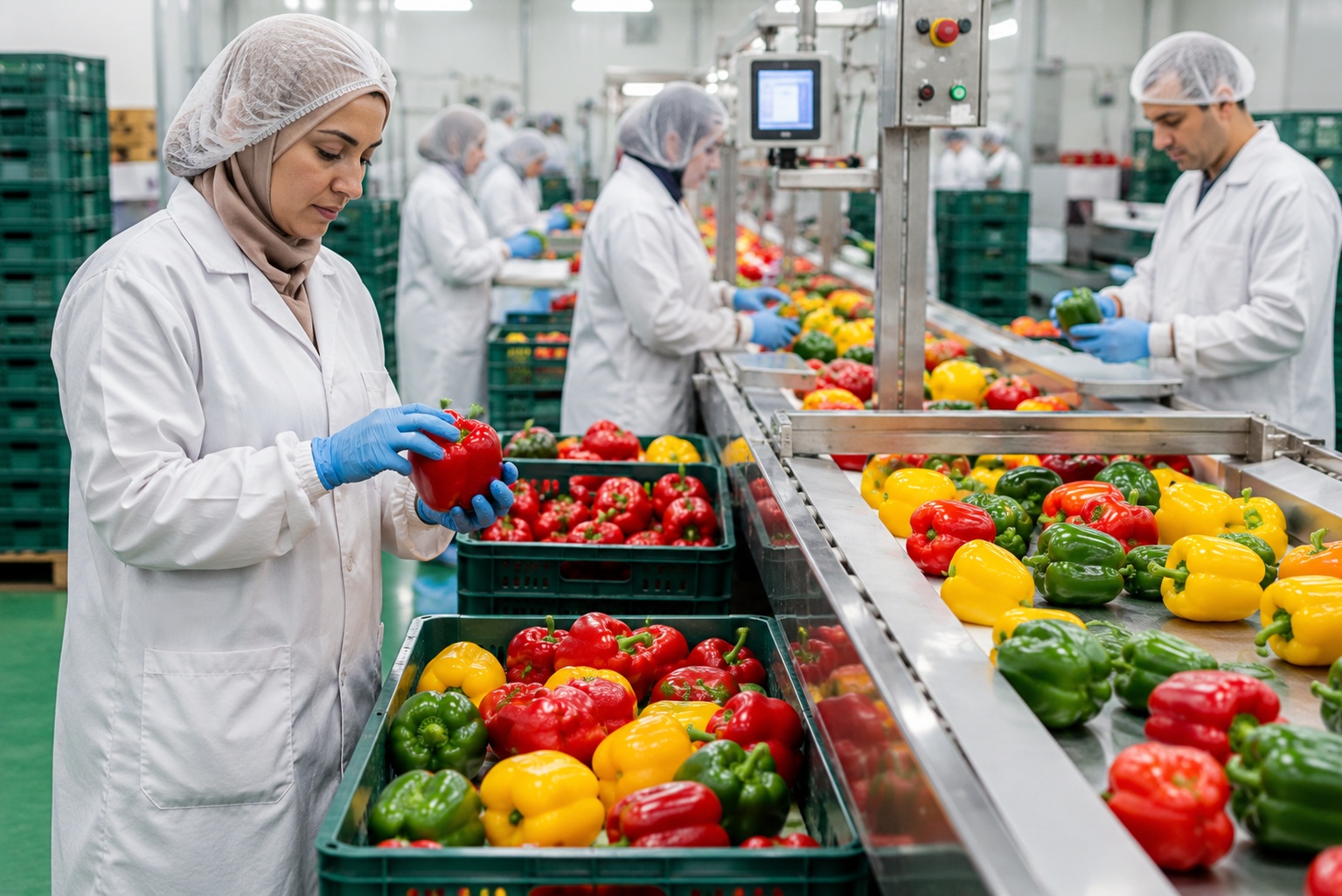
Peppers sit on two compliance watchlists at once: pesticide residues on the fresh side, where peppers have repeatedly faced extra EU scrutiny, and aflatoxins and unauthorised dyes on the dried side. Add a regulated insect pest, and peppers become one of the more compliance-intensive crops to export. This guide sets out what an importer and exporter need in place to move Egyptian peppers (fresh and dried) cleanly.
Quick answer: Fresh peppers need a phytosanitary certificate (key pests: false codling moth, Thaumatotibia leucotreta, and Mediterranean fruit fly, Ceratitis capitata), strict compliance with destination MRLs (EU: Regulation (EC) No 396/2005 — peppers have faced increased EU residue checks), and GLOBALG.A.P. with ISPM 15 packaging. Dried paprika/chili additionally need control of aflatoxins and unauthorised dyes (e.g. Sudan), with HACCP and testing. Fresh trades under HS 0709.60, dried under HS 0904.21/0904.22.
Fresh peppers travel with an official phytosanitary certificate from Egypt’s plant-quarantine authority (CAPQ), confirming inspection and freedom from quarantine pests. The main concerns are false codling moth (Thaumatotibia leucotreta) and Mediterranean fruit fly (Ceratitis capitata), plus thrips and whitefly — managed through monitored field/greenhouse programs and pre-export inspection.
This is the critical compliance point for fresh peppers. They must meet destination MRLs — for the EU, Regulation (EC) No 396/2005 — and peppers (including from Egypt) have at times been placed under increased official controls for pesticide residues, meaning a higher share of consignments is checked at the border — historically in the region of 10–20%, set in the annexes of Regulation (EU) 2019/1793 and revised roughly twice a year (confirm the current rate before shipping). Disciplined spray programs, approved products, pre-harvest intervals and residue testing are therefore essential.
Dried paprika and chili carry their own risks. The EU enforces strict limits on aflatoxins (and ochratoxin A) in dried spices, and bans unauthorised colours such as Sudan dyes; both are common reasons for border rejection of chili/paprika. Compliant dried products need HACCP, controlled drying and storage, and laboratory testing for mycotoxins and dyes.
For EU and UK retail, GLOBALG.A.P. certification is the baseline for fresh, frequently with the GRASP add-on, alongside packhouse food-safety management (HACCP) and clear lot-coded traceability. Wood pallets and dunnage must be ISPM 15 compliant.
| Document | Fresh | Dried |
|---|---|---|
| Phytosanitary certificate | Required | Usually not applicable |
| Residue test report | Important (MRLs) | Recommended |
| Aflatoxin / dye test report | — | Required (paprika/chili) |
| GLOBALG.A.P. certificate | Baseline | At farm level |
| HACCP / food-safety cert | Recommended | Expected (plant) |
| Certificate of Origin / EUR.1 | Required | Required |
| Invoice, packing list, B/L (AWB) | Required | Required |
| ISPM 15 marked pallets | If wood used | If wood used |
Pesticide residues – peppers have faced increased EU residue checks (historically around 10-20% sampling), so MRL compliance, approved products, pre-harvest intervals and testing are essential.
Strict aflatoxin limits and a ban on unauthorised dyes (e.g. Sudan), requiring HACCP, controlled drying and laboratory testing.
False codling moth (Thaumatotibia leucotreta) and Mediterranean fruit fly (Ceratitis capitata), plus thrips and whitefly.
A phytosanitary certificate, MRL compliance with residue testing, GLOBALG.A.P., ISPM 15 packaging and standard commercial documents.
Fresh peppers are HS 0709.60; dried Capsicum is HS 0904.21/0904.22.
How to cite this page
PEI Trade. “Egyptian Peppers Export Requirements.” peitrade.com, 2026. https://peitrade.com/egyptian-peppers-export-requirements/
This page is part of our Egyptian Pepper Export Guide hub.
Export Egyptian peppers the compliant way with PEI Trade. Phytosanitary documentation and pest control, disciplined residue management with testing for fresh, and aflatoxin/dye-controlled HACCP processing for dried paprika and chili. Contact: [email protected] · WhatsApp +20 109 911 1918 · www.peitrade.com