Address
Work Hours
Monday to Friday: 7AM - 7PM
Weekend: 10AM - 5PM

Address
Work Hours
Monday to Friday: 7AM - 7PM
Weekend: 10AM - 5PM


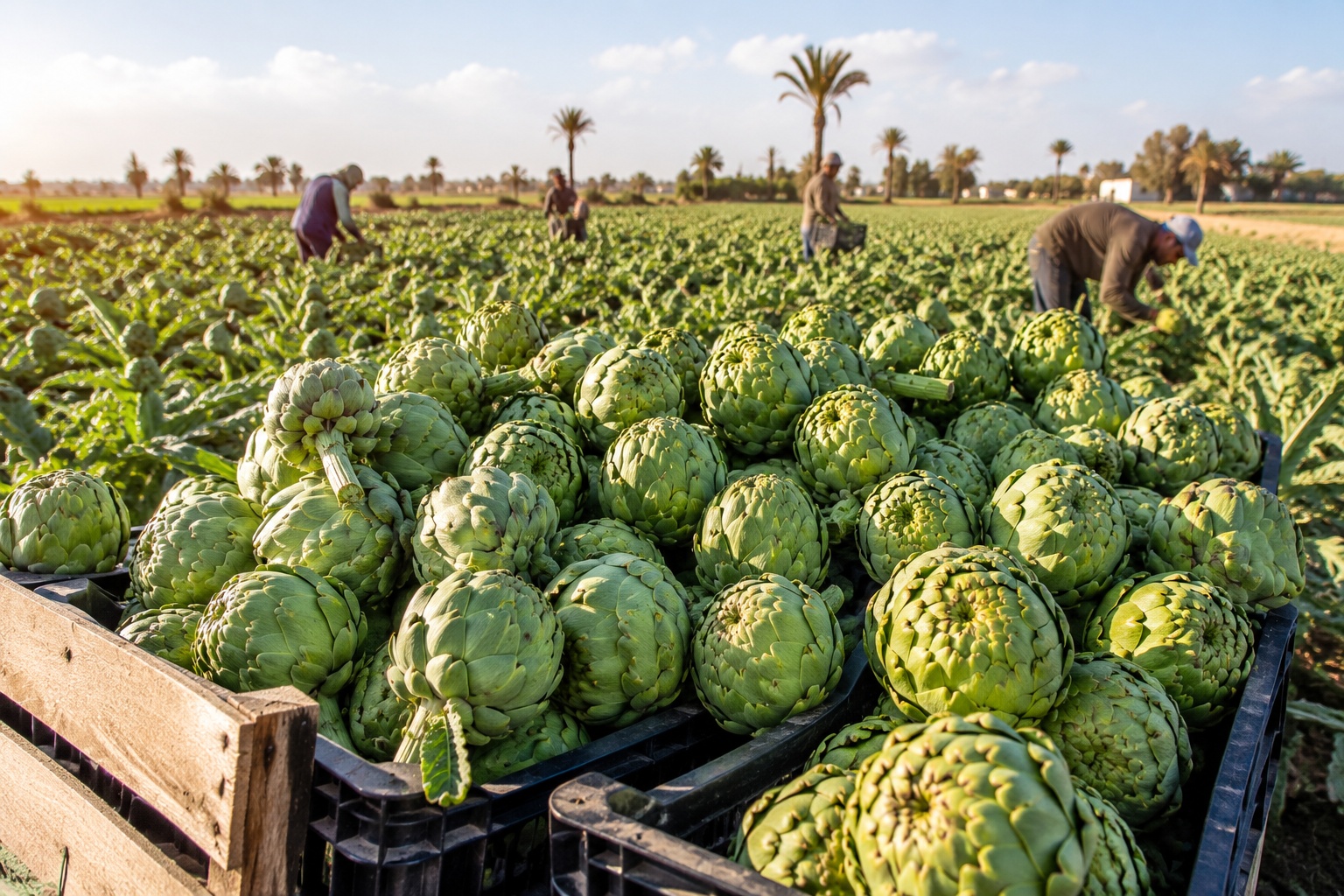
Egypt’s artichoke calendar is built around the European winter: a fresh season that runs when EU artichoke production is dormant, plus a frozen supply that runs all year. For importers, that means fresh heads through the cold months and processing-grade frozen hearts and bottoms any time. This guide sets out the Egyptian artichoke export season and how to plan around it.
Quick answer: The Egyptian fresh artichoke export season runs from about November to April, peaking January to March — counter-seasonal to Europe. Frozen hearts and bottoms are produced during the season and shipped year-round from cold storage. (Fresh peaks January–March; exact windows shift year to year with planting and weather.)
Fresh artichokes are picked and shipped within the winter window and are perishable, so timing matters. Frozen hearts and bottoms are produced from the same crop, IQF-frozen and stored at −18°C, then released across the year. Knowing which you are buying is the key to planning.
| Month | Fresh heads | Frozen hearts/bottoms |
|---|---|---|
| Nov | Season opens | Available from storage |
| Jan–Mar | Peak supply & quality | Peak freezing season |
| Apr | Season winds down | Available from storage |
| May–Oct | Out of fresh season | Year-round from cold storage |
European artichoke production is dormant in deep winter, so from December through March there is demand with limited local supply. Egypt’s fresh heads fill that gap, making the country a reliable winter source for EU retail, alongside other winter origins. The big artichoke-consuming markets — Italy, Spain, France — anchor demand.
Because IQF hearts and bottoms are held at −18°C, Egyptian processors ship them in any month to the EU and US processing, foodservice and retail industry. This year-round availability is a core part of Egypt’s artichoke trade.
Roughly November to April, peaking January-March – counter-seasonal to Europe.
Yes – frozen hearts and bottoms are produced in season and shipped year-round from cold storage.
January to March for both fresh quality and freezing volume.
European production is dormant in winter, so Egypt’s fresh heads fill the gap.
Yes – planting and weather shift the dates, so confirm the program window with your supplier.
How to cite this page
PEI Trade. “Egyptian Artichoke Export Season & Calendar.” peitrade.com, 2026. https://peitrade.com/egyptian-artichoke-export-season/
This page is part of our Egyptian Artichoke Export Guide hub.
Plan your Egyptian artichoke program with PEI Trade. Fresh winter heads and year-round frozen IQF hearts and bottoms, with full documentation and a tight cold chain. Contact: [email protected] · WhatsApp +20 109 911 1918 · www.peitrade.com