Address
Work Hours
Monday to Friday: 7AM - 7PM
Weekend: 10AM - 5PM
Address
Work Hours
Monday to Friday: 7AM - 7PM
Weekend: 10AM - 5PM


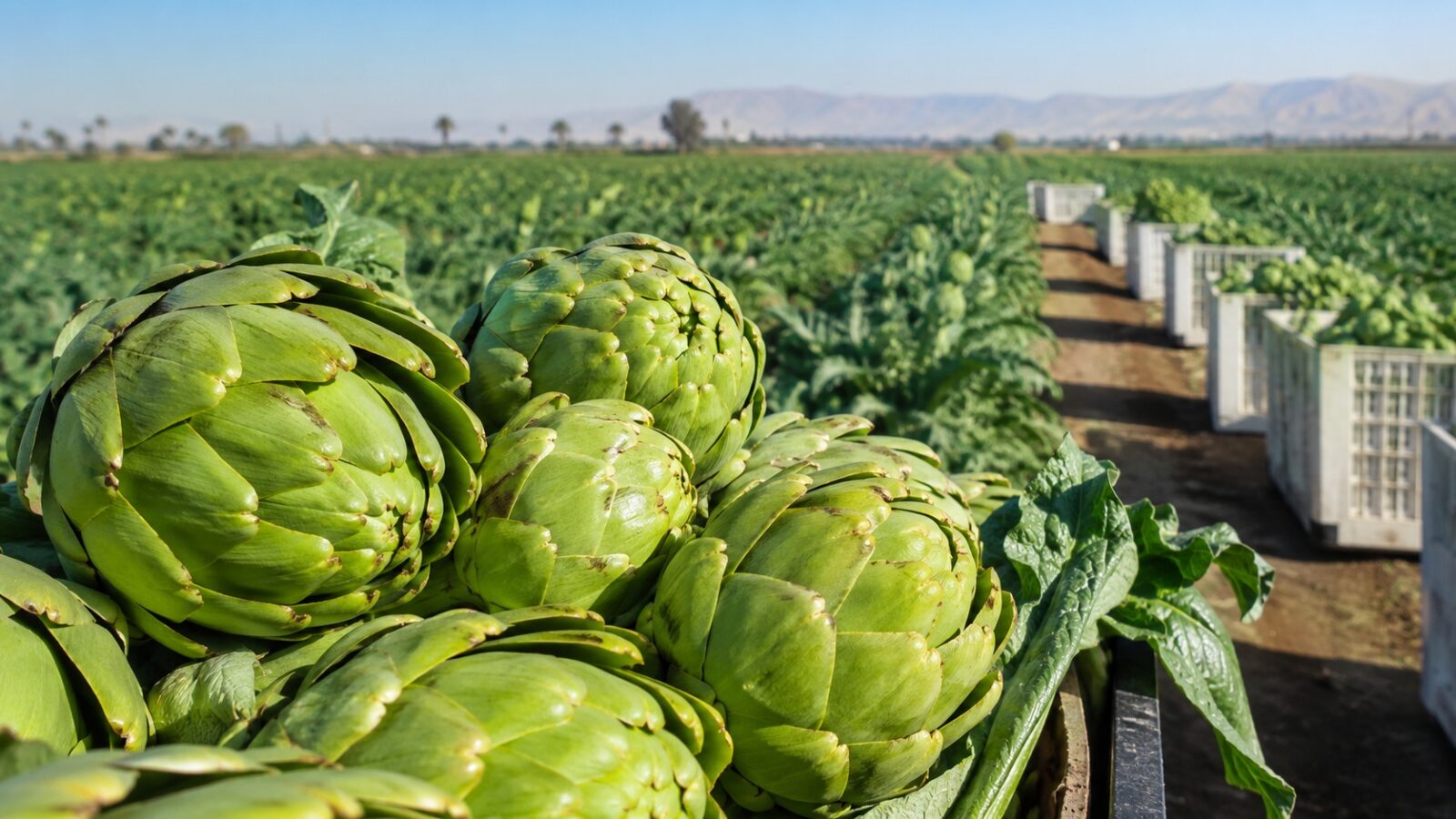
Egypt is the world’s largest globe artichoke producer and a significant exporter — fresh heads in winter and, increasingly, frozen hearts and bottoms year-round. With a warm Delta climate that yields artichokes when European production is dormant, Egypt is a reliable counter-seasonal source for the big artichoke-consuming markets. This guide is the hub for importers: what Egypt grows, when it ships, the markets it serves, the specifications buyers ask for and the compliance behind every consignment.
Quick answer: Egypt is the world’s largest globe artichoke producer — around 460,000 tonnes a year (FAOSTAT, 2022), roughly 29% of global output — and a leading supplier of frozen (IQF) artichoke to the EU. Exports are fresh whole heads (green and purple types) and frozen hearts/bottoms (IQF). The fresh season runs roughly November to April (peak January–March), counter-seasonal to Europe; frozen ships year-round. Fresh artichokes trade under HS code 0709.91 and frozen under HS 0710.80. Markets include the EU (Italy, Spain, France), the Gulf, and frozen to EU/US processing. (Sources: FAOSTAT, 2022; ITC Trade Map / CBI, 2025.)
| Form | Description | Main market |
|---|---|---|
| Fresh green heads | Globe heads, green types | EU & Gulf retail |
| Fresh purple heads | Purple-tinged local/Balady types | EU & regional |
| Frozen hearts / quarters | IQF trimmed hearts | EU/US processing & retail |
| Frozen bottoms | IQF artichoke bottoms | Foodservice & processing |
The fresh season runs from about November to April, peaking January to March — the European off-season. Frozen hearts and bottoms are produced during the season and held in cold storage, so Egypt supplies them year-round. Growing is concentrated in the Nile Delta — Beheira, Kafr El Sheikh and Nubaria. Exact windows shift year to year with planting and weather.
Fresh artichokes are traded under HS code 0709.91, frozen under HS 0710.80.
Fresh artichokes require a phytosanitary certificate, compliance with destination MRLs (EU: Regulation (EC) No 396/2005), and GLOBALG.A.P. certification with ISPM 15 packaging and traceability. Frozen hearts and bottoms are a processed food and additionally need food-safety management (HACCP, and where required BRCGS / IFS / ISO 22000) with microbiological control. Egyptian artichokes are not on the EU’s enhanced official-controls list (Regulation (EU) 2019/1793), so they are not subject to increased border checks — standard MRL and phytosanitary rules apply.
Fresh from about November to April (peak January-March); frozen hearts and bottoms are available year-round.
Fresh whole heads (green and purple) and frozen IQF hearts, quarters and bottoms.
The EU (Italy, Spain, France), the Gulf, and frozen to EU/US processing.
Fresh under HS 0709.91 and frozen under HS 0710.80.
Phytosanitary certificate, MRL compliance, GLOBALG.A.P. and ISPM 15 for fresh; plus HACCP/GFSI food safety for frozen.
How to cite this page. Reusing a figure from this guide? Please cite it and link to this page as the source.
PEI Trade. “Egyptian Artichoke Export: The Complete Guide.” peitrade.com, 2026. https://peitrade.com/egyptian-artichoke-export-guide/
Source Egyptian artichokes with PEI Trade. We supply fresh green and purple heads and frozen IQF hearts and bottoms to EU, Gulf and processing buyers, with GLOBALG.A.P. handling, phytosanitary documentation and a tight cold chain. Contact: [email protected] · WhatsApp +20 109 911 1918 · www.peitrade.com