Address
Work Hours
Monday to Friday: 7AM - 7PM
Weekend: 10AM - 5PM

Address
Work Hours
Monday to Friday: 7AM - 7PM
Weekend: 10AM - 5PM


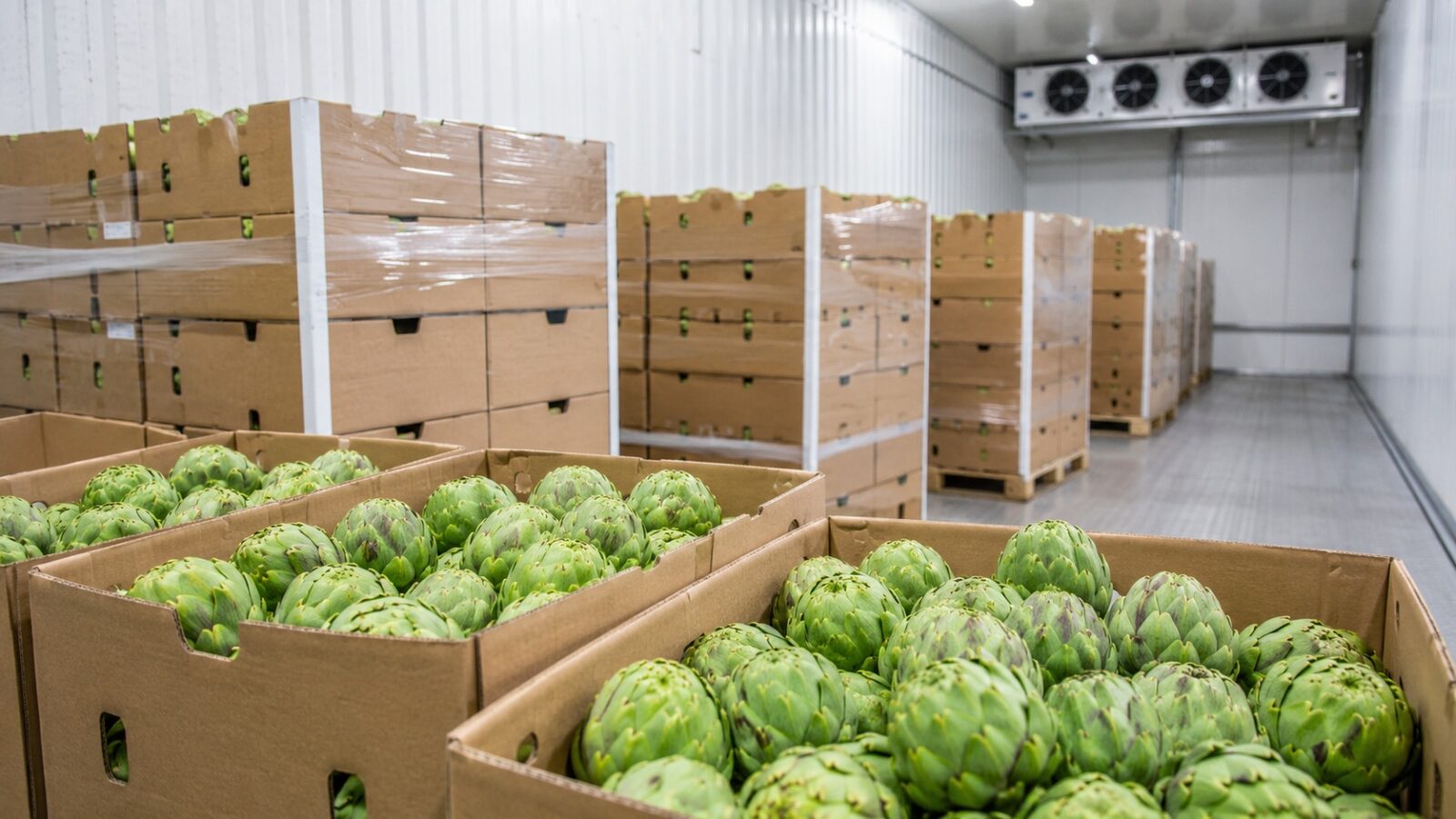
Artichokes are perishable but, unlike peppers or melons, they tolerate cold — so they are pre-cooled fast and held near 0°C to slow ageing and keep the heads tight and green. The frozen trade takes the same crop through blanching and IQF freezing. This guide covers the artichoke cold chain from harvest to reefer, the frozen process, and packing.
Quick answer: Fresh Egyptian artichokes are pre-cooled fast (hydro or forced-air) and held near 0°C at 90–95% RH — they are not chilling-sensitive, so cold storage is correct. Shelf life is roughly 2–3 weeks. They ship by reefer at ~0–2°C, packed in cartons by count. Frozen hearts and bottoms are trimmed, blanched and IQF-frozen, then held at −18°C. Fresh trades under HS 0709.91, frozen under HS 0710.80.
Artichokes respire actively and lose moisture and tenderness if field heat is not removed, so Egyptian export heads are moved to hydro- or forced-air cooling quickly and held near 0°C. Because they are not chilling-sensitive, cold storage with 90–95% RH is ideal — it keeps the bracts tight, the colour fresh and the stems firm.
| Stage | Fresh heads | Frozen hearts/bottoms |
|---|---|---|
| After harvest | Hydro / forced-air pre-cool | Trim, anti-brown, blanch, IQF |
| Storage | Near 0°C, 90–95% RH | −18°C |
| Packaging | Cartons by count, single layer | Bags / cartons |
| Shipping | Reefer at ~0–2°C | Reefer at −18°C |
For frozen, heads are trimmed to hearts or bottoms, treated to prevent browning, briefly blanched (to set colour and stop enzyme activity) and then individually quick-frozen, so pieces stay separate and free-flowing. Held at −18°C, they keep for a long time and let the customer use exactly the quantity needed — the basis of Egypt’s year-round artichoke supply.
Fresh heads are graded by size and handled to avoid bruising and bract damage; frozen pieces are graded by size and count.
Fresh artichokes ship by reefer at ~0–2°C with airflow and logged temperature; frozen ships at −18°C. A temperature recorder gives the buyer proof the chain held.
Near 0 degrees C at 90-95% humidity – artichokes are not chilling-sensitive, so cold storage is correct.
Roughly 2-3 weeks in good cold-chain conditions.
Hearts or bottoms are trimmed, treated against browning, blanched and individually quick-frozen, then held at minus 18 degrees C.
In cartons by count, usually single layer, sometimes with the stem on.
Fresh by reefer at ~0-2 degrees C; frozen by reefer at minus 18 degrees C, with logged temperature.
How to cite this page
PEI Trade. “Egyptian Artichoke Packaging & Cold Chain.” peitrade.com, 2026. https://peitrade.com/egyptian-artichoke-packaging-cold-chain/
This page is part of our Egyptian Artichoke Export Guide hub.
Ship Egyptian artichokes that arrive in spec with PEI Trade. Fast pre-cooling, correct near-0°C storage, gentle carton packing and an unbroken −18°C chain for frozen hearts and bottoms. Contact: [email protected] · WhatsApp +20 109 911 1918 · www.peitrade.com