Address
Work Hours
Monday to Friday: 7AM - 7PM
Weekend: 10AM - 5PM
Address
Work Hours
Monday to Friday: 7AM - 7PM
Weekend: 10AM - 5PM


Because most Egyptian peas ship frozen, their compliance picture centres on a clean, certified IQF operation, with the usual phytosanitary and MRL fundamentals on the fresh side. This guide sets out what an importer and exporter need to move Egyptian green peas (frozen and fresh) cleanly.
Quick answer: Frozen peas need HACCP plus a GFSI scheme (BRCGS / ISO 22000), microbiological control and an unbroken −18°C cold chain. Fresh peas need a phytosanitary certificate (pests: pea moth, aphids), compliance with destination MRLs (EU: Regulation (EC) No 396/2005), and GLOBALG.A.P. with ISPM 15 packaging and traceability. Fresh trades under HS 0708.10, frozen under HS 0710.21.
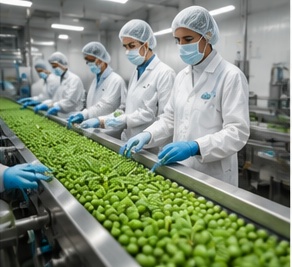
Since frozen IQF is the dominant form, the central requirement is a clean, certified processing operation: HACCP with a GFSI-recognised scheme (BRCGS or ISO 22000 / FSSC 22000), hygiene and water control, microbiological testing, blanching and IQF freezing, and an unbroken −18°C cold chain. Buyers specify size grade, colour and freedom from foreign matter and extraneous vegetable material.
Fresh peas travel with an official phytosanitary certificate from Egypt’s plant-quarantine authority (CAPQ), confirming inspection and freedom from quarantine pests — mainly pea moth and aphids — managed through field programs and inspection.
Peas must meet destination MRLs — for the EU, Regulation (EC) No 396/2005. Exporters follow approved spray programs, pre-harvest intervals and, where required, residue testing. This applies to fresh peas and (via the raw crop) frozen peas. Green peas are not currently among the Egyptian products on the EU’s enhanced import-controls list (Regulation (EU) 2019/1793); verify the latest annex and any destination-specific checks before shipping.
For EU and UK retail, GLOBALG.A.P. is the baseline at farm level for both fresh and frozen, alongside packhouse/plant food-safety management and clear lot-coded traceability. Wood pallets and dunnage must be ISPM 15 compliant.
| Document | Fresh | Frozen |
|---|---|---|
| Phytosanitary certificate | Required | Not applicable |
| Residue test report (MRLs) | As required | Recommended |
| GLOBALG.A.P. certificate | Baseline | At farm level |
| BRCGS / ISO 22000 | — | Expected (plant) |
| Health / free-sale certificate | — | Often required |
| CoO / EUR.1, invoice, packing list, B/L | Required | Required |
HACCP with a GFSI scheme (BRCGS/ISO 22000), microbiological control and an unbroken minus 18 degrees C chain.
A phytosanitary certificate, MRL compliance, GLOBALG.A.P. and standard commercial documents.
Pea moth and aphids, controlled through field programs and inspection.
Yes – at farm level, alongside the plant’s food-safety certification.
Fresh peas are HS 0708.10; frozen is HS 0710.21.
How to cite this page
PEI Trade. “Egyptian Green Peas Export Requirements.” peitrade.com, 2026. https://peitrade.com/egyptian-green-peas-export-requirements/
This page is part of our Egyptian Green Peas Export Guide hub.
Export Egyptian green peas the compliant way with PEI Trade. A certified IQF operation with HACCP/BRCGS food safety and an unbroken −18°C chain for frozen, plus phytosanitary documentation, MRL-compliant production and GLOBALG.A.P. for fresh. Contact: [email protected] · WhatsApp +20 109 911 1918 · www.peitrade.com