Address
Work Hours
Monday to Friday: 7AM - 7PM
Weekend: 10AM - 5PM

Address
Work Hours
Monday to Friday: 7AM - 7PM
Weekend: 10AM - 5PM


Guava is fragrant, fast-ripening and chilling-sensitive, so its cold chain is a balancing act: cool enough to slow ripening and protect the fruit, but never so cold that it suffers chilling injury. Because ripe guava softens quickly, speed matters — and premium fresh fruit is often airfreighted. This guide covers the guava cold chain from harvest to shipping, plus the frozen route, and packing.
Quick answer: Fresh guava is pre-cooled and held cool at about 8–10°C, 85–90% RH — it is chilling-sensitive, so it is not stored cold like apples. Guava is climacteric (it ripens after harvest, producing ethylene) with a short shelf life once ripe (roughly 1–2 weeks). Premium fresh fruit is often airfreighted; firmer fruit ships by reefer at the same cool setpoint. Frozen pulp and halves are held at −18°C. Fresh trades under HS 0804.50, frozen under HS 0811.90.
Guava carries field heat and ripens fast, so Egyptian export fruit is pre-cooled soon after harvest and held at about 8–10°C with 85–90% RH. This slows ripening and water loss while staying above the chilling-injury threshold. Harvest maturity is matched to the journey — firmer fruit for longer transits, riper fruit for short, fast routes.
Guava is chilling-sensitive: stored too cold, it develops surface pitting, browning and failure to ripen properly. That is why the setpoint stays around 8–10°C rather than near 0°C. As a climacteric, ethylene-producing fruit, it is also kept away from ethylene-sensitive produce.
| Stage | Fresh guava | Frozen pulp/halves |
|---|---|---|
| After harvest | Pre-cool promptly | Process & IQF / pack pulp |
| Storage | ~8–10°C, 85–90% RH | −18°C |
| Shelf life | ~1–2 weeks (ripe) | Months frozen |
| Shipping | Airfreight (premium) or reefer ~8–10°C | Reefer at −18°C |
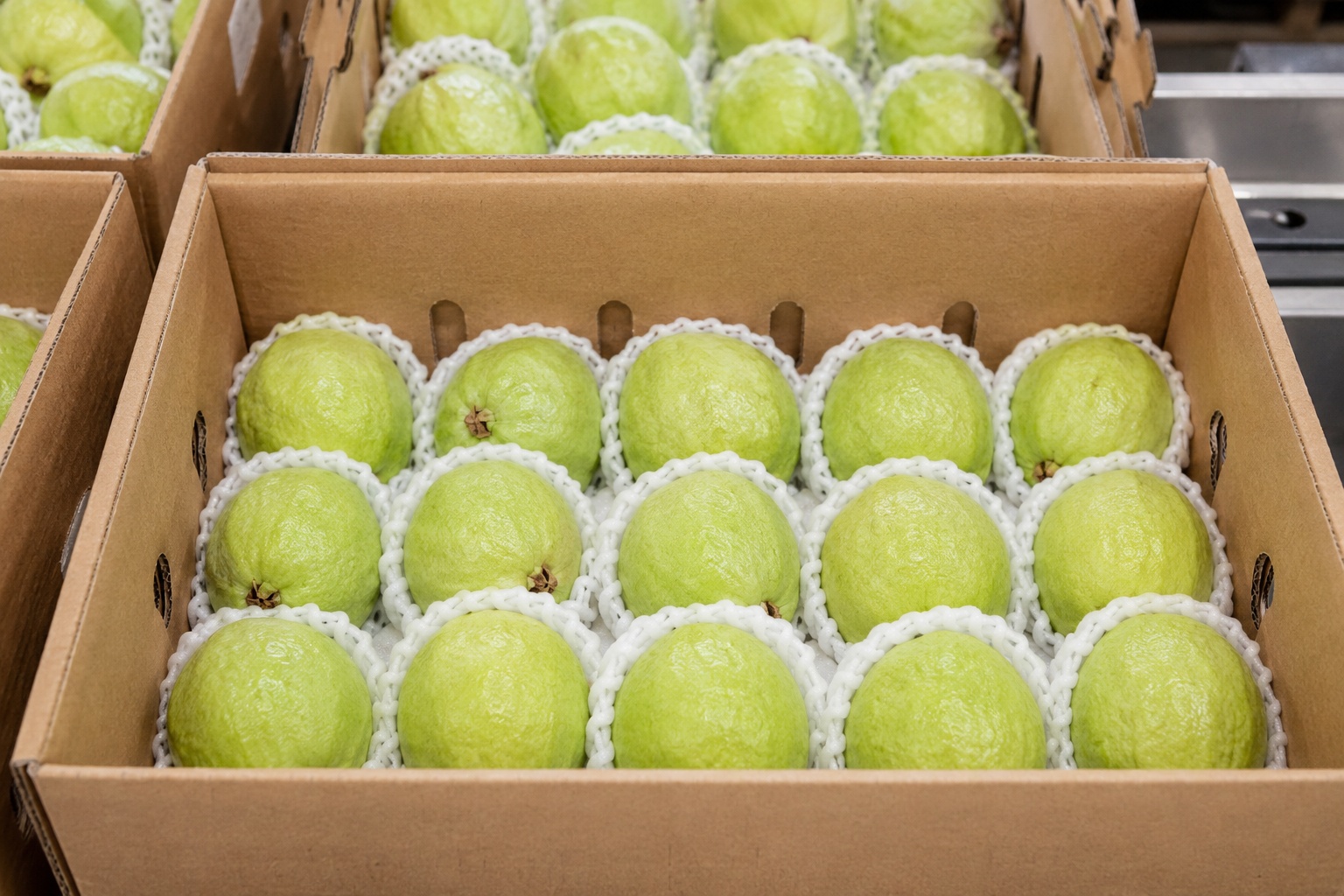
Fresh guava is graded by size, handled gently and kept humid; the right harvest maturity is the key decision for shipping.
Premium fresh guava is frequently airfreighted to reach distant markets before it over-ripens; firmer fruit ships by reefer at ~8–10°C with airflow and logged temperature. Frozen pulp and halves ship at −18°C. A temperature recorder gives the buyer proof the chain held within the correct cool range.
Cool, around 8-10 degrees C at 85-90% humidity – not near 0 degrees C, because guava is chilling-sensitive.
It develops surface pitting, browning and fails to ripen properly.
Roughly 1-2 weeks once ripe, which is why premium fruit is often airfreighted.
Premium fresh guava is often airfreighted; firmer fruit ships by reefer at ~8-10 degrees C.
As pulp, puree or IQF halves held at minus 18 degrees C.
How to cite this page
PEI Trade. “Egyptian Guava Packaging & Cold Chain.” peitrade.com, 2026. https://peitrade.com/egyptian-guava-packaging-cold-chain/
This page is part of our Egyptian Guava Export Guide hub.
Ship Egyptian guava that arrives fragrant with PEI Trade. Prompt pre-cooling, correct chilling-sensitive storage, gentle single-layer packing and airfreight or logged reefer transit — plus frozen pulp and halves at −18°C. Contact: [email protected] · WhatsApp +20 109 911 1918 · www.peitrade.com