Address
Work Hours
Monday to Friday: 7AM - 7PM
Weekend: 10AM - 5PM

Address
Work Hours
Monday to Friday: 7AM - 7PM
Weekend: 10AM - 5PM


Fresh herbs are among the most perishable produce there is, so their cold chain is unforgiving — cool fast, hold cold and humid, move by air. But there is a crucial split: most leafy herbs want near-0°C, while basil is chilling-sensitive and must be kept warm. Dried herbs, by contrast, are shelf-stable and about moisture and pest control. This guide covers the herb cold chain, the basil exception, dried-herb handling, and packing.
Quick answer: Most fresh leafy herbs (mint, parsley, dill, coriander, chives, rocket) are hydro- or forced-air cooled and held cold at ~0–2°C, 95% RH, then airfreighted — they are highly perishable (days, not weeks). Basil is the exception: it is chilling-sensitive and held warm (~10–12°C), because cold makes it blacken. Dried herbs are shelf-stable at ambient, needing dry, cool, pest-free storage. HS codes vary (fresh culinary 0709.99; aromatic 1211.90; dried 1211.90 / 0712).
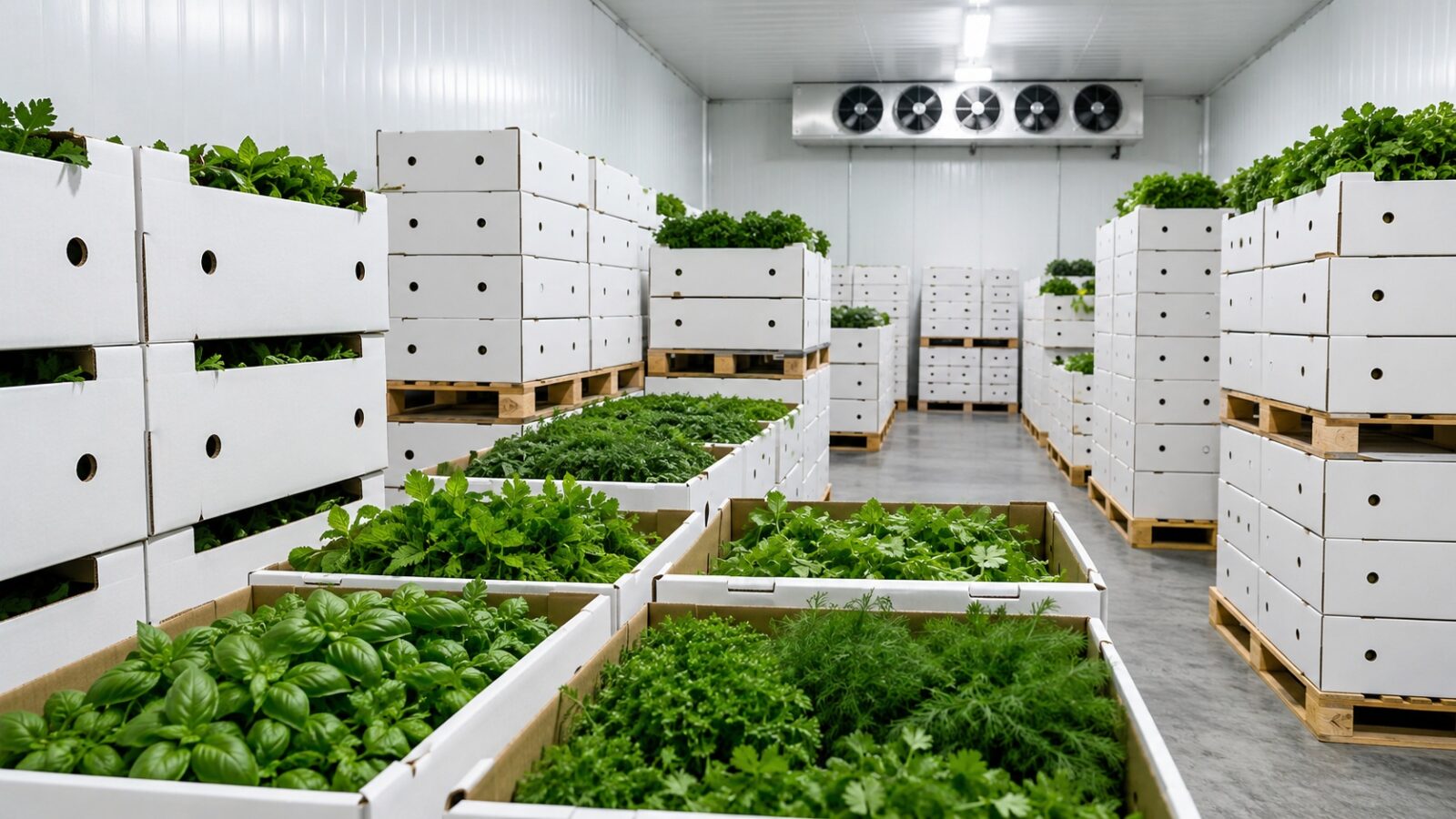
Leafy herbs wilt within hours of cutting if not cooled, so Egyptian export herbs are hydro-cooled or forced-air cooled immediately and held near 0–2°C at very high humidity (~95% RH). Because shelf life is measured in days, they are airfreighted to reach Europe and the Gulf fresh, often with cool packs in the cartons.
Basil breaks the rule: it is chilling-sensitive and develops black, water-soaked patches if held cold. It is kept warm, around 10–12°C, separately from the cold leafy herbs. Mishandling basil in a cold chain is the classic herb error — correct warm handling is the mark of an experienced exporter.
| Product | Temperature | Notes |
|---|---|---|
| Leafy herbs (mint, parsley, dill, coriander) | ~0–2°C, 95% RH | Airfreight; days of shelf life |
| Basil | ~10–12°C | Chilling-sensitive; kept warm & separate |
| Dried herbs | Ambient | Dry, cool, pest-free; low moisture |
Dried herbs are shelf-stable, so handling is about keeping them that way: dried to a low, stable moisture, stored dry, cool and pest-free, and protected from re-absorbing humidity. Good moisture control also underpins the aflatoxin control covered in the requirements guide.
Fresh herbs are graded for colour and aroma and handled gently to avoid bruising and moisture loss; dried herbs are graded by cut size and cleanliness.
Fresh leafy herbs ship by airfreight with cold-chain handling on the ground; basil travels warm and separate. Dried herbs ship by sea or air at ambient. Temperature discipline (and keeping basil out of the cold) is the key to fresh arrival quality.
Most leafy herbs near 0-2 degrees C at ~95% humidity – but basil is kept warm.
Basil is chilling-sensitive and blackens if cold, so it is held around 10-12 degrees C, separate from other herbs.
Only days, which is why they are airfreighted with a tight cold chain.
At ambient – dry, cool and pest-free, at a low, stable moisture content.
By airfreight, often with cool packs, with cold-chain handling on the ground.
How to cite this page
PEI Trade. “Egyptian Herbs Packaging & Cold Chain.” peitrade.com, 2026. https://peitrade.com/egyptian-herbs-packaging-cold-chain/
This page is part of our Egyptian Herbs Export Guide hub.
Ship Egyptian herbs that arrive fresh with PEI Trade. Fast cooling and correct cold storage for leafy herbs, expert warm handling of basil, airfreight logistics, and dry, pest-free handling of dried herbs. Contact: [email protected] · WhatsApp +20 109 911 1918 · www.peitrade.com