Address
Work Hours
Monday to Friday: 7AM - 7PM
Weekend: 10AM - 5PM
Address
Work Hours
Monday to Friday: 7AM - 7PM
Weekend: 10AM - 5PM


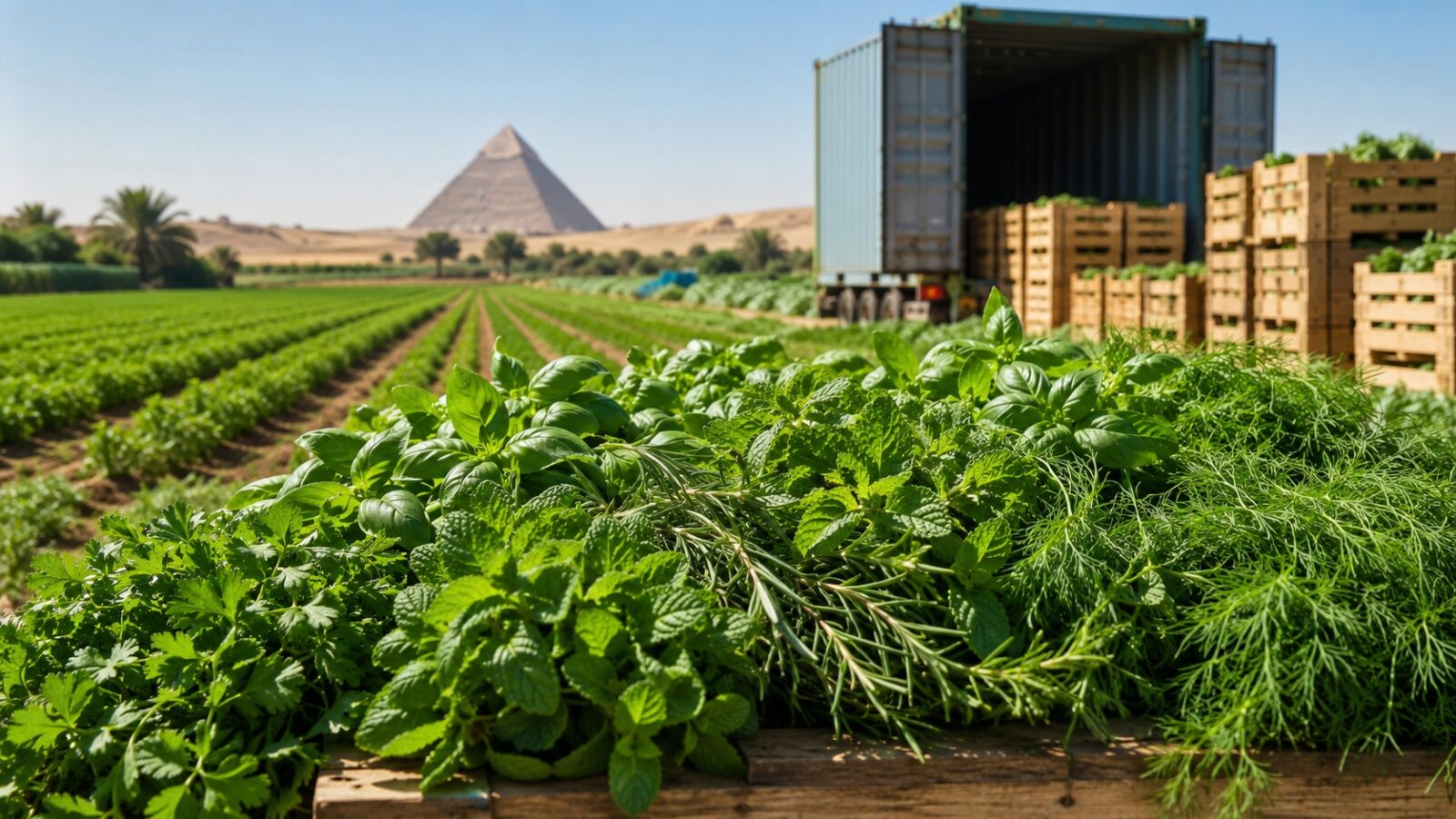
Egypt is one of the world’s leading herb exporters — fragrant fresh mint, basil, parsley, dill and coriander airfreighted to Europe and the Gulf, and a huge dried-herb and spice-seed industry supplying basil, marjoram, mint, coriander, cumin and fennel to food manufacturers worldwide. A warm climate, year-round growing and a deep processing base make Egyptian herbs a global staple. This guide is the hub for importers: what Egypt grows, when it ships, the markets it serves, the specifications buyers ask for and the compliance behind every consignment.
Quick answer: Egypt is one of the world’s leading exporters of dried herbs and spice seeds — a top global supplier of dried basil, marjoram and mint and of seed spices such as coriander, cumin, fennel, caraway and anise — and a major fresh-herb exporter. Fresh lines include mint, basil, parsley, dill, coriander, chives, rocket, rosemary, thyme, sage and marjoram. Fresh herbs are available year-round (peak winter for Europe) and are airfreighted; dried ships year-round. HS codes vary by botanical: fresh leafy culinary herbs commonly 0709.99; aromatic/medicinal herbs (basil, mint, marjoram, sage, rosemary, fresh or dried) under 1211.90; seed spices (coriander, cumin, caraway, fennel, anise) under heading 0909; and other dried spices such as thyme and bay leaves under heading 0910. Most fresh herbs are kept cold (~0–2°C) but basil is chilling-sensitive (~10–12°C). Markets include the EU, UK and the Gulf. (Sources: ITC Trade Map, 2025; CBI.)
| Herb | Form | Notes |
|---|---|---|
| Mint | Fresh & dried | Major line; cold-stored fresh |
| Basil | Fresh & dried | Chilling-sensitive fresh; big dried export |
| Parsley | Fresh & dried | Flat & curled; cold-stored fresh |
| Dill | Fresh & dried | Cold-stored fresh |
| Coriander | Fresh, dried & seed | Leaf cold-stored; seed a major spice line (0909) |
| Cumin, caraway, fennel, anise | Seed (dried) | Major seed-spice exports (heading 0909) |
| Marjoram, thyme, sage, rosemary | Fresh & dried | Aromatic; major dried lines |
Fresh herbs are grown year-round in open field and greenhouses, with the export emphasis on the winter months when European local supply is limited. Dried herbs and spice seeds are produced and shipped year-round. Growing and drying are concentrated in Beheira, Nubaria, Fayoum, Beni Suef and Minya, the last three being major dried-herb, seed-spice and medicinal-plant areas. Exact patterns vary by botanical, planting and weather.
HS classification depends on the botanical and form, which buyers should confirm per line: fresh leafy culinary herbs (parsley, dill, coriander leaf, rocket, chives) commonly fall under 0709.99; aromatic and medicinal herbs used mainly in flavouring, perfumery or pharmacy (basil, mint, marjoram, sage, rosemary), whether fresh or dried, under 1211.90; seed spices (coriander seed, cumin, caraway, fennel, anise) under heading 0909 — not 0910; and other spices such as thyme, bay leaves, ginger and turmeric under heading 0910.
Herbs are a high-scrutiny category. Fresh herbs require a phytosanitary certificate, strict compliance with destination MRLs (EU: Regulation (EC) No 396/2005 — fresh herbs face close residue checking), and microbiological control (Salmonella/E. coli on leafy herbs), with GLOBALG.A.P. certification. Dried herbs and spice seeds additionally need HACCP with controls for aflatoxins, Salmonella and, for some, unauthorised dyes (e.g. Sudan), often with BRCGS / ISO 22000. While Egypt as an origin is not on the EU’s enhanced official-controls list (Regulation (EU) 2019/1793) for herbs, the category is inherently residue- and contaminant-sensitive, so disciplined MRL and microbiological management is essential to avoid border rejections.
Fresh and dried mint, basil, parsley, dill, coriander, chives, rocket and aromatic herbs like marjoram, thyme, sage and rosemary, plus seed spices such as coriander, cumin, caraway, fennel and anise.
Yes – it is among the world’s largest dried-herb and seed-spice suppliers and a major fresh-herb exporter.
Yes – fresh herbs grow year-round (with a winter export emphasis), and dried herbs and seed spices ship year-round.
Mostly airfreighted because they are highly perishable, with cold-chain handling (basil kept warmer).
Phytosanitary certificates, strict MRLs and micro control for fresh; HACCP with aflatoxin/Salmonella/dye controls for dried and seed spices.
How to cite this page. Reusing a figure from this guide? Please cite it and link to this page as the source.
PEI Trade. “Egyptian Fresh Herbs Export: The Complete Guide.” peitrade.com, 2026. https://peitrade.com/egyptian-herbs-export-guide/
Source Egyptian herbs with PEI Trade. We supply fresh culinary and aromatic herbs, a full range of dried herbs and seed spices to EU, UK and Gulf buyers, with GLOBALG.A.P. handling, strict residue and microbiological control, and correct cold-chain or airfreight logistics. Contact: [email protected] · WhatsApp +20 109 911 1918 · www.peitrade.com