Address
Work Hours
Monday to Friday: 7AM - 7PM
Weekend: 10AM - 5PM
Address
Work Hours
Monday to Friday: 7AM - 7PM
Weekend: 10AM - 5PM


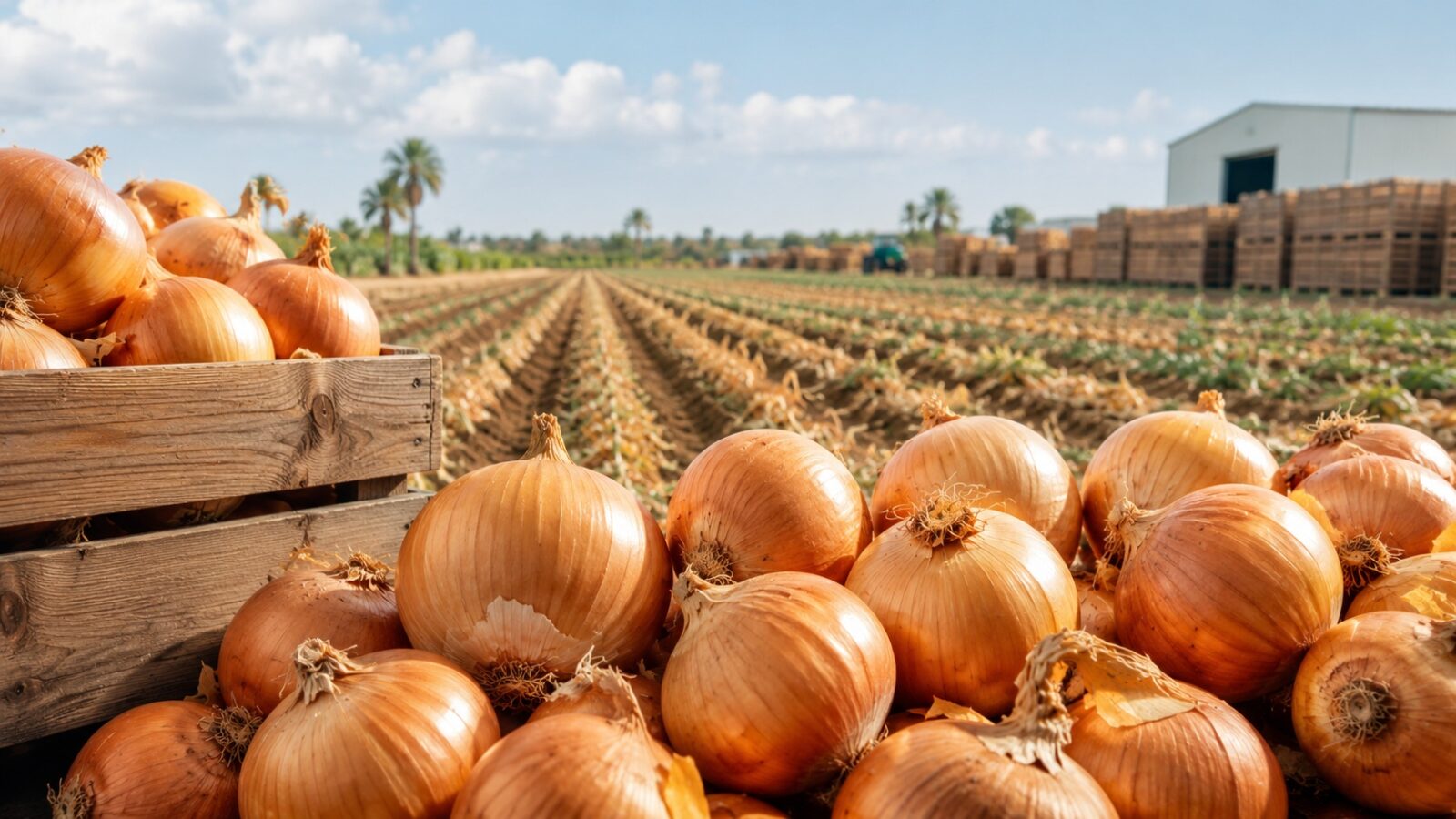
Egypt is one of the world’s major onion exporters, and its onions — firm, pungent, long-storing golden and red bulbs — reach Europe, the Gulf, the UK, Russia, Asia and Africa. A spring harvest that lands before Europe’s own crop, combined with low growing costs and good storage life, makes Egyptian onions a counter-seasonal staple for importers. This guide is the hub: what Egypt grows, when it ships, the markets it serves, the specifications buyers ask for and the compliance behind every consignment.
Quick answer: Egypt is the world’s third-largest onion producer (around 3.7–3.8 million tons a year), and onions are among its top agricultural exports at roughly 277,000 tons (its fifth-largest agri-export). The main export window runs roughly April to October — built on the March–May bulb harvest plus cold-dry storage, with early spring/green onions from around February — counter-seasonal supply that reaches Europe before its own crop. Egypt ships golden/yellow and red onions to the EU, Gulf, UK, Russia, Asia and Africa. Fresh onions are traded under HS code 0703.10 (dried/dehydrated onion under 0712.20). (Sources: FAO, 2023; ITC Trade Map / Egyptian Ministry of Agriculture, 2025.)
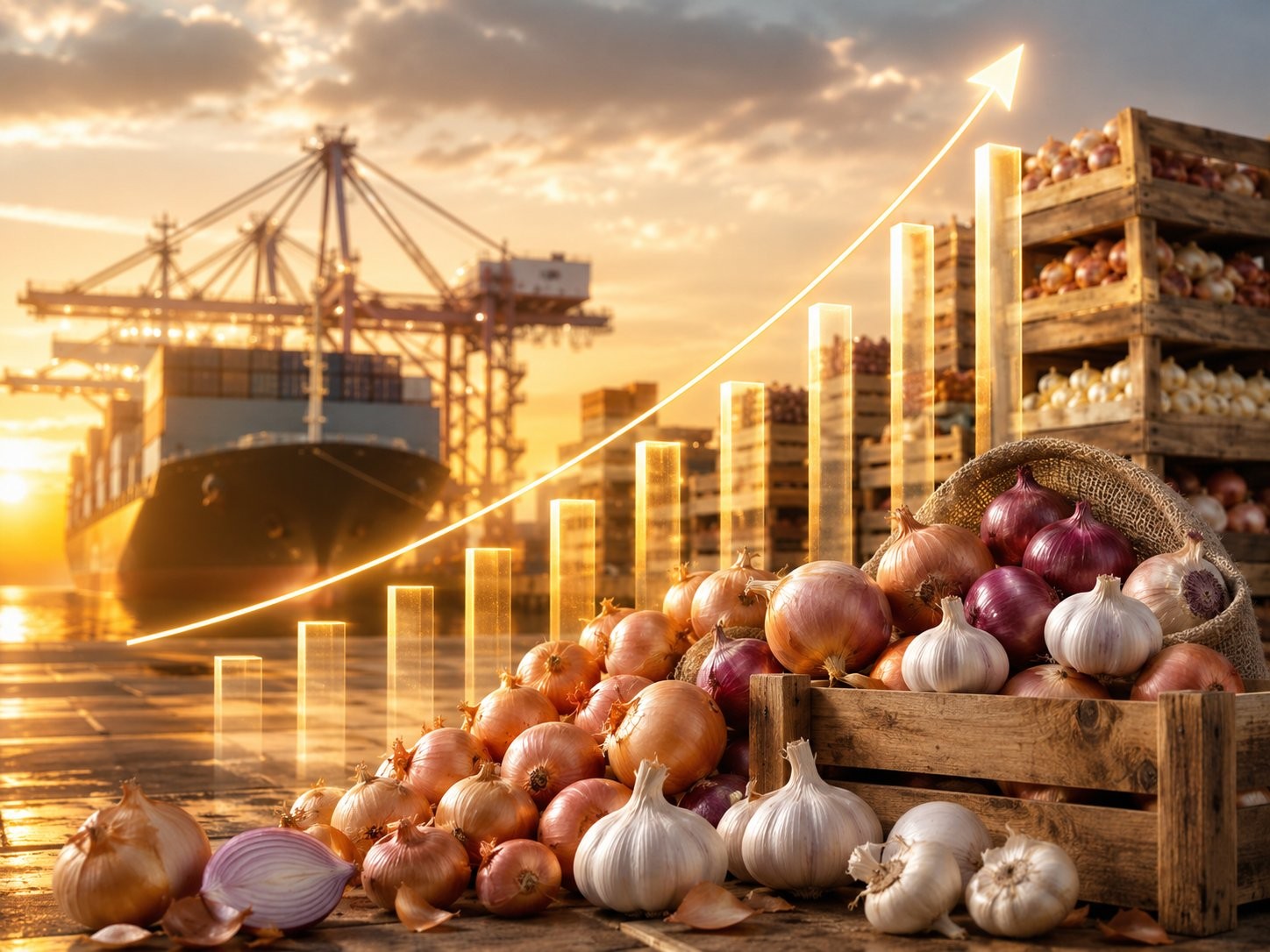
Egypt grows both main colour types at export scale, alongside early-season green onions and a dehydrated segment for processing.
| Type | Notes | Main use / market |
|---|---|---|
| Golden / yellow onions | Firm, pungent, long shelf life; the export mainstay | EU, Gulf, UK — retail & foodservice |
| Red onions (e.g. Giza 6 and local red types) | Deep red, firm | Gulf, Asia, Europe |
| Spring / green onions | Early-season, bunched | Early export windows |
| Dehydrated onion (segment) | Dried flakes / granules / powder | Food processing — global |
The Egyptian onion bulb harvest runs from about March to May, and the main export window runs from roughly April to October — the spring crop plus cold, dry storage. Early spring/green onions open the window from around February, and the main golden and red bulb crop follows. Exact harvest and export dates shift year to year with planting and weather.
Note on export policy: Egypt has at times regulated or temporarily restricted onion exports to manage domestic supply and prices, so the current export-policy status should be confirmed before contracting.
Fresh onions and shallots are traded under HS code 0703.10; dried/dehydrated onion (flakes, granules, powder) falls under 0712.20.
For EU and UK programs, onions must meet residue limits (MRLs, Regulation (EC) No 396/2005) and the EU general marketing standard for fresh produce, travel with a phytosanitary certificate, and increasingly carry GLOBALG.A.P. certification with packhouse food-safety management (HACCP, and where required ISO 22000 or a GFSI scheme). Wood pallets must be ISPM 15 compliant, with clear lot-coded traceability. Egyptian onions are not on the EU’s enhanced official-controls list (Regulation (EU) 2019/1793), so they are not subject to increased border checks — standard MRL and phytosanitary rules apply.
The bulb harvest runs roughly March to May, and the main export window runs from about April to October (spring crop plus cold, dry storage), with early spring/green onions from around February.
Mainly golden/yellow and red onions, plus early spring/green onions and a significant dehydrated-onion segment for processing.
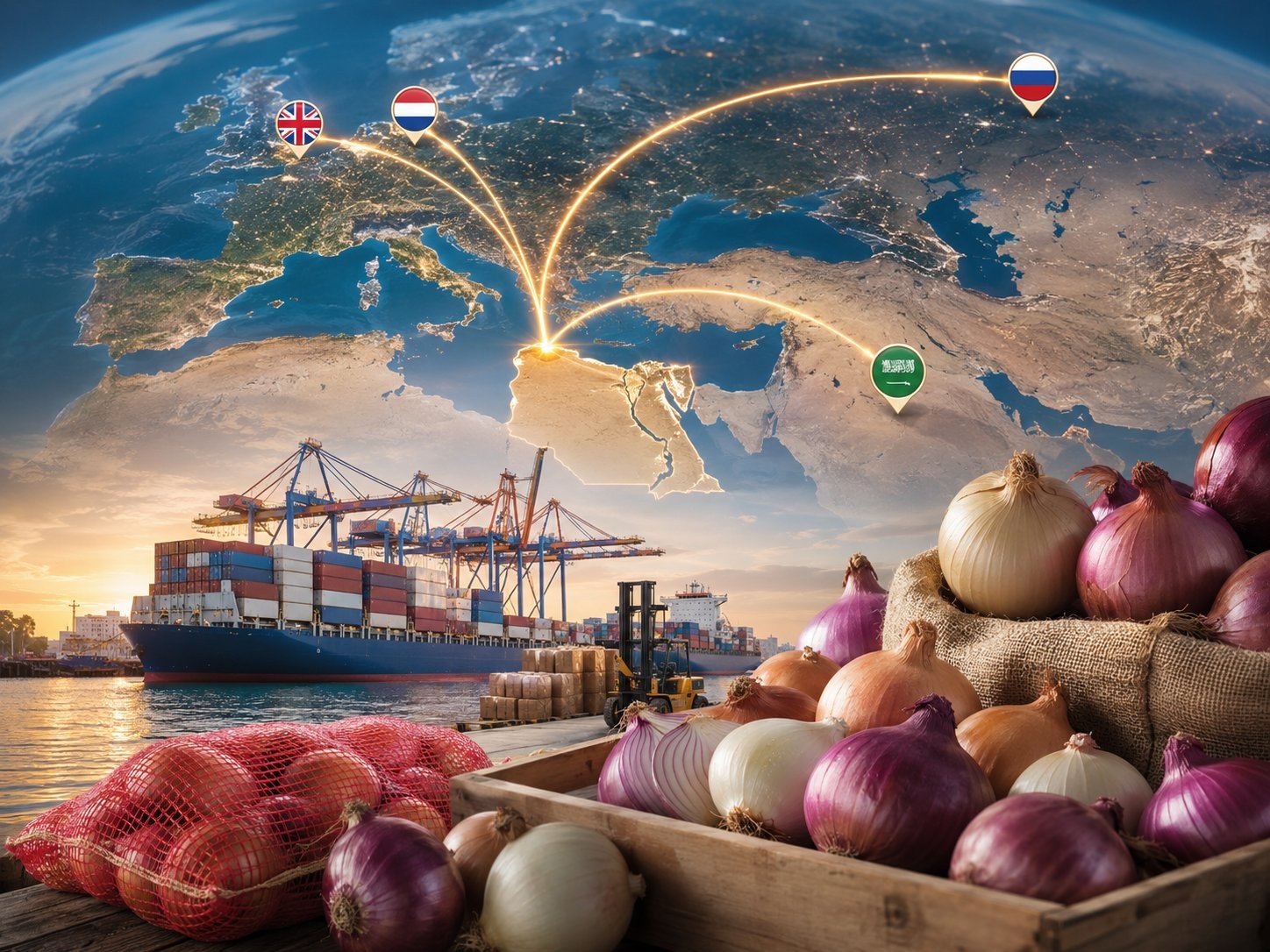
The EU (a major spring market), the Gulf and Arab states, the UK, Russia, Asia and Africa.
Fresh onions and shallots fall under HS code 0703.10; dried or dehydrated onion falls under 0712.20.
A phytosanitary certificate, compliance with EU MRLs and the general marketing standard, GLOBALG.A.P. with packhouse food-safety certification, and ISPM 15 wood packaging.
How to cite this page. Reusing a figure from this guide? Please cite it and link to this page as the source.
PEI Trade. “Egyptian Onion Export: The Complete Guide.” peitrade.com, 2026. https://peitrade.com/egyptian-onion-export-guide/
Source Egyptian onions with PEI Trade. We supply golden and red onions — graded to your calibers — to EU, Gulf, UK, Russian, Asian and African buyers, with GLOBALG.A.P. handling, full documentation and cold-dry storage discipline. Contact: [email protected] · WhatsApp +20 109 911 1918 · www.peitrade.com