Address
Work Hours
Monday to Friday: 7AM - 7PM
Weekend: 10AM - 5PM

Address
Work Hours
Monday to Friday: 7AM - 7PM
Weekend: 10AM - 5PM


Specification reference for Egyptian onion exports: yellow, red and golden types, size bands in millimetres, mesh bag and jumbo bag formats, pallet and container configuration, storage set points and the defects that decide an arrival grading.
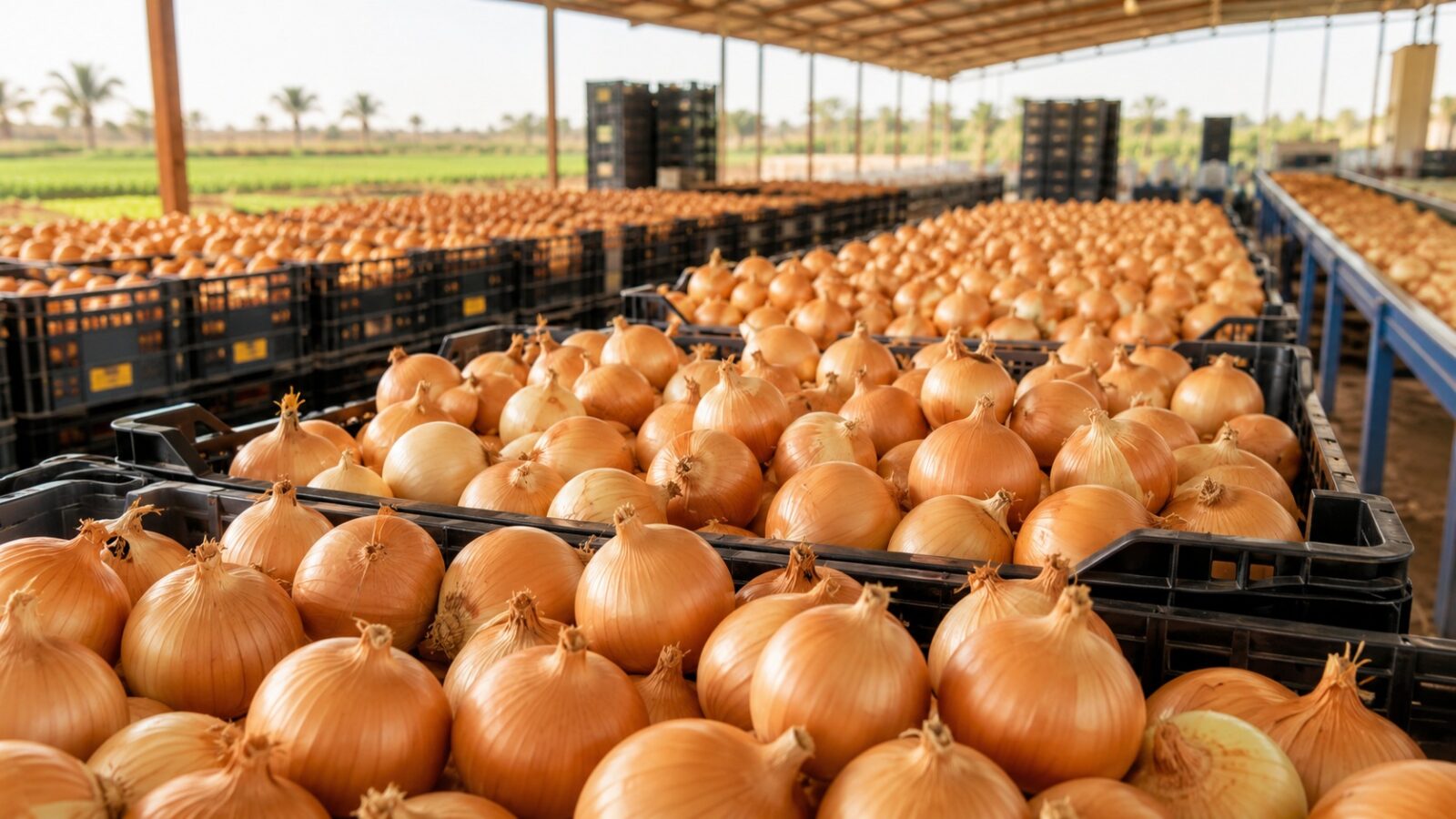
Onion is the least glamorous line in the Egyptian export basket and one of the most reliable. It ships in a ventilated dry box rather than a reefer on most lanes, it carries a long selling window at destination, and it tolerates a transit that would finish a soft fruit. What it does not tolerate is a loose specification. Almost every onion dispute we see traces back to a contract that named a colour and a weight and nothing else.
Three categories cover nearly all export volume. Yellow or brown onion, including the Giza selections and yellow hybrids, is the workhorse for wholesale and processing across the Gulf, Europe and West Africa. Red onion, dominated by the Behairy type and its selections, moves into markets where cooking practice favours a sharper bulb, particularly parts of the Gulf, East Africa and South Asia. Golden or Grano-type onion from the early crop is milder and softer skinned, better suited to early-season programmes than to long storage.
The practical difference for a buyer is skin retention and dry matter. A high dry matter yellow onion from the main crop holds its skins through a long sea leg. An early Grano type in the same box, on the same transit, arrives scuffed and pale. Specify the crop, not just the colour.
The early crop lifts from roughly February into April, the main crop from April through June. What ships now, in September, is stored main-crop onion out of controlled storage. That is an important distinction commercially. Stored onion is graded a second time before packing, so the export percentage is lower and the price reflects it, but the bulbs that pass have already survived several months and travel well. Expect stored volume to run until the early crop reopens the cycle.
Onion is sold on diameter bands, not on count. The common export bands are 40 to 60 mm, 50 to 70 mm, 60 to 80 mm and 70 to 90 mm, with a jumbo band above 90 mm for specific processing and foodservice buyers. Narrower bands cost more because they consume more grading time. Class I (a grade tier from the applicable marketing standard, not a marketing term — see our Extra, Class I and Class II tolerances reference) tolerances allow a small percentage outside the band and a small percentage of superficial defects. Agree the tolerance figure in the contract rather than relying on a general reference to Class I, and state whether the band is a hard screen or a nominal one.
Rejection at arrival usually comes down to four defects: sprouting, neck rot, soft or watery scales, and doubles. Sprouting is the one most affected by storage temperature and by how the crop was cured before it went in. Our reference on curing onions, garlic and root crops covers why the cure decides what the bulb can survive later.
Mesh bags in 5, 10, 20 and 25 kg are the standard export formats, printed or with an applied label depending on market. Jumbo or big bags of 800 to 1,000 kg are used for processing buyers and for some bulk wholesale lanes. Carton packing exists for retail programmes but is a minority of volume.
A 40 ft high cube ventilated container typically takes 26 to 28 tonnes of onion depending on bag format, stow pattern and the road weight limit at both ends. Palletised loads carry less product and more air but arrive in better order and unload in a fraction of the time. Which of the two suits a lane is a commercial decision, not a technical one, and it should be settled before the price is quoted.
Onion in storage is held cold and dry. In transit the priority is air movement and moisture removal rather than deep chilling, which is why ventilated dry containers handle most of the volume and why vents are set open on the usual routings. A sealed box on a long humid leg is what produces the arrival mould that buyers then blame on the packhouse. The same logic governs garlic, and the parallel specification sits in our Egyptian garlic export specification.
Type and crop, size band and tolerance, bag format and weight, pallet or loose stow, container type and vent setting, and the labelling required by the destination. Six lines, and they remove most of the ground an arrival dispute needs.
For current availability, size bands and a quotation on Egyptian onion, FOB Alexandria or Damietta or on CFR terms to your port, message the PEI Trade export desk on WhatsApp at +20 10 9911 1918.
