Address
Work Hours
Monday to Friday: 7AM - 7PM
Weekend: 10AM - 5PM

Address
Work Hours
Monday to Friday: 7AM - 7PM
Weekend: 10AM - 5PM


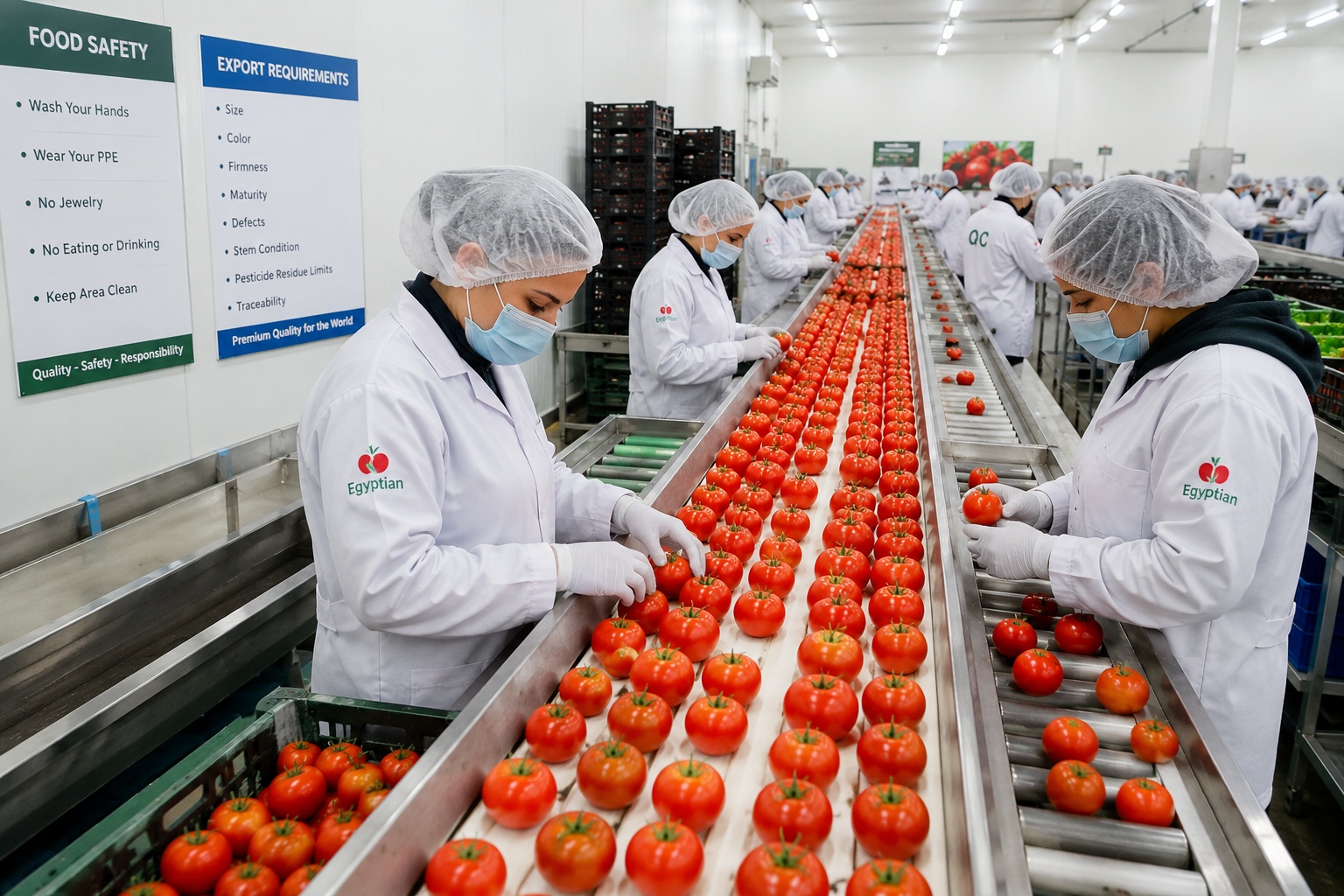
Tomatoes carry a distinctive compliance profile: a high-impact quarantine pest (Tuta absoluta), virus and whitefly concerns, MRL scrutiny on a heavily sprayed crop, and — for paste and sun-dried — a full processed-food safety layer. Getting these right is what keeps fresh and processed tomato consignments moving. This guide sets out what an importer and exporter need to move Egyptian tomatoes cleanly.
Quick answer: Fresh tomatoes need a phytosanitary certificate (key pest: tomato leafminer, Tuta absoluta; plus fruit flies and whitefly-borne viruses), compliance with destination MRLs (EU: Regulation (EC) No 396/2005), and GLOBALG.A.P. with ISPM 15 packaging and traceability. Paste, concentrate and sun-dried need HACCP plus a GFSI scheme (BRCGS / ISO 22000) and microbiological control. Fresh trades under HS 0702.00, paste under HS 2002.90.
Fresh tomatoes travel with an official phytosanitary certificate from Egypt’s plant-quarantine authority (CAPQ). The central concern is the tomato leafminer (Tuta absoluta), a globally regulated pest, alongside fruit flies and whitefly-transmitted viruses (e.g. tomato leaf-curl). Control rests on monitored field programs, protected cultivation and pre-export inspection. Under EU plant-health law (Regulation (EU) 2019/2072), tomato consignments must meet defined special requirements — typically pest-free-area origin or production-site freedom established by official inspection during the growing season — for Tuta absoluta and regulated tomato viruses; confirm the conditions in force for each destination and season before shipping.
Tomatoes must meet destination MRLs — for the EU, Regulation (EC) No 396/2005. As an intensively grown, thin-skinned crop eaten fresh, tomatoes attract residue attention, so exporters run disciplined spray programs, observe pre-harvest intervals and use accredited residue testing before shipment.
Processed tomato products are foods in their own right and require full food-safety management: HACCP with a GFSI-recognised scheme (BRCGS, IFS or ISO 22000 / FSSC 22000), hygiene and water control, microbiological testing, and correct preservation (aseptic filling for paste; controlled drying for sun-dried). Buyers often specify Brix, colour and mould-count limits.
For EU and UK retail, GLOBALG.A.P. certification is the baseline for fresh, frequently with the GRASP add-on, alongside packhouse food-safety management (HACCP) and clear lot-coded traceability. Wood pallets and dunnage must be ISPM 15 compliant.
| Document | Fresh | Paste / sun-dried |
|---|---|---|
| Phytosanitary certificate | Required (Tuta absoluta) | Often required (sun-dried) |
| Residue test report (MRLs) | Strongly expected | Recommended |
| GLOBALG.A.P. certificate | Baseline | At farm level |
| BRCGS / IFS / ISO 22000 | — | Expected (plant) |
| Health / free-sale certificate | — | Often required |
| CoO / EUR.1, invoice, packing list, B/L | Required | Required |
A phytosanitary certificate, MRL compliance, GLOBALG.A.P. and standard commercial documents.
The tomato leafminer (Tuta absoluta), plus fruit flies and whitefly-borne viruses – with EU special requirements under Regulation (EU) 2019/2072.
They are intensively grown, thin-skinned and eaten fresh, so MRL compliance and testing are important.
HACCP with a GFSI scheme (BRCGS/IFS/ISO 22000), microbiological control and correct preservation.
Fresh tomatoes are HS 0702.00; paste/concentrate is HS 2002.90.
How to cite this page
PEI Trade. “Egyptian Tomato Export Requirements.” peitrade.com, 2026. https://peitrade.com/egyptian-tomato-export-requirements/
This page is part of our Egyptian Tomato Export Guide hub.
Export Egyptian tomatoes the compliant way with PEI Trade. Phytosanitary documentation and Tuta absoluta control, MRL-compliant production with accredited testing, GLOBALG.A.P. for fresh, and HACCP/BRCGS food safety for paste, concentrate and sun-dried. Contact: [email protected] · WhatsApp +20 109 911 1918 · www.peitrade.com