Address
Work Hours
Monday to Friday: 7AM - 7PM
Weekend: 10AM - 5PM

Address
Work Hours
Monday to Friday: 7AM - 7PM
Weekend: 10AM - 5PM


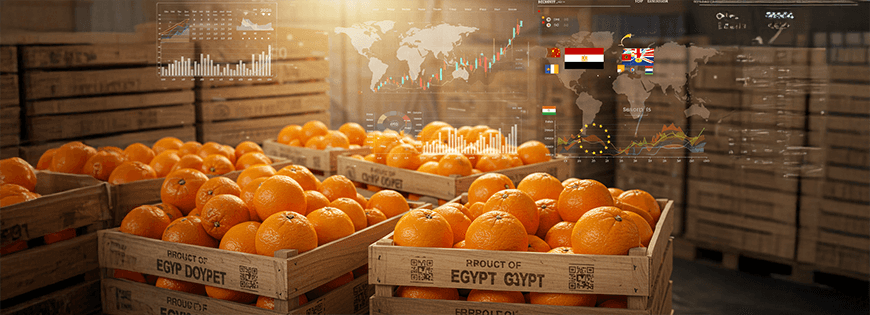
Egypt is the world’s largest orange exporter by volume, ahead of Spain and South Africa. For an importer that raises two practical questions: which markets the fruit already flows into and what the established lanes look like, and how the price you are quoted moves through a season. This guide covers both, plus the logistics points that decide whether a container arrives in condition.
It is written for buyers sourcing from Egypt rather than for growers. If you are qualifying suppliers, the companion piece is best orange export companies in Egypt; if you want the full technical picture on varieties, grades and cold chain, start from the complete Egyptian citrus export guide.
Egypt is the largest orange exporter in the world by volume, on published trade reporting.
| Market | Why it buys Egyptian | What it typically specifies |
|---|---|---|
| Russia and Eastern Europe | Egypt’s single largest citrus destination; limited access to EU produce | Volume fruit, mid-to-large counts, Navel through winter |
| Gulf states (Saudi Arabia, UAE, Qatar) | Short transit, consistent supply, Ramadan demand | Appearance-led Navel; retail-ready packs |
| India | Growing fresh-fruit demand at a mid price point | Larger volumes, less demanding on cosmetic grade |
| China | Protocol market; access is documentation-driven | Strict phytosanitary compliance and cold treatment where required |
| European Union | Fills seasonal gaps in Mediterranean supply | Tight residue compliance, count precision, retail labelling |
| Netherlands and Greece re-export hubs | Onward distribution into Europe | Pallet configuration that suits repacking |
We do not publish price figures, because a number written on a page is wrong within weeks and misleads a buyer into planning against it. What is stable is the shape of the curve, and knowing it is worth more than a stale figure:
| Driver | How it moves the quote | What a buyer can do about it |
|---|---|---|
| Position in the season | Highest at the opening, softest through peak harvest, firming again as the window closes | Programme across the curve rather than buying only at the open |
| Count demanded | The counts the retail trade is chasing carry a premium over the rest of the size curve | Accept a count range rather than a single count where the end use allows |
| Freight on the lane | Moves independently of the fruit and can dominate a landed cost on long lanes | Quote FOB and CIF separately so you can see which moved |
| Currency | Egyptian pound movement feeds through to FOB quotes | Fix the currency of the contract explicitly |
| Specification tightness | Narrow defect and count tolerances cost more to pack to | Specify what your market actually rejects, not the strictest option |
Most orange claims are not fruit problems. They are cold chain or paperwork problems that became fruit problems by the time the container was opened.
A full 40 ft high-cube reefer of oranges is 1,664 cartons and 24,960 kg net on our standard stow. Not every buyer wants that as a first order, and there are two ways below it: a mixed container that carries oranges alongside another Egyptian line, or a part load consolidated with other cargo on the same lane. Both cost more per kilo than a full container, and which is available depends on the destination and the week.
Tell us the quantity you actually want and we will say which of the two is possible for your weeks rather than quoting a container you do not need.
Russia and Eastern Europe take the largest share, followed by the Gulf states, with India, China and the European Union all significant. Netherlands and Greek re-export hubs move fruit onward into Europe.
Because a figure on a page is wrong within weeks and a buyer who plans against it is misled. Pricing moves with the position in the season, the count demanded, freight on the lane, currency and how tight the specification is. Send the requirement and we quote against the position on the day.
Through the peak harvest, softest in the middle of a variety’s window rather than at its opening or close. Programming across the curve usually beats buying only at the open.
Yes, either as a mixed container carrying oranges alongside another Egyptian line, or as a part load consolidated on the same lane. Both cost more per kilo than a full container, and availability depends on destination and week.
1,664 cartons of 15 kg in a 40 ft high-cube reefer on our standard stow: 24,960 kg net, 26,624 kg gross with the cartons. The arithmetic is set out line by line in the ten reasons guide.
Yes. Custom cartons with your logo, language and design, built to the destination market’s labelling rules so the pack clears without relabelling at the port.
Cold chain and documentation, not the fruit. A set point that was not recorded for the lane, a stow that blocks airflow, or a destination document prepared generically rather than to that market’s requirement.
Send the destination port, the volume, the variety and count, and the shipping weeks. We will quote against the current position and say plainly what is not available for those weeks rather than quoting around it.