Address
Work Hours
Monday to Friday: 7AM - 7PM
Weekend: 10AM - 5PM
Address
Work Hours
Monday to Friday: 7AM - 7PM
Weekend: 10AM - 5PM


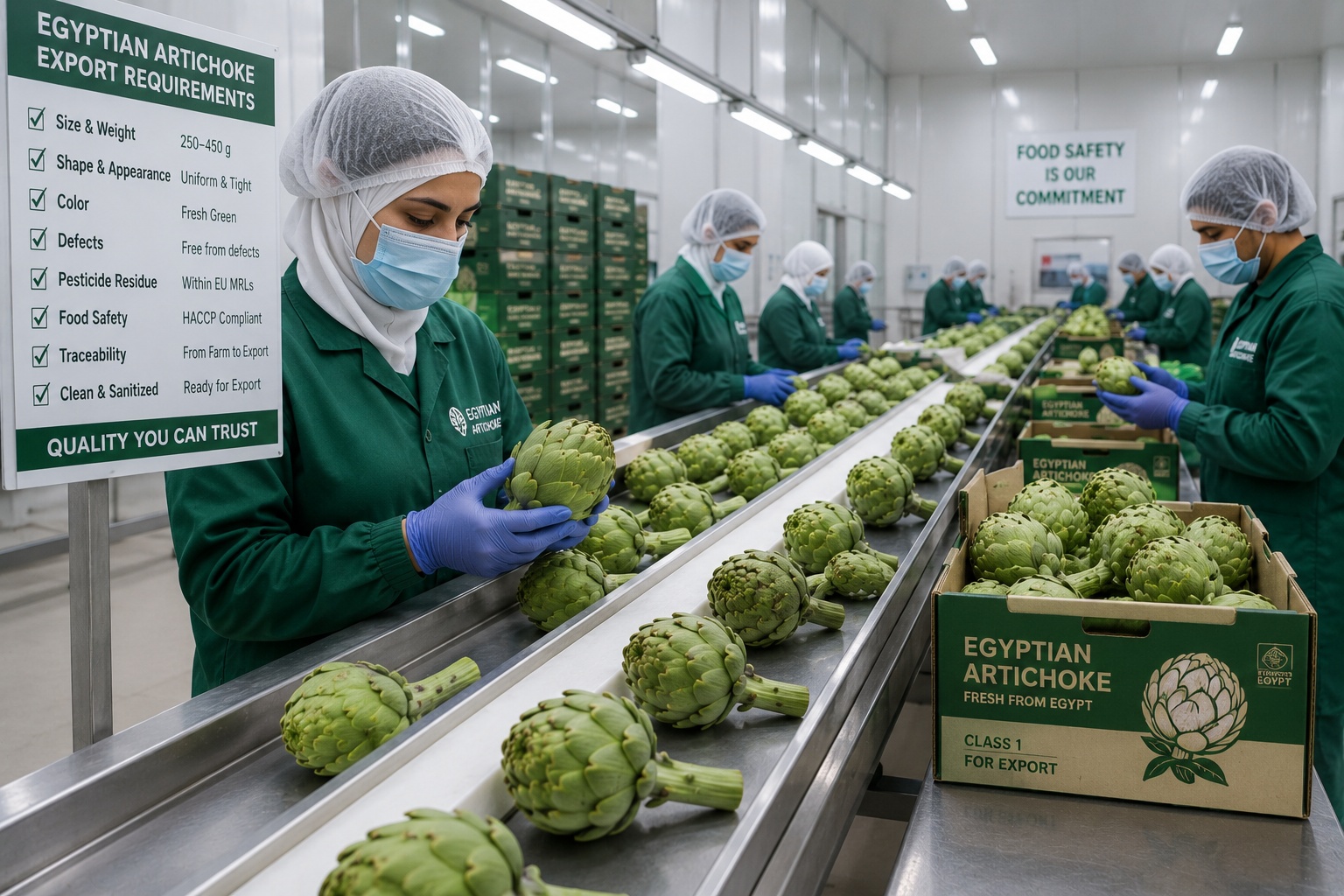
Artichokes are a relatively well-behaved fresh export on compliance, with the usual phytosanitary and MRL fundamentals — but the large frozen-hearts business adds a full food-safety layer that processors must meet. This guide sets out what an importer and exporter need in place to move Egyptian artichokes (fresh and frozen) cleanly.
Quick answer: Fresh artichokes need a phytosanitary certificate, compliance with destination MRLs (EU: Regulation (EC) No 396/2005), and GLOBALG.A.P. with ISPM 15 packaging and traceability. Frozen hearts and bottoms need HACCP plus a GFSI scheme (BRCGS / IFS / ISO 22000) and microbiological control. Fresh trades under HS 0709.91, frozen under HS 0710.80.
Fresh artichokes travel with an official phytosanitary certificate from Egypt’s plant-quarantine authority (CAPQ), confirming inspection and freedom from quarantine pests (artichoke aphid and others), managed through field programs and pre-export inspection.
Artichokes must meet destination MRLs — for the EU, Regulation (EC) No 396/2005. Exporters follow approved spray programs, pre-harvest intervals and, where required, residue testing. Artichoke is not currently among the Egyptian products on the EU’s enhanced import-controls list (Regulation (EU) 2019/1793); verify the latest annex and any destination-specific checks before shipping.
Frozen / IQF artichoke hearts and bottoms are a processed food, so they require full food-safety management: HACCP with a GFSI-recognised scheme (BRCGS, IFS or ISO 22000 / FSSC 22000), hygiene and water control, microbiological testing, and an unbroken −18°C cold chain. Anti-browning control (e.g. citric/ascorbic treatment) during trimming is standard for colour.
For EU and UK retail, GLOBALG.A.P. certification is the baseline for fresh, frequently with the GRASP add-on, alongside packhouse food-safety management (HACCP) and clear lot-coded traceability. Wood pallets and dunnage must be ISPM 15 compliant.
| Document | Fresh | Frozen |
|---|---|---|
| Phytosanitary certificate | Required | Not applicable |
| Residue test report | As required (MRLs) | Recommended |
| GLOBALG.A.P. certificate | Baseline | At farm level |
| BRCGS / IFS / ISO 22000 | — | Expected (plant) |
| Health / free-sale certificate | — | Often required |
| Certificate of Origin / EUR.1 | Required | Required |
| Invoice, packing list, B/L | Required | Required |
| ISPM 15 marked pallets | If wood used | If wood used |
A phytosanitary certificate, MRL compliance, GLOBALG.A.P., ISPM 15 packaging and standard commercial documents.
HACCP with a GFSI scheme (BRCGS/IFS/ISO 22000), microbiological control and an unbroken minus 18 degrees C cold chain.
Cut artichoke flesh browns quickly, so citric/ascorbic treatment during trimming keeps frozen hearts pale and attractive.
Artichoke aphid and other field pests, controlled through monitored programs and inspection.
Fresh artichokes are HS 0709.91; frozen are HS 0710.80.
How to cite this page
PEI Trade. “Egyptian Artichoke Export Requirements.” peitrade.com, 2026. https://peitrade.com/egyptian-artichoke-export-requirements/
This page is part of our Egyptian Artichoke Export Guide hub.
Export Egyptian artichokes the compliant way with PEI Trade. Phytosanitary documentation and pest control, MRL-compliant production and GLOBALG.A.P. for fresh, and HACCP/BRCGS-level food safety with colour control for frozen hearts and bottoms. Contact: [email protected] · WhatsApp +20 109 911 1918 · www.peitrade.com