Address
Work Hours
Monday to Friday: 7AM - 7PM
Weekend: 10AM - 5PM

Address
Work Hours
Monday to Friday: 7AM - 7PM
Weekend: 10AM - 5PM


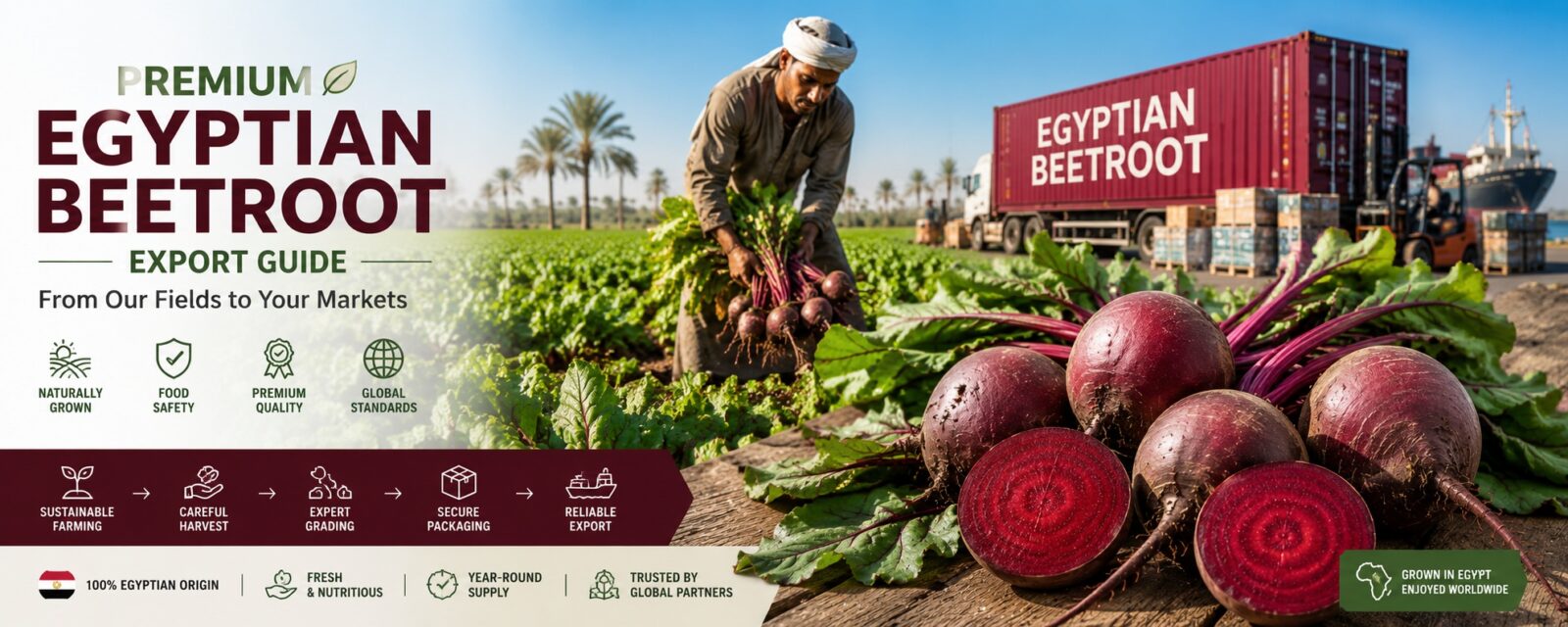
Beetroot is a dependable, well-travelling Egyptian root export — deep-red table beet shipped fresh to Europe, the Gulf and Russia, plus cooked and frozen beetroot for the convenience trade. Sandy soils, good storage behaviour and steady demand make it a reliable, year-round line. (Note: this guide covers table beetroot; sugar beet is a separate, domestically processed crop.) This guide is the hub for importers: what Egypt grows, when it ships, the markets it serves, the specifications buyers ask for and the compliance behind every consignment.
Quick answer: Egypt exports red table beetroot — Detroit-type round and Cylindra — plus golden and Chioggia specialty types, sold fresh (bunched with tops or topped) and as cooked / frozen product. It is available much of the year (main winter–spring) and stores well. Fresh beetroot trades under HS code 0706.90 and frozen under HS 0710.80 (note: sugar beet is a different crop under HS 1212.91). It is not chilling-sensitive — stored cold near 0°C. Markets include the EU, the Gulf, Russia and Eastern Europe. (Source: ITC Trade Map, 2025.)
| Type | Character | Best for |
|---|---|---|
| Red round (Detroit type) | Round, deep red, smooth | Fresh & processing (the mainstay) |
| Cylindra | Cylindrical, even slices | Slicing & processing |
| Golden | Yellow-gold flesh, mild, no bleed | Specialty retail |
| Chioggia | Red-and-white rings, striking | Specialty & foodservice |
Beetroot is available for much of the year, with the main cool-season crop harvested from about November to April. Because topped roots store well, Egypt can supply beyond the main harvest from controlled storage. Production is concentrated in the Nile Delta, Beheira and Nubaria. Exact windows shift year to year with planting and weather.
Fresh beetroot is traded under HS code 0706.90, frozen under HS 0710.80. (Sugar beet, a separate crop, is classified under HS 1212.91.)
Fresh beetroot requires a phytosanitary certificate with soil freedom (as for any root crop), compliance with destination MRLs (EU: Regulation (EC) No 396/2005 — generally lower residue risk for a root), and GLOBALG.A.P. with ISPM 15 packaging and traceability. Cooked/frozen beetroot is a processed food and additionally needs food-safety management (HACCP, and where required BRCGS / ISO 22000). Egyptian beetroot is not on the EU’s enhanced official-controls list (Regulation (EU) 2019/1793), so it is not subject to increased border checks — standard MRL and phytosanitary rules apply.
The main cool-season crop is harvested from about November to April, but topped roots store well, so Egypt supplies beetroot for much of the year.
Red round (Detroit type) and Cylindra, plus golden and Chioggia specialty types.
No – this is table beetroot for eating (HS 0706.90). Sugar beet is a separate crop grown for sugar processing and classified under HS 1212.91; Egypt grows it at large scale, but it is processed domestically, not exported as a vegetable.
Fresh beetroot under HS 0706.90 and frozen under HS 0710.80.
Cold, near 0 degrees C at high humidity – beetroot is not chilling-sensitive and keeps well.
How to cite this page. Reusing a figure from this guide? Please cite it and link to this page as the source.
PEI Trade. “Egyptian Beetroot Export: The Complete Guide.” peitrade.com, 2026. https://peitrade.com/egyptian-beetroot-export-guide/
Source Egyptian beetroot with PEI Trade. We supply red, golden and Chioggia table beetroot — bunched, topped and cooked/frozen — to EU, Gulf, Russian and Eastern European buyers, with GLOBALG.A.P. handling, phytosanitary documentation and correct cold storage. Contact: [email protected] · WhatsApp +20 109 911 1918 · www.peitrade.com