Address
Work Hours
Monday to Friday: 7AM - 7PM
Weekend: 10AM - 5PM

Address
Work Hours
Monday to Friday: 7AM - 7PM
Weekend: 10AM - 5PM


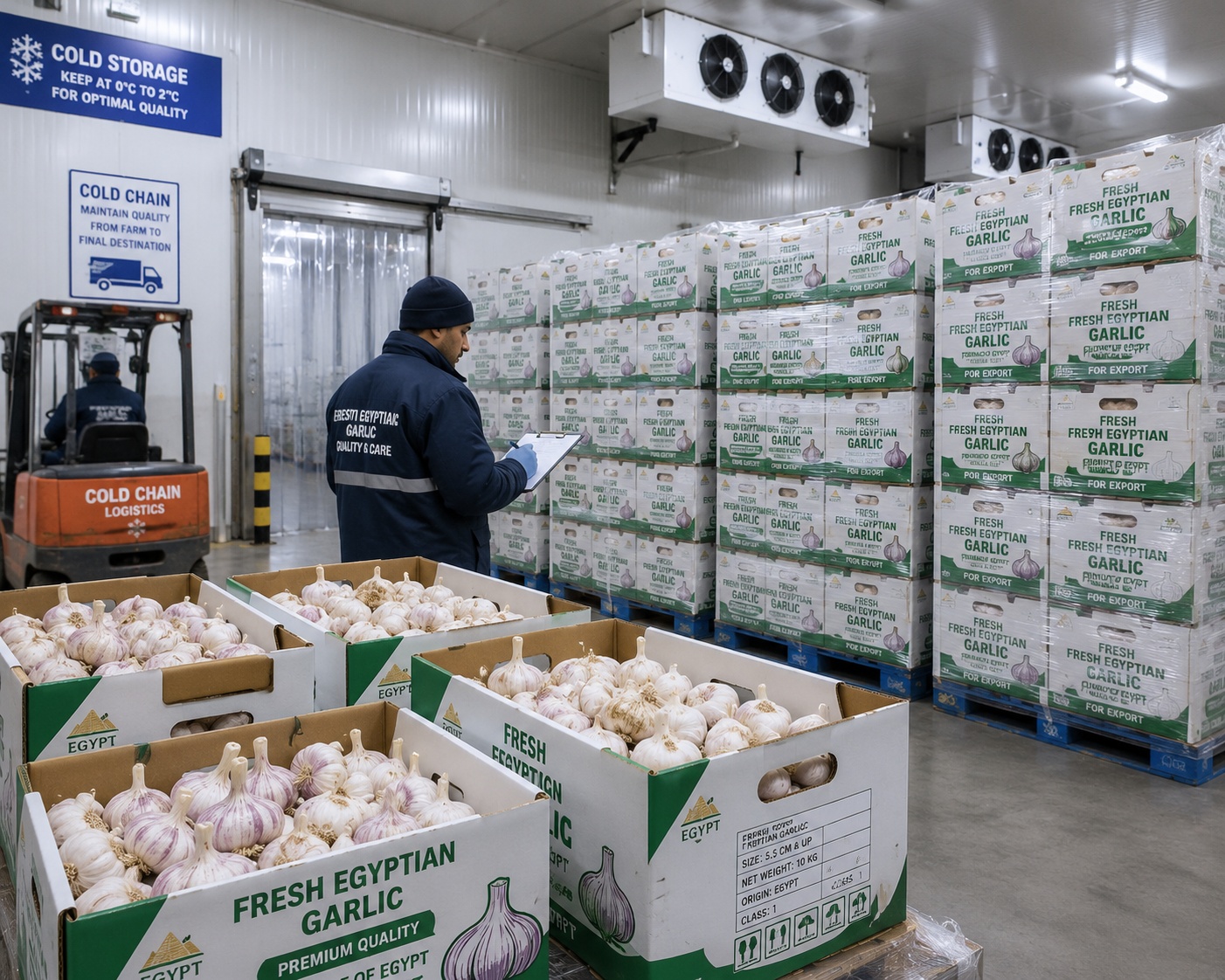
Garlic has a storage quirk worth knowing: it sprouts fastest at in-between temperatures, so it keeps best either properly cold or warm and dry — never lukewarm. Get curing and temperature right and Egyptian garlic ships for months without sprouting or softening. This guide covers the garlic cold chain from harvest to reefer, plus packing formats.
Quick answer: Egyptian garlic is cured until the skins are papery and the necks tight, then stored cold and dry — around 0°C (down to about −1°C) at 60–70% RH for long-term export — or kept warm and dry for shorter holds. Sprouting is worst at intermediate temperatures (~5–18°C), so those are avoided. Pack in mesh / net bags (5–20 kg), cartons, braids or pre-packed nets, and ship in ventilated or reefer containers.
After lifting, garlic is cured — dried in the field or with forced air for roughly two to four weeks until the outer skins are papery and the necks are tight and sealed. Proper curing is the single biggest factor in storage life: it locks out rot and moisture loss and sets the clean white appearance buyers want.
Garlic’s sprouting is fastest at intermediate temperatures (around 5–18°C), so it is stored away from that range. For long-term export storage, the target is cold and dry — about 0°C (down to roughly −1°C) at a low 60–70% RH with airflow. (For shorter periods, warm, dry, well-ventilated storage also keeps garlic dormant.) Low humidity is key in both cases to prevent rooting and rot.
| Parameter | Target | Why |
|---|---|---|
| Temperature (long-term) | ~0°C (to −1°C) | Suppresses sprouting & rooting |
| Humidity | 60–70% RH | Low RH prevents rooting & rot |
| Avoid | ~5–18°C | The fastest sprouting range |
| Airflow | Steady ventilation | Removes moisture & heat |
Bulbs are graded by diameter, well-cured with dry intact skins, and palletised for ventilated, stable loading.
Garlic ships in reefer (or well-ventilated) containers, kept cold/cool and dry with fresh-air exchange to vent moisture and prevent condensation — the main enemy in transit. Keep the chain unbroken and avoid wetting, which triggers rooting and rot. Peeled garlic ships chilled; dehydrated garlic ships dry at ambient, protected from moisture.
For long-term export, around 0 degrees C (down to about minus 1 degrees C) at a low 60-70% humidity; warm, dry storage works for shorter holds. Intermediate temperatures (~5-18 degrees C) cause the fastest sprouting and are avoided.
Curing dries the skins and seals the necks, dramatically reducing rot and moisture loss and giving the clean white appearance buyers want.
Mainly by storage temperature – keeping garlic either properly cold or warm and dry, away from the intermediate sprouting range.
Usually in net/mesh bags (5-20 kg), cartons, pre-packed nets or braids; peeled in vacuum packs; dehydrated in bags/cartons.
In reefer or well-ventilated containers, kept cool and dry with fresh-air exchange; dehydrated garlic ships dry at ambient.
How to cite this page
PEI Trade. “Egyptian Garlic Packaging & Cold Chain.” peitrade.com, 2026. https://peitrade.com/egyptian-garlic-packaging-cold-chain/
This page is part of our Egyptian Garlic Export Guide hub.
Ship Egyptian garlic that arrives in spec with PEI Trade. Proper curing, cold-dry storage, sprout control and ventilated reefer discipline — in mesh bags, cartons, nets or braids, plus peeled and dehydrated. Contact: [email protected] · WhatsApp +20 109 911 1918 · www.peitrade.com