Address
Work Hours
Monday to Friday: 7AM - 7PM
Weekend: 10AM - 5PM
Address
Work Hours
Monday to Friday: 7AM - 7PM
Weekend: 10AM - 5PM


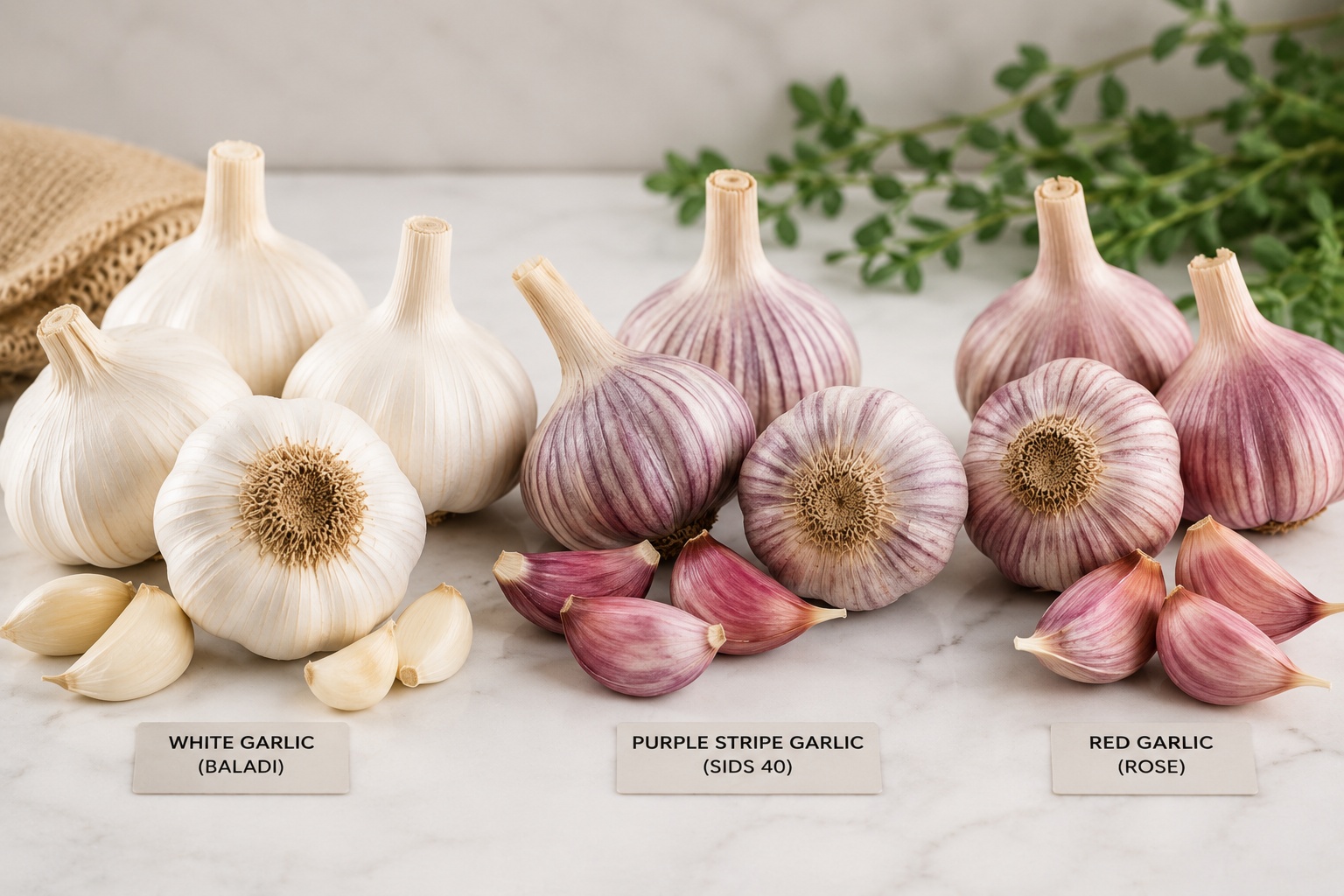
Egyptian garlic splits into two stories: the large white bulbs grown for export, and the traditional, intensely pungent Balady that defines Egyptian garlic at home. Add improved varieties such as Sids 40 and a large dehydrated segment, and you have a crop that serves everything from supermarket shelves to food factories. This guide breaks down the main Egyptian garlic types and how to match them to your buyers.
Quick answer: The Egyptian export mainstay is large white garlic — firm, well-storing, good caliber. The traditional Balady is purple-tinged, smaller-cloved and very pungent. Improved varieties such as Sids 40 raise yield and bulb size, and a significant dehydrated segment supplies flakes, granules and powder. Egyptian garlic is prized for its high pungency and solids. Garlic trades under HS code 0703.20.
| Type | Character | Best for |
|---|---|---|
| White garlic | Large, white, firm bulbs; good shelf life | Main fresh export (EU, Gulf, Brazil, Asia) |
| Balady (local) | Purple-tinged, small cloves, very pungent | Traditional, regional & pungency-led markets |
| Sids 40 & improved | Higher-yielding, larger, uniform bulbs | Fresh export with good caliber |
| Dehydrated (segment) | Flakes / granules / minced / powder | Food processing — global |
Large white garlic is the backbone of Egyptian exports. Its firm, well-sized bulbs, clean white skin and good storage make it the default specification for the EU, the Gulf, Brazil and Asia, graded by caliber and packed in mesh bags or cartons. For most importers, white garlic is the starting point.
Balady — the local Egyptian garlic — is purple-tinged with smaller cloves and a powerful, hot flavour. It carries strong regional and culinary significance and suits buyers who want maximum pungency, though white garlic dominates the modern export trade on size and appearance.
Improved varieties such as Sids 40 lift yield and bulb size while keeping good quality, strengthening fresh-export programs. Separately, Egypt’s dehydrated garlic segment — flakes, granules, minced and powder — supplies food manufacturers worldwide, complementing the dehydrated-onion trade.
Start from use and market: large white garlic for mainstream fresh retail and foodservice; Balady where intense pungency is wanted; dehydrated for processing. Then agree caliber, peeled vs whole, and packing. A good supplier will match type, size and pungency to your destination.
Large white garlic – firm, well-sized and good-storing – is the export mainstay.
The traditional local Egyptian garlic – purple-tinged, small-cloved and very pungent – with strong regional and culinary significance.
Yes – Egyptian garlic is valued for high pungency and solids; Balady is especially hot.
Yes – Egypt is a notable exporter of dehydrated garlic (flakes, granules, minced, powder) for food processing.
Garlic falls under HS code 0703.20.
How to cite this page
PEI Trade. “Egyptian Garlic Varieties: Balady, White & More.” peitrade.com, 2026. https://peitrade.com/egyptian-garlic-varieties/
This page is part of our Egyptian Garlic Export Guide hub.
Source the right Egyptian garlic with PEI Trade. Large white garlic, traditional Balady and dehydrated garlic, matched to your caliber, pungency and packing needs, with GLOBALG.A.P. handling and full documentation. Contact: [email protected] · WhatsApp +20 109 911 1918 · www.peitrade.com