Address
Work Hours
Monday to Friday: 7AM - 7PM
Weekend: 10AM - 5PM

Address
Work Hours
Monday to Friday: 7AM - 7PM
Weekend: 10AM - 5PM


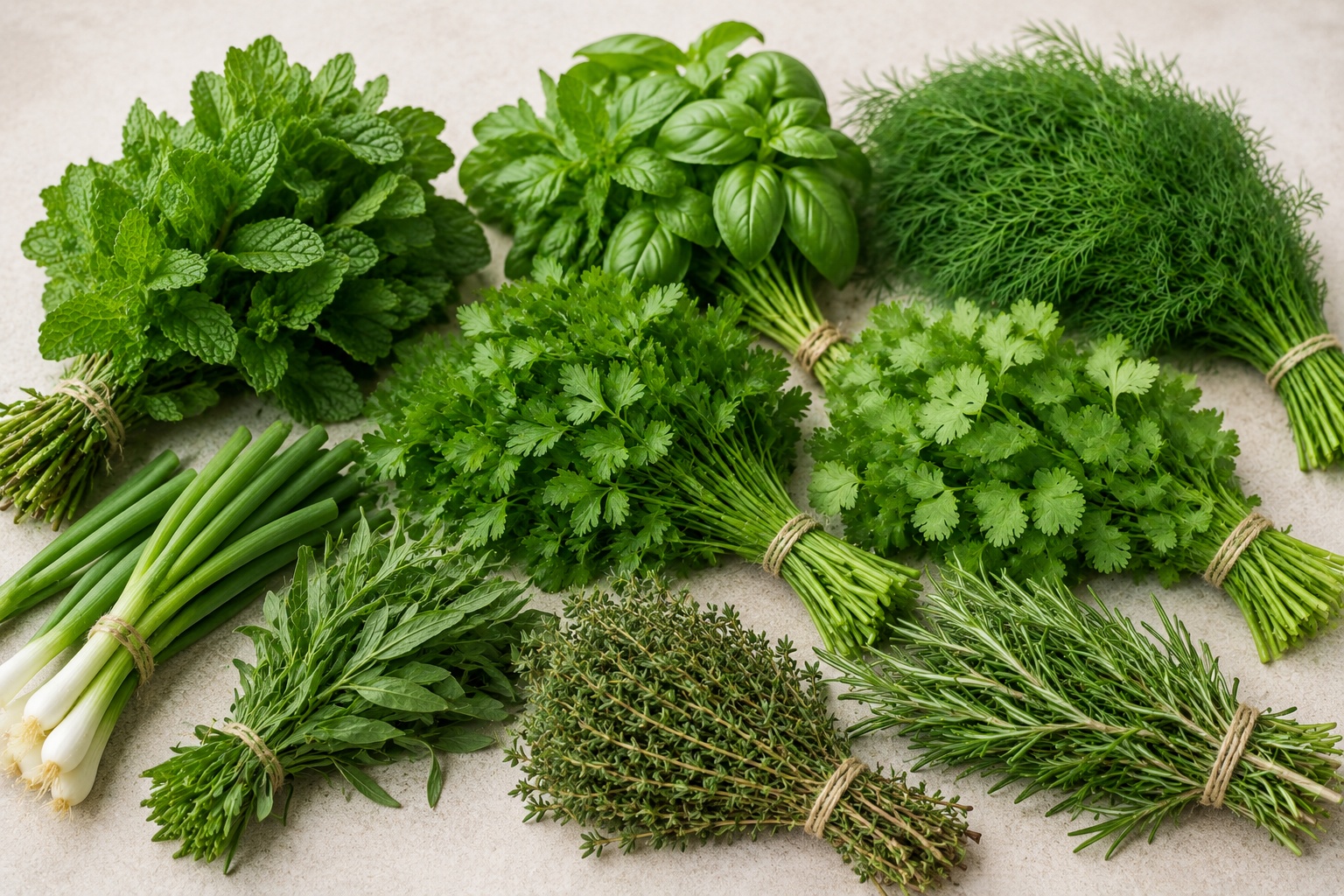
Herbs are bought by line and form: fresh leafy herbs like mint, parsley, dill and coriander; the chilling-sensitive specialty that is fresh basil; and a wide range of dried herbs — basil, marjoram, mint and more — for the food industry. Egypt grows and processes them all. This guide breaks down the main Egyptian herb lines and how to match them to your buyers.
Quick answer: Egypt’s main fresh herbs are mint, parsley, dill, coriander, chives and rocket (kept cold) and basil (chilling-sensitive, kept warmer). Aromatic herbs — marjoram, thyme, sage, rosemary, oregano — are grown fresh and, importantly, as major dried lines. Quality is judged on colour, aroma and cleanliness. HS codes vary by herb (fresh culinary commonly 0709.99; aromatic mint/basil 1211.90; dried 1211.90 / 0712).
| Herb | Fresh handling | Also dried? |
|---|---|---|
| Mint | Cold (~0–2°C) | Yes — major |
| Basil | Warm (~10–12°C) — chilling-sensitive | Yes — major |
| Parsley (flat & curled) | Cold (~0–2°C) | Yes |
| Dill | Cold (~0–2°C) | Yes |
| Coriander | Cold (~0–2°C) | Yes (& seed) |
| Rocket & chives | Cold (~0–2°C) | Mostly fresh |
| Marjoram, thyme, sage, rosemary, oregano | Cold fresh | Yes — major dried lines |
Mint, parsley, dill, coriander, chives and rocket are the core fresh leafy herbs, prized for bright colour and strong aroma. They are highly perishable, kept cold (~0–2°C) and high-humidity, and airfreighted. Parsley comes in flat-leaf and curled forms.
Basil is the key exception: unlike other fresh herbs, it is chilling-sensitive and blackens if stored cold, so it is held warmer (about 10–12°C). This single difference makes basil the trickiest fresh herb to handle — and a clear test of a supplier’s expertise.
Aromatic herbs — marjoram, thyme, sage, rosemary, oregano — and the leafy herbs above are also produced as dried lines, where Egypt is a global leader. Dried herbs are graded by colour, aroma, leaf/stem ratio and cut size, and held to strict microbiological standards for the food industry.
For fresh retail and foodservice, specify the leafy herb and bunch/pack — remembering basil needs warm handling. For manufacturing, choose dried herbs by cut size and micro spec. A good supplier handles each line correctly and certifies to your standard.
Mint, parsley, dill, coriander, chives, rocket and basil.
Basil is chilling-sensitive and blackens if stored cold, so it is kept warmer (~10-12 degrees C) than other herbs.
Yes – it is a global leader in dried basil, marjoram, mint and other dried herbs.
By colour, aroma, leaf/stem ratio, cut/sieve size and microbiological cleanliness.
They vary: fresh culinary herbs commonly 0709.99; aromatic mint/basil 1211.90; dried 1211.90 / 0712.
How to cite this page
PEI Trade. “Egyptian Herb Types: Mint, Basil, Parsley & More.” peitrade.com, 2026. https://peitrade.com/egyptian-herbs-varieties/
This page is part of our Egyptian Herbs Export Guide hub.
Source the right Egyptian herbs with PEI Trade. Fresh mint, parsley, dill, coriander, basil and aromatic herbs, plus a full dried-herb range, handled correctly line by line. Contact: [email protected] · WhatsApp +20 109 911 1918 · www.peitrade.com